
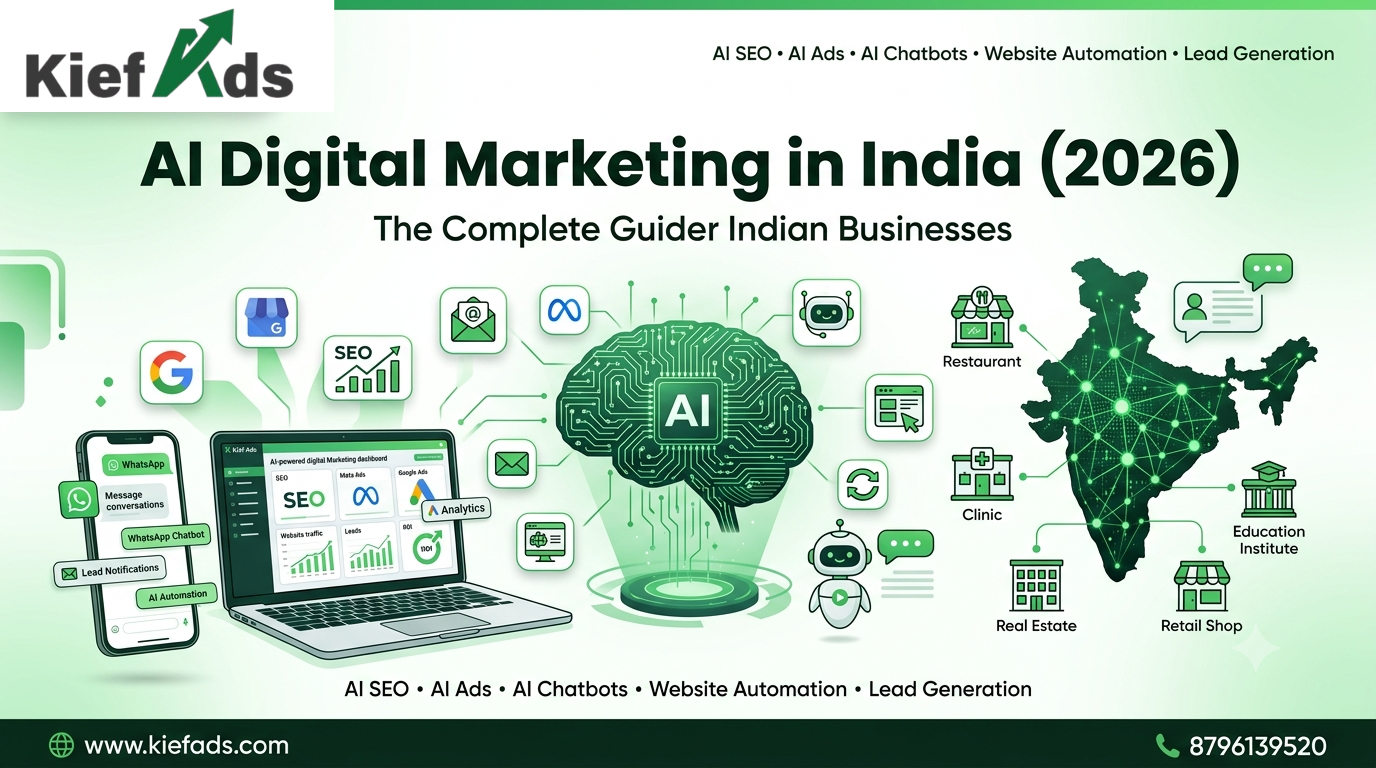
Three years ago, “using AI in marketing” meant trying out a chatbot or asking a tool to draft a caption. In 2026, it means something far bigger. AI digital marketing in India now shapes how businesses find customers, answer enquiries at midnight, personalize their websites, set ad bids and predict which leads are actually ready to buy.
For startups, small and medium businesses (SMBs) and large enterprises alike, this has stopped being a nice-to-have. Ad costs keep climbing, customers expect replies within minutes, and competitors that automate can do more with smaller teams. At Kiefads, we help businesses bring together AI automation, digital marketing and conversion-focused website design, and the direction is clear: businesses that build AI into their marketing early tend to bring down their customer acquisition cost (CAC), while those that wait keep paying more for the same leads.
This guide explains what AI digital marketing actually is, why 2026 is the tipping point, five ways AI is transforming marketing for Indian businesses, a practical four-phase roadmap to get started, and the mistakes to avoid. You’ll also find answers to the questions we hear most often.
Key takeaways
- AI digital marketing uses machine learning, automation and generative AI to plan, run and optimize campaigns with far less manual effort.
- In India’s mobile-first, WhatsApp-driven and multilingual market, speed and personalization decide who wins the lead.
- The biggest gains come from five areas: AI chatbots, CRM automation, AI-driven website design, predictive SEO and smart advertising.
- Fix your foundation first, automate follow-ups next, and scale ad spend last.
- AI handles the repetitive work; people still own strategy, creativity and relationships.
In this guide: What Is AI Digital Marketing? · Why 2026 Is the Tipping Point · 5 Ways AI Is Transforming Marketing · Implementation Roadmap · Metrics to Track · Mistakes to Avoid · Industries · FAQs
[Image alt text: AI digital marketing dashboard tracking leads, CAC and campaign performance for an Indian business]
What Is AI Digital Marketing?
AI digital marketing is the use of artificial intelligence, machine learning and automation to analyze customer data, predict behavior and run marketing activities, such as ads, emails, WhatsApp messages, SEO and website personalization, with minimal manual effort.
In practice, that means software that can:
- Segment audiences by behavior, location and intent instead of broad demographics
- Reply to enquiries instantly through chatbots, on your website and on WhatsApp, 24/7
- Score leads so your sales team calls the most promising ones first
- Personalize website content, emails and offers for each visitor
- Adjust ad bids and budgets in real time toward the audiences that convert
- Forecast demand and campaign performance before you commit the budget
Traditional digital marketing depends on people doing each of these steps by hand, often after the moment has passed. AI shrinks that cycle from days to seconds.
Why 2026 Is the Tipping Point for AI Digital Marketing in India
A huge market that is too competitive to run manually
India has well over 800 million internet users, most of them online through smartphones. That reach is a gift, but it also means every category, from real estate and education to direct-to-consumer (D2C) fashion and healthcare, is crowded, and attention is expensive. AI lets you tailor messages by city, language and buying stage at a scale no human team can match.
Three forces have converged
- AI tools became affordable. No-code chatbots, built-in CRM automation and generative tools now fit SMB budgets, not just enterprise ones.
- Platforms went AI-first. Google, Meta and most modern CRMs now run on machine learning by default, from smart bidding to predictive lead scoring.
- Customer expectations reset. People used to instant, personalized service from big apps expect the same from every business they contact.
What this means for CAC
Businesses that use AI for website design, lead follow-up and ad optimization can often lower CAC, because fewer leads slip through the cracks and less budget goes to audiences that never convert. Those still relying on manual bidding, spreadsheet-based lead sorting and slow follow-up are increasingly outbid and outpaced.
Search is changing, too
Search is no longer just ten blue links. Google’s AI-generated summaries and tools such as ChatGPT and Perplexity now answer questions directly, so your content has to be clear, well structured and genuinely useful to get cited, not just keyword-optimized.
Manual vs. AI-powered marketing at a glance
| Area | Manual approach | AI-powered approach |
|---|---|---|
| Lead response | Hours, or the next business day | Instant, 24/7 |
| Lead qualification | Sales team calls everyone | Chatbot and lead scoring pre-qualify |
| Ad bidding | Manual bid changes | Smart bidding toward a target CPA or ROAS |
| Website | One static page for all visitors | Dynamic content by location, device and behavior |
| SEO | Keyword lists and guesswork | Intent analysis and content-gap mapping at scale |
| Reporting | Monthly spreadsheets | Real-time dashboards and forecasts |
5 Ways AI Is Transforming Digital Marketing for Indian Businesses
1. AI Chatbots and Conversational Lead Qualification
The old “leave your details and we’ll get back to you” form loses leads at the exact moment their interest peaks. AI chatbots now greet visitors, answer product questions, ask about budget and timeline, and book appointments on your website, on WhatsApp (via the WhatsApp Business API) and in social DMs, at any hour.
Why this matters especially in India:
- WhatsApp is where conversations happen. Hundreds of millions of Indians use it, and many would rather message a business than fill in a form.
- Language is a growth lever. Bots that handle Hindi, Hinglish, Tamil, Telugu, Marathi or Bengali reach customers that English-only funnels miss.
- Leads don’t keep office hours. Ads run at night and on weekends. A bot can respond when your team can’t.
Example scenario: Consider a home-interiors company in Pune whose Instagram and Meta ads bring in plenty of enquiries, but many come from people who are only browsing or whose budgets are far below the company’s minimum. A chatbot can ask about property type (1BHK, 2BHK or 3BHK), city, budget range and timeline up front, then pass only serious prospects to a design consultant, along with the full conversation. Consultants spend their time on better leads, ad spend stops leaking to the wrong audiences, and the same team can handle more projects.
[Image alt text: AI chatbot qualifying leads on WhatsApp for an Indian business]
2. AI-Powered CRM and Marketing Automation
A customer relationship management (CRM) system is only as useful as the speed and intelligence around it. When Meta Ads, Google Ads, organic search and website forms all feed one AI-enabled CRM, every lead is captured, tagged, scored and followed up automatically.
What that looks like day to day:
- An instant WhatsApp message and email when someone enquires, even late at night or on a Sunday
- Nurture sequences that change based on what the lead clicks or asks
- Lead scoring that puts high-intent prospects at the top of your sales team’s list
- Automated re-engagement of leads that have gone cold
- Alerts when a prospect returns to your pricing page
A simple 5-day follow-up sequence:
- Minute 0: Acknowledge the enquiry on WhatsApp and email, and offer a clear next step.
- Day 1: Share a useful resource that answers the most common question.
- Day 2: Send social proof, such as a testimonial or case study from a similar customer.
- Day 3: Address objections around price, timelines or alternatives.
- Day 5: Make a clear call to action: book a call, demo or site visit.
Speed is the real advantage here. A prospect who clicks your ad late at night and gets a helpful reply within seconds stays warm until your team is back online.
3. AI-Driven Website Design and Conversion Rate Optimization (CRO)
Your website is no longer a digital brochure; it’s your hardest-working salesperson. AI website design uses live visitor data to test and improve pages continuously.
- Dynamic personalization: A visitor from Chandigarh browsing in December can see heavy winterwear, while someone from Chennai sees breathable cottons. Location, device, traffic source and past behavior all shape the page.
- Automated A/B testing: AI tests headlines, images, layouts and buttons together and shifts traffic toward the winners.
- Friction detection: Heatmaps and session analysis show where visitors hesitate or drop off, so you fix real problems instead of guessing.
- Speed on any network: Automated image compression, lazy loading and code optimization help pages load quickly on 4G connections in tier-2 and tier-3 cities.
This level of personalization was once the preserve of e-commerce giants. Today it is within reach of SMBs, too.
[Image alt text: AI website design personalizing homepage content for different Indian visitors]
4. Predictive SEO and AI-Ready Content
AI has moved SEO from reactive to predictive. Instead of waiting to see what ranks, teams can now:
- Decode search intent: Work out what kind of page (guide, comparison or landing page) deserves to rank for terms like “AI digital marketing India.”
- Map content gaps: Compare your site against your top competitors to find missing topics, questions and formats.
- Scale local pages: Build city- or service-specific pages with schema markup for stronger local visibility.
- Plan around demand: Forecast seasonal spikes, from Diwali and wedding season to monsoon sales and exam results, so content is live before interest peaks.
- Reach vernacular and voice searchers: More Indians now search by speaking, in Hindi and regional languages.
A word on AI-written content: Google has said it rewards helpful, original content however it is produced. Use AI to research, outline and scale, then have human experts add real experience, local nuance and fact-checking. That mix supports E-E-A-T (Experience, Expertise, Authoritativeness, Trustworthiness) and improves your odds of being cited in AI-generated search answers.
5. AI-Optimized Advertising
Once lead capture and follow-up are automated, AI advertising becomes far more effective, because ad platforms learn from better data.
- Smart bidding: Give the algorithm a target cost per acquisition (CPA), say ₹600 per lead, and let it find the users most likely to convert at that price.
- Creative testing at scale: Generate and test dozens of headlines, images and video variations, then scale the winners.
- Audience discovery: Machine learning surfaces high-intent and lookalike segments that manual targeting would miss.
- Cross-channel budgeting: Automated campaign types such as Google’s Performance Max and Meta’s Advantage+ shift spend toward what’s working.
- Revenue-based optimization: When your CRM tells the platform which leads became paying customers, the algorithm optimizes for sales, not just clicks.
One caution: smart bidding is only as good as your tracking. Make sure conversions are recorded accurately (GA4, Meta Pixel with Conversions API, and Google Ads conversion tracking) before you hand the wheel to the algorithm.
How to Implement AI Digital Marketing: A 4-Phase Roadmap for Indian Businesses
You don’t need to overhaul everything at once. A phased approach keeps risk low and results visible. Timelines below are typical and will vary with business size and starting point.
Phase 1: Audit and fix your foundation (weeks 1–2)
- Make sure your website is mobile-first, fast and easy to use.
- Verify conversion tracking across GA4, Meta and Google Ads, plus call and WhatsApp clicks.
- Clean your data: define lead stages, remove duplicates and merge sources.
- Record baseline numbers for CAC, cost per lead, lead-to-sale rate and response time.
If your site takes five seconds to load on a 4G connection in a tier-2 city, no amount of AI will rescue your bounce rate. Fix the basics first.
Phase 2: Automate lead capture and follow-up (weeks 2–4)
- Launch an AI chatbot on your website and WhatsApp.
- Connect every lead source to an AI-enabled CRM.
- Set up the 5-day nurture sequence and lead scoring.
- Define exactly when the bot hands over to a human.
Phase 3: Personalize and optimize (weeks 4–8)
- Start A/B tests and dynamic content on your highest-traffic pages.
- Build a predictive SEO plan: content-gap analysis, city and service pages, and FAQ content.
- Add Hindi or regional-language versions of key pages and chatbot flows.
Phase 4: Scale with AI advertising (week 8 onward)
- Feed CRM conversion data back into your ad platforms.
- Move to smart bidding with a target CPA or target ROAS (return on ad spend) once you have enough conversion data.
- Test creative variations, scale winners gradually and review results weekly.
Key Metrics to Track
| Metric | What it tells you | How AI helps |
|---|---|---|
| Customer acquisition cost (CAC) | What it costs to win one customer | Better targeting and faster follow-up reduce waste |
| Cost per lead (CPL) | How efficiently ads generate enquiries | Smart bidding and creative testing |
| Lead-to-customer rate | Lead quality and sales effectiveness | Chatbot qualification and lead scoring |
| Response time | How quickly leads hear back | Instant automated replies |
| Website conversion rate | How well traffic turns into enquiries | CRO testing and personalization |
| Average order value and lifetime value | Revenue quality per customer | Recommendations, remarketing and retention flows |
Common Mistakes to Avoid When Adopting AI Marketing
- Automating a broken process. AI amplifies whatever you feed it. Fix your offer, pricing and sales flow first.
- Removing humans entirely. Set clear handoff rules so complex or high-value conversations reach a person quickly.
- Ignoring consent and privacy. Use opt-in messaging, honor opt-outs, and align your data practices with India’s Digital Personal Data Protection (DPDP) Act.
- Communicating only in English. In a multilingual market, vernacular support can be the difference between good conversion and great.
- Publishing unedited AI content. Review every piece for accuracy, originality and brand voice.
- Chasing tools instead of outcomes. Start with a business goal, such as lower CAC, faster response or more bookings, then choose the tools.
Which Indian Industries Benefit Most from AI Marketing?
- Real estate: Lead qualification, site-visit booking and long nurture cycles
- E-commerce and D2C: Personalization, abandoned-cart recovery and repeat-purchase flows
- Healthcare and clinics: Appointment booking, reminders and patient follow-ups
- Education and coaching: Enquiry handling, counselling bookings and admissions funnels
- SaaS and IT services: Lead scoring, demo scheduling and targeted outreach
How Kiefads Helps Businesses Put AI Marketing to Work
At Kiefads, we help Indian businesses turn AI from a buzzword into a working growth system. We bring together:
- AI automation: Chatbots, CRM integrations and follow-up workflows that respond to every lead instantly
- Digital marketing: SEO, paid media and content strategies guided by data, not guesswork
- Website design: Fast, mobile-first sites built to turn visitors into enquiries
Every engagement starts with your funnel: where leads come from, where they drop off, and where automation will make the biggest difference.
Frequently Asked Questions About AI Digital Marketing in India
What is AI digital marketing?
AI digital marketing uses artificial intelligence, machine learning and automation to collect data, predict customer behavior and run campaigns (emails, ads, chatbots, SEO and website personalization) with far less manual work than traditional methods.
Is AI digital marketing suitable for small businesses in India?
Yes, and small businesses often gain the most. AI works like a round-the-clock team member, so a three-person business in Ahmedabad can respond, follow up and advertise with the consistency of a much larger team, while keeping overhead under control.
How much does AI marketing automation cost in India?
Costs depend on scope. A simple chatbot or WhatsApp automation is a relatively modest setup, while an end-to-end system with CRM integration, lead scoring, dynamic website design and AI advertising is a bigger investment, usually with ongoing tool and management fees. The smartest way to budget is to start with one high-impact use case, such as lead follow-up, and expand as results come in. Kiefads can provide a tailored estimate after reviewing your funnel.
Will AI replace human digital marketers?
No. AI takes over repetitive work such as data entry, manual bidding and first-line replies, freeing marketers to focus on strategy, creative ideas, brand building and customer relationships, where human judgment matters most.
How long does it take to see results from AI marketing?
Some benefits, like faster response times, fewer missed leads and hours of saved effort, can appear within the first few weeks. Larger gains such as lower CAC, stronger ad efficiency and organic growth usually build over two to six months as your systems gather data. Timelines vary by industry, budget and starting point.
What is the difference between marketing automation and AI marketing?
Marketing automation runs on fixed rules (“if a lead does X, send Y”). AI marketing learns from data, predicts outcomes and adapts on its own. Most modern setups combine both.
Can AI chatbots talk to customers in Hindi and regional languages?
Yes. Today’s conversational AI can handle Hindi, Hinglish and many regional languages. Quality varies by language and setup, so test with real customer questions and keep a human fallback.
Is AI marketing compliant with Indian data protection rules?
Compliance depends on how you collect, store and use data, not just on the tool. Get clear consent, explain how you use personal data, honor opt-outs and align your practices with the DPDP Act. For specifics, check with a legal professional.
Final Thoughts: Start Building Your AI Marketing Engine
The gap between businesses that use AI and those that don’t widens every quarter. AI digital marketing in India isn’t about chasing a trend; it’s about building a marketing engine that responds faster, spends smarter and keeps learning. Whether you run a SaaS startup in Bengaluru, a clinic in Indore, a D2C brand in Ahmedabad or a real estate business in Hyderabad, connecting your website, lead follow-up and advertising with AI is one of the highest-leverage moves you can make this year.
Ready to start? Book an AI marketing audit with Kiefads and get a clear, prioritized roadmap for your business.