
When someone searches for a service near them — a dentist, a restaurant, a coaching centre — they almost never scroll past the first few results. If your business isn’t there, a competitor who ranks higher is the one who gets the call, the booking, or the walk-in. Local SEO is the discipline that decides which businesses show up in those moments, and getting it right is often the difference between a phone that rings and one that doesn’t.
What Is Local SEO?
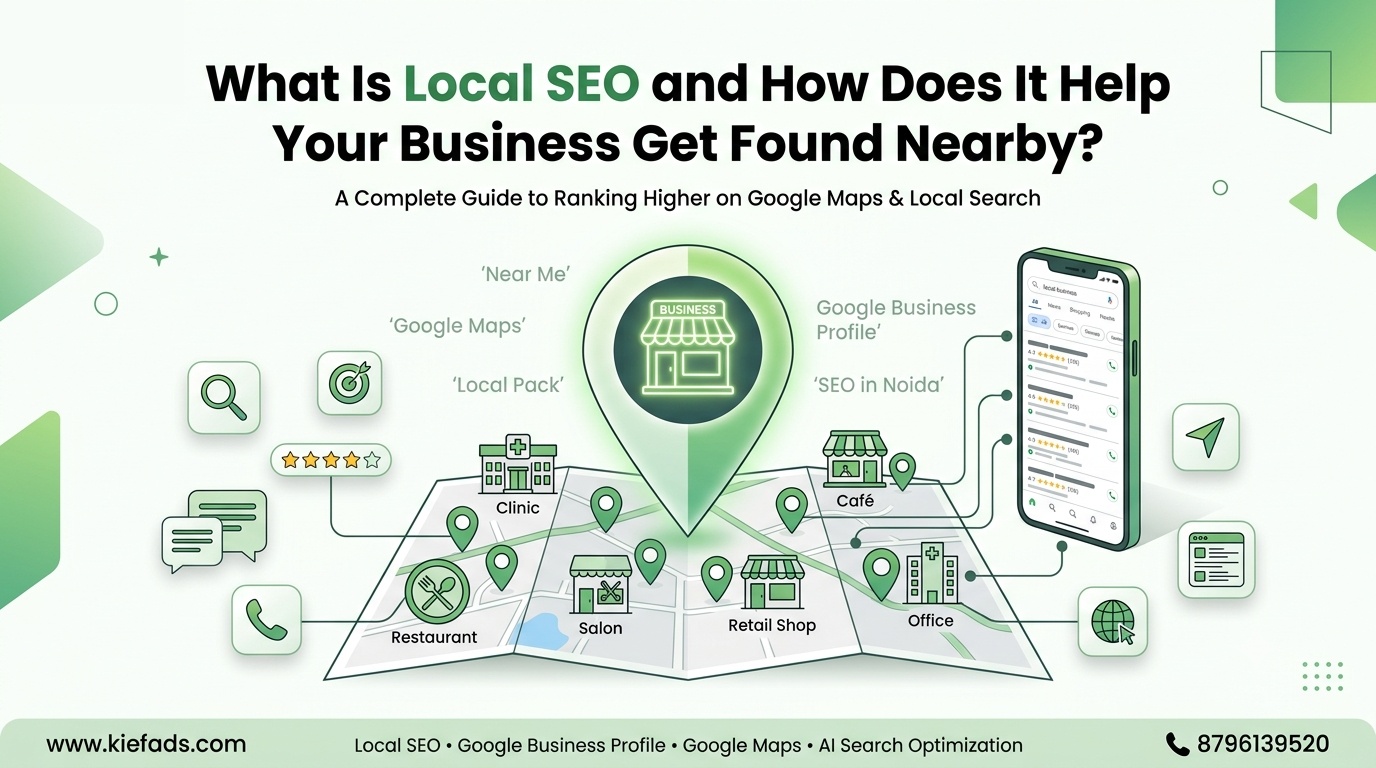
Local SEO is the process of optimizing your online presence so your business shows up for searches tied to a specific location — a city, a neighborhood, or simply “near me.” It plays out across Google Search, Google Maps, Apple Maps, Bing Places, and other local discovery surfaces, not just a standard organic results page.
Where traditional SEO competes for visibility across an entire country or the whole web, local SEO narrows the competition to whoever else is nearby. Search “best dental clinic near me” or “top-rated Italian restaurant downtown,” and Google responds with the Local Pack — the map and three business listings sitting above the standard organic results. Ranking there is the primary goal of local SEO.
Local SEO vs. Traditional SEO
- Traditional SEO competes for keyword rankings regardless of the searcher’s location.
- Local SEO competes for visibility among businesses physically close to the searcher, weighted heavily by proximity.
A national e-commerce brand mostly needs traditional SEO. A dental clinic, restaurant, or law firm with a physical address or service area needs local SEO first — national rankings won’t put them in front of the people who can actually walk through the door.
How Google Ranks Local Results
Google has been fairly open about the three factors that decide who appears in the Local Pack:
- Relevance — how well your Google Business Profile and website match what the searcher is looking for.
- Distance — how close your business or service area is to the searcher.
- Prominence — how well-known and well-reviewed your business is, based on review volume, ratings, citations, and general web presence.
Nearly every local SEO tactic exists to move the needle on one of these three factors.
Why Local SEO Matters for Your Business
Local searches carry unusually high intent. Someone searching “plumber near me” is typically ready to call or book within a day or two, not just browsing.
The Local Pack captures most of the attention. Businesses in the map pack get the bulk of clicks and calls on mobile, where most local searches happen.
Mobile searchers need instant answers. Someone searching on the go wants your phone number, hours, and directions immediately — local SEO keeps that information front and center.
It’s a sustainable, lower-cost acquisition channel. Strong organic local visibility reduces how much you need to spend on paid ads to stay in front of nearby customers.
Reviews and reputation compound over time. Every review and mention adds to the prominence signal Google uses to rank you, building an advantage competitors can’t simply buy their way past.
Step-by-Step Local SEO Strategy
1. Claim and fully optimize your Google Business Profile. Keep NAP (Name, Address, Phone) consistent everywhere, pick the most precise category available, write a clear description, and upload fresh photos regularly. Use the Q&A and Posts features to keep the profile active.
2. Research local keywords. Explicit keywords name a place directly (“SEO agency in [city]”); implicit keywords rely on Google inferring location (“near me,” “nearby”).
3. Build real location pages, not a list. Multi-location businesses need a dedicated page per branch — unique content, local contact details, embedded map, local reviews — rather than one thin generic page.
4. Build and audit local citations. Submit NAP details to relevant directories and check regularly for discrepancies in spelling, formatting, or outdated numbers.
5. Actively manage reviews. Encourage honest reviews soon after service, respond to every review professionally, and reference specific services naturally where it fits.
6. Publish location-focused content. Blog posts, FAQs, and guides addressing local needs or community topics build authority with users and search engines alike.
7. Earn local links and mentions. Sponsorships, local press, and partnerships with nearby businesses feed directly into the prominence factor.
8. Add LocalBusiness schema markup. Structured data lets search engines parse your address, hours, and service area with certainty instead of guessing.
Local SEO Across Key Industries
| Industry | Primary Focus | Key Deliverables |
|---|---|---|
| Healthcare & Clinics | Patient trust, bookings | Optimized doctor profiles, treatment pages, schema markup, reviews |
| Hospitality & Restaurants | Footfall, ratings | Menu integration, geotagged photos, review management, booking links |
| Education Institutes | Admissions, parent inquiries | Location-based course pages, virtual tours, testimonials, FAQs |
| E-commerce & D2C | Regional awareness, delivery | City-specific landing pages, hyperlocal delivery info, local keywords |
| Retail & Local Services | Calls, visits, quotes | Maps optimization, call CTAs, service-area pages |
Common Local SEO Mistakes to Avoid
- Inconsistent NAP across the website, GBP, and directories
- Generic GBP categories instead of precise ones
- Inconsistent or absent review responses
- Thin, near-duplicate location pages for multi-branch businesses
- Treating local SEO as a one-time setup rather than ongoing maintenance
- Neglecting mobile speed and usability, where most local searches happen
How to Measure Local SEO Success
- Google Business Profile Insights — calls, direction requests, and website clicks from your profile
- Local Pack rank tracking — position for priority local keywords over time
- Call and form tracking — attributing actual leads back to local search
- Maps and local organic traffic — segmented in your analytics platform
FAQs
How long does local SEO take to show results? Most businesses see measurable movement within 3–6 months, though competitive categories and multi-location businesses can take longer.
Does local SEO work without a physical storefront? Yes — service-area businesses can rank locally using a defined service area on their Google Business Profile, even without a public address.
How important are reviews compared to other ranking factors? Very. Review quantity, recency, and rating feed directly into the prominence factor, and reviews heavily influence whether a searcher clicks and converts at all.
Can one Google Business Profile cover multiple locations? No — each physical location generally needs its own profile tied to its own address and phone number.
Local SEO Is How Nearby Customers Actually Find You
Ranking nationally doesn’t help a clinic, restaurant, or local service business nearly as much as showing up the moment someone nearby searches for exactly what they offer. Getting there takes profile management, citation cleanup, review strategy, and content running in parallel, not as one-off tasks.
Kiefads builds and manages local SEO programs around exactly that — starting with a full local visibility audit covering Google Business Profile accuracy, citation consistency, review gaps, and on-site local signals, then building the keyword and content strategy to close them. For multi-location businesses, we manage campaigns branch by branch, and we factor in AEO and GEO so your business surfaces in AI-powered and voice search too, not just the map pack.
Talk to the Kiefads team to request a local SEO audit and see where you’re losing visibility to nearby competitors.