
Quick answer
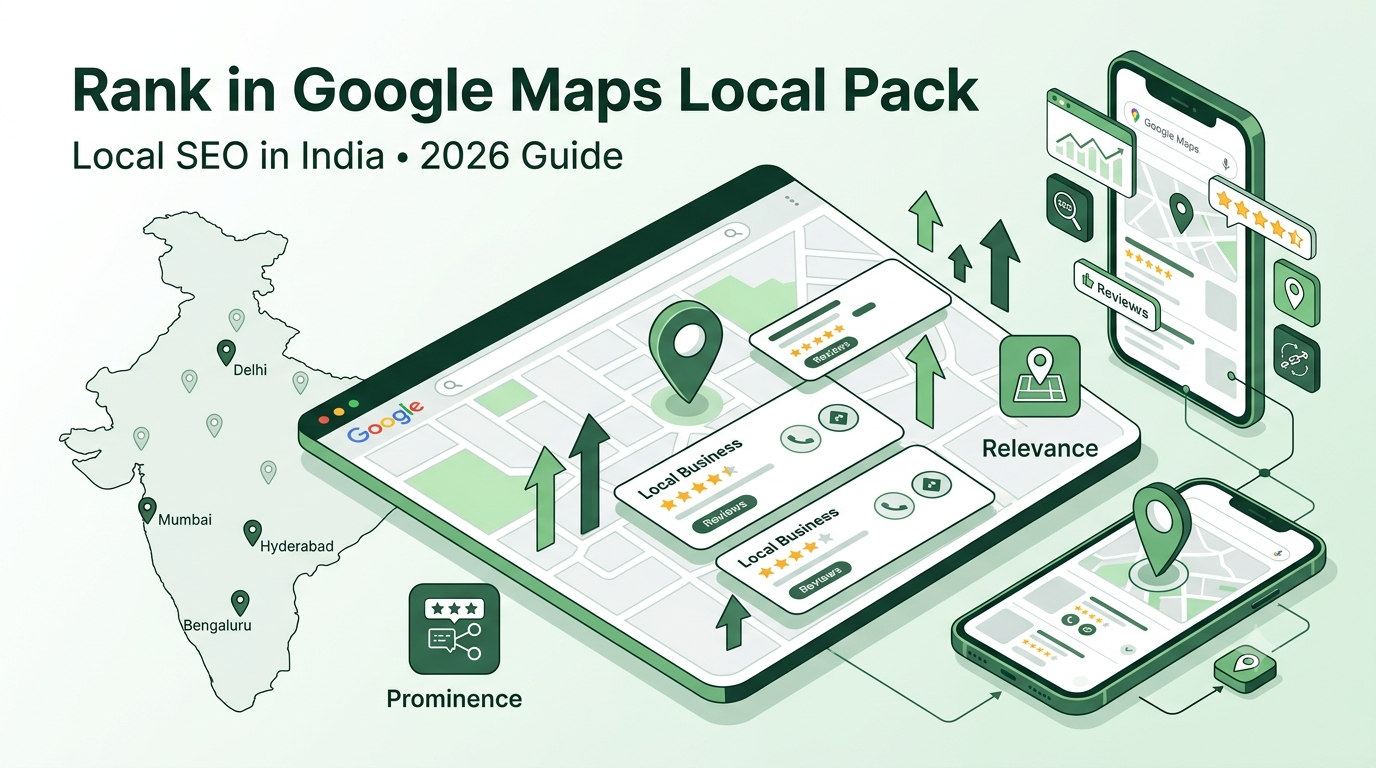
To rank in the Google Maps local pack in India, you need to strengthen the three signals Google uses to order local results: relevance, distance and prominence. Distance is fixed by your location. Relevance is improved with an accurate, well-categorised Google Business Profile (GBP) and matching website content. Prominence is built through genuine reviews, consistent local citations, quality backlinks and overall reputation.
For most Indian businesses, the local pack (the three listings shown with a map) drives more calls, WhatsApp chats, direction requests and store visits than any other search feature. Most local searches in India happen on mobile, and most users never scroll past those three results.
When someone in Delhi searches “dentist near me” or a traveller in Jaipur searches “cafe nearby,” Google shows a map and three business listings before any website links. On a phone screen, those three listings are often the entire decision. If you are not one of them, you effectively do not exist for that search.
Getting listed on Google is only the starting line. This guide covers the next step: ranking in the top three map results in the Indian market. If you have not yet claimed and completed your profile, start with our guide to Google Business Profile optimisation in India, then come back here to compete for the ranking itself.
Why the local pack matters for Indian businesses
India is one of the world’s largest mobile-first markets. Customers search on their phones while commuting, shopping or travelling, and they want an answer immediately. Local pack results appear at the top of the page and show the essentials: name, rating, distance, opening hours, a call button and directions.
- Trust is visible at a glance. Star ratings and review counts influence the choice before a customer opens a website.
- Intent is high. Someone searching “AC repair near me” or “best pediatrician in Indiranagar” usually wants to act today.
- Competition is intense. Thousands of businesses in every city compete for three slots, so a structured strategy beats guesswork.
The three signals that decide local pack rankings
| Signal | What it means | Can you influence it? |
|---|---|---|
| Relevance | How well your business matches what the searcher is looking for. | Strongly, through categories, services and content. |
| Distance | How close you are to the searcher or the area they searched. | No, but relevance and prominence can offset it. |
| Prominence | How well-known and trusted your business is overall. | Strongly, through reviews, citations, links and reputation. |
You cannot move your building, so you win the local pack by dominating relevance and prominence. Here is how each works in practice.
Winning on relevance
1. Choose the right primary and secondary categories
Your primary category is one of the strongest relevance signals you control. Pick the most specific category that describes your core business, not a vague general one, then add accurate secondary categories for your other services.
Example: A clinic that selects “Dental clinic” as its primary category will outrank one that chose the generic “Doctor” for dental searches. Likewise, a “Wedding photographer” listing beats a generic “Photographer” listing for wedding-related queries.
2. Match your website to your profile
Google cross-checks your Business Profile against your website. If your profile says you are an SEO company in Mumbai, your website should clearly say the same, with:
- a dedicated service page for that city,
- a consistent business name, address and phone number (NAP),
- a Google Map embed and clear contact details,
- LocalBusiness schema markup.
Local landing pages, such as a dedicated “SEO company in Delhi” page, do real work here by reinforcing the relevance of your listing.
3. Use every field: services, products, attributes and description
Every completed field gives Google more to match against. List services with clear names, add products with prices where relevant, and write a business description in natural language that reflects how customers actually search. Add attributes such as “Wheelchair accessible,” “Online appointments” or “Women-led” where they apply.
In India, completing your content in both English and Hindi (or the regional language of your city, such as Marathi, Tamil, Telugu, Kannada or Bengali) widens the range of searches you can appear for. Many users search in Hinglish or in their local language, so use those terms naturally in your reviews responses, posts and service descriptions.
Winning on prominence
1. Build a steady flow of genuine reviews
Reviews are the biggest prominence lever for most local businesses. What matters is quantity, quality, recency and the words customers use. A profile earning a few honest reviews every week outperforms one that collected twenty two years ago and none since.
How to get more reviews the right way:
- Ask every satisfied customer, in person, by SMS or on WhatsApp.
- Share a direct review link or QR code at your counter, on invoices and in follow-up messages.
- Reply to every review, in English, Hindi or the reviewer’s language.
- Respond calmly and professionally to negative reviews, and offer to resolve the issue.
Never buy fake reviews. It violates Google’s guidelines and risks having your profile suspended.
2. Keep your citations consistent
A citation is any mention of your business name, address and phone number across the web. In India, that includes directories and platforms such as Justdial, Sulekha, IndiaMART, TradeIndia, Yellow Pages India, industry-specific portals and social profiles.
Google reads consistency as a trust signal, so your NAP must match exactly everywhere it appears. Watch for:
- old or discontinued phone numbers,
- different spellings of the locality or landmark,
- missing or inconsistent PIN codes,
- variations like “Pvt. Ltd.” versus “Private Limited.”
Audit your citations at least once a year.
3. Earn local links and mentions
Links and brand mentions from Indian and regional websites, local news portals, industry directories, chambers of commerce, colleges and partner businesses build the broader reputation Google reads as prominence. They do not need to come from large publications. Relevant, genuine local mentions are exactly what an established business accumulates naturally.
4. Post regularly and add fresh photos
Regular Google posts (offers, updates, events), new photos and short videos show that your business is active. Businesses with real photos of their premises, team, products and work receive more direction requests and calls.
Proximity tip: Because distance is measured from the searcher, your rankings change as customers move around the city. Track your local pack position from several points across your service area (for example, different sectors of Gurugram or different localities of Pune), not just from your own office. Otherwise you will overestimate how visible you really are.
Special cases for Indian businesses
Service-area businesses without a storefront
Plumbers, electricians, home tutors, packers and movers, cloud kitchens and other home-service providers can rank without showing a public address. Set up a service-area profile that lists the cities or localities you serve, hide the pin, and define your coverage area. The same relevance and prominence rules apply.
Multi-location and multi-city businesses
A business operating in several Indian cities needs a separate, fully completed profile for each location, each paired with its own local landing page. This is how a brand competes in the local pack in Delhi NCR, Mumbai, Bengaluru and Hyderabad at once, rather than diluting a single profile across the country. City-by-city service pages follow exactly this model.
Seasonal, festive and tourism businesses
For businesses in destinations like Goa, Jaipur, Udaipur, Rishikesh or Manali, the local pack matters most when visitors are on the ground searching for somewhere nearby. Retailers, sweet shops and event businesses also see demand spikes around Diwali, Eid, Durga Puja, Holi and wedding season. Keep these in mind:
- update photos to match the season,
- keep opening hours current, including holiday hours,
- run offer posts before peak periods,
- ask for reviews during busy weeks, when experiences are fresh.
Local pack ranking checklist
- Claim and verify your Google Business Profile
- Select the most specific primary category
- Add accurate secondary categories, services and attributes
- Use a consistent NAP across the website and all citations
- Create a dedicated local landing page for every location
- Add LocalBusiness schema and an embedded map
- Collect genuine reviews every week and reply to all of them
- Upload fresh photos and post updates regularly
- Build local citations and relevant local backlinks
- Track rankings from multiple points in your service area
How Kiefads can help
At Kiefads, we help Indian businesses of every size, from single-shop startups to multi-city brands, earn visibility in the Google Maps local pack. Our local SEO process covers profile optimisation, citation clean-up, review strategy, local landing pages and location-based rank tracking, so your business shows up when nearby customers are ready to buy. Get in touch with Kiefads for a free local SEO audit.
Frequently asked questions
What is the Google Maps local pack?
The local pack is the group of three business listings that Google shows with a map for searches with local intent, such as “salon near me” or “best restaurants in Chennai.” Each listing shows the business name, rating, address, hours and quick actions like call and directions.
What are the three signals Google uses to rank the local pack?
Google uses relevance (how well your business matches the search), distance (how far you are from the searcher or the searched area) and prominence (how well-known and trusted your business is, based on reviews, citations, links and reputation).
How do reviews affect Google Maps ranking in India?
Reviews influence prominence and also affect how many people click. The number of reviews, average rating, how recent they are and the keywords customers mention all play a part. Consistent, genuine reviews with owner replies help most. Fake or incentivised reviews can lead to suspension.
Can a business rank on Google Maps without a physical storefront?
Yes. Service-area businesses can hide their address and list the cities or localities they serve. They follow the same relevance and prominence rules and must still meet Google’s eligibility guidelines.
How long does it take to rank in the local pack?
It depends on competition, your category and your starting point. Many businesses see improvement within a few weeks of fixing their profile and citations, while competitive categories in large cities such as Delhi or Mumbai may take a few months of steady review and content work.
Do I need a website to appear on Google Maps?
No, but a website helps. A well-optimised site with local content, consistent NAP details and schema markup reinforces relevance and improves your chances of outranking competitors who rely on their profile alone.
Is Google Business Profile free in India?
Yes. Creating and managing a Google Business Profile is free. Paid help is only needed if you hire an agency such as Kiefads to optimise and manage it for you.