
1. Why Finding the Right Keywords Matters More Than Ever
Keywords are the bridge between what your customers are actually typing into a search bar and what your website offers. Get that bridge wrong, and even a beautifully designed, technically flawless site sits invisible to the people who need it most. With the overwhelming majority of searchers never scrolling past page one, the wrong keyword choice doesn’t just mean slower growth — it often means zero visibility for the exact terms that would have brought real business through the door.
In 2026, this problem has only gotten sharper. Search results pages are more crowded, AI-generated overviews are absorbing clicks that used to go to websites, and competition for “obvious” keywords has never been higher. Businesses that still treat keyword research as a five-minute task before writing begins are the ones losing ground fastest.
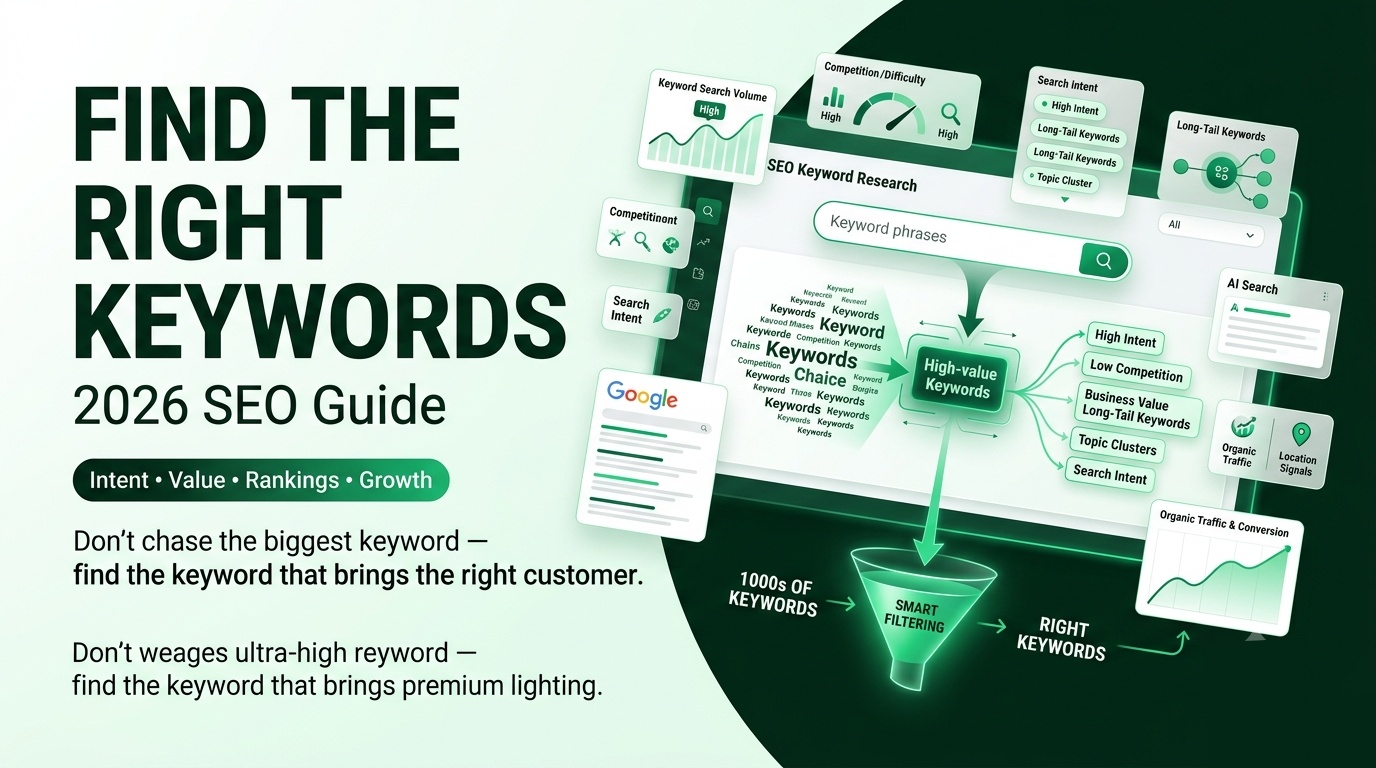
2. How to Find the Right Keywords for Your Business, Step by Step
| Step | What to Do |
|---|---|
| 1. Start with seed topics, not search tools | List what your business actually offers, using the words your customers use — not internal jargon |
| 2. Mine real customer language | Check your own site navigation, support tickets, sales calls, and competitor menus for phrasing you’re missing |
| 3. Expand with a research tool | Feed your seed list into Google Keyword Planner or a similar tool to surface related terms and search volume |
| 4. Filter by search intent | Separate informational, commercial, and transactional queries — each needs a different type of page |
| 5. Weigh business value over volume | A smaller, ready-to-buy audience almost always outperforms a bigger, just-browsing one |
| 6. Group into topic clusters | Organize related keywords under one strong page or a linked cluster, rather than one thin page per term |
This isn’t a one-off checklist — it’s a cycle. Search behavior shifts, competitors publish new content, and your own business evolves. Revisiting these six steps every quarter keeps your keyword strategy from going stale.
3. Search Intent: The Filter Most Businesses Skip
Not every keyword deserves the same kind of page. Someone searching “SEO” is likely just researching the concept; someone searching “SEO agency for e-commerce website” is much closer to making a buying decision. Understanding which of the four core intents — informational, navigational, commercial, and transactional — a keyword falls under determines whether it should become a blog post, a comparison page, or a dedicated service page.
Skipping this step is the single most common reason otherwise well-optimized pages fail to convert traffic into leads. You can rank on page one and still generate almost no business if the page you built doesn’t match what the searcher actually wanted to do next.
4. Volume vs Business Value: Why Bigger Isn’t Always Better
A keyword with a huge search volume is not automatically the best keyword for your business. A lower-volume, highly specific term can generate far better results if it attracts people who are genuinely ready to act. Chasing volume alone is how businesses end up with impressive traffic charts and disappointing sales numbers — the two aren’t automatically connected.
Think of it this way: 10,000 monthly searches for a broad, generic term might send you a thousand visitors who bounce in seconds. A hundred monthly searches for a specific, high-intent phrase might send you ten visitors — and three of them convert. Business value, not vanity metrics, should decide which keyword wins.
5. Why AI Search Has Changed Which Keywords Are Worth Chasing
Purely informational keywords with simple, factual answers are becoming less valuable as traffic drivers, because AI tools now answer many of them directly without a click-through. What still reliably delivers genuine visits in 2026 are keywords tied to complex comparisons, nuanced advice, local searches, and transactional intent — queries that need more depth than a quick AI summary can provide.
It’s no longer about matching an exact phrase on a page; ranking now depends on demonstrating genuine expertise and topical relevance across a subject. This is a meaningful shift from the keyword-stuffing playbook of a decade ago, and businesses that haven’t adjusted their strategy are increasingly losing traffic to AI-generated answer boxes.
6. Free vs Paid Keyword Research Tools
| Tool Type | Examples | Best For |
|---|---|---|
| Free | Google Keyword Planner, Google Search Console | Getting started, checking what you already rank for |
| Paid, all-in-one | Semrush, Ahrefs | Competitor analysis, difficulty scoring, tracking across platforms |
| Content-focused | Yoast SEO and similar on-page plugins | Tightening individual pages around a chosen keyword |
None of these tools do the strategic thinking for you — they surface data. The judgment call on which terms are actually worth pursuing still needs a human (or an experienced agency) reading the numbers against real business goals.
7. A Common Situation: Chasing High-Volume Keywords That Never Convert
A pattern we see often: a business targets the biggest, most obvious keyword in its industry, ranks reasonably well after months of work, and still sees almost no leads — because that keyword attracts researchers, not buyers. After shifting toward more specific, intent-matched terms grouped into proper topic clusters, businesses in this position typically see lower traffic numbers but a noticeably higher share of visitors who actually convert.
(Illustrative pattern based on typical outcomes for comparable situations; actual results vary by industry and competition.)
8. Which Keyword Strategy Fits Your Business Stage?
| Your Situation | What to Prioritize |
|---|---|
| Brand new website, low domain authority | Long-tail, low-competition keywords you can realistically rank for now |
| Established site, ranking for some terms | Topic clusters expanding outward from what’s already working |
| High traffic, low conversion rate | An intent audit — you may be attracting the wrong kind of searcher |
| Local business serving a specific area | Location-combined keywords (service + city/neighbourhood) |
9. How Kiefads Approaches Keyword Research
At Kiefads, we treat keyword research as the foundation of the entire SEO strategy, not a quick brainstorm before writing begins. Every engagement starts by understanding your actual customer language and business goals — not a generic template applied to every client regardless of industry.
Because website development and SEO sit under the same in-house team at Kiefads, keyword decisions get connected directly to page structure and site architecture, rather than handed off to a developer who has no idea what the SEO strategy actually was. Backed by a 2300+-business track record across wildly different industries — manufacturing, hospitality, education, e-commerce — that experience means we’ve already seen which keyword patterns actually convert for businesses like yours, not just which ones have impressive search volume.
10. How to Get Started
- Book a free consultation and tell us about your business, customers, and current goals.
- We review your existing content and identify keyword gaps against real competitors.
- You get a clear, prioritized keyword strategy — not a spreadsheet dump.
- Content and on-page work begins, with monthly reporting on real ranking and traffic movement.
Not sure which keywords would actually grow your business?
Get a free consultation with Kiefads — we’ll show you keyword opportunities grounded in commercial reality, not vanity search volume.
[Get Free Consultation]
11. A Quick Checklist Before You Commit to a Keyword
- ✅ Does it match real customer language? Not internal jargon or industry terms only insiders use.
- ✅ Is the intent clear? Informational, commercial, or transactional — each needs a different kind of page.
- ✅ Can you actually compete for it? Check what’s already ranking, not just the search volume number.
- ✅ Does it fit into a broader topic cluster? Isolated keywords rank worse than pages backed by topical depth.
- ✅ Would ranking for it actually move your business? Traffic that never converts isn’t the win it looks like on a dashboard.
12. Common Mistakes When Choosing Keywords
Chasing the highest search-volume term available, regardless of whether it matches what your business actually sells, is the most common and costly mistake in keyword research. Treating keyword research as a one-time task rather than an ongoing process is another — the landscape shifts constantly, and yesterday’s winning strategy needs regular review. And repeating a target phrase excessively across content, hoping it helps rankings, is actively counterproductive; content density matters far less than genuine topical relevance in 2026.
Frequently Asked Questions
How do I find the right keywords for my business if I have no SEO experience?
Start by listing the words your actual customers use to describe what you offer, then feed that list into a free tool like Google Keyword Planner to see related terms and volume.
Should I always target the highest search-volume keyword?
No — a lower-volume keyword with clearer buying intent often delivers better business results than a high-volume keyword that mostly attracts researchers.
What is search intent, and why does it matter?
Search intent is what someone actually wants when they type a query — informational, commercial, or transactional. Matching your page type to that intent is essential for the content to actually rank and convert.
Are long-tail keywords still worth targeting in 2026?
Yes, often more so than before — long-tail keywords tied to specific, nuanced queries tend to survive AI-driven search better than broad, simple informational terms.
How often should I update my keyword strategy?
Keyword research should be an ongoing process, not a one-time task. Reviewing performance regularly helps you stay ahead of shifts in search behavior and competition.
Does keyword density still matter for ranking?
Somewhat — a natural density of around 1–2% is a reasonable guideline, but topical depth and genuinely helpful content matter far more than repeating a phrase.
Does Kiefads help with keyword research specifically?
Yes, it’s the foundation of every SEO engagement at Kiefads — keyword strategy is built around your actual customers and connected directly to site structure by the same in-house team.
Final Verdict
The right keyword isn’t the one with the biggest number next to it — it’s the one that matches what your customer actually wants and brings them to a page built to meet that need. Businesses that build their SEO strategy around intent, business value, and topic clusters consistently outperform those chasing raw search volume, especially as AI search continues to absorb clicks from generic informational queries.
If your current keyword strategy is generating traffic but not results, that’s usually a sign the intent-matching step got skipped — not that your content needs more volume. Kiefads builds keyword strategy the way it should be built: grounded in real customer language, tied directly to site structure, and measured by business outcomes rather than vanity metrics.