
Quick Answer
No, AI cannot fully replace SEO experts in 2026. AI tools handle repetitive SEO work well, such as keyword research, on-page checks, and reporting, and they make good teams faster. But they cannot set strategy, weigh business priorities, judge search intent, or take responsibility for results. For most Indian businesses, the best approach is AI-assisted and human-led: let AI handle the busywork while an expert makes the decisions.
Introduction
AI SEO tools arrived with big promises: faster keyword research, instant content optimization, automated reports, and shortcuts that manual work could never match. As these tools matured, many began claiming they could handle everything.
That raises a fair question for founders, marketing heads, and business owners across India: if AI can automate SEO tasks, do we still need SEO experts?
This guide answers that honestly. It covers what AI does well, where it fails, and how to combine both for growth that lasts. It matters because SEO mistakes rarely fail fast. They fail quietly, over months, while your team believes everything is on track.
Why Is AI in SEO So Widely Used Today?
With AI-powered search and generative results now part of everyday browsing, brands are adapting their visibility strategies. Generative engine optimization (GEO) is emerging as a key practice for businesses that want to appear inside AI-generated answers, not just in traditional search listings.
Three reasons explain the rapid adoption of AI SEO tools among Indian businesses.
1. Everyone Wants Faster Results
AI tools respond to one core demand: speed. They analyze rankings, keywords, competitors, and trends all at once. For startups and SMEs juggling many priorities with small teams, that speed is a real relief.
2. Automation Reduces Mental Load
No one misses manually grouping keywords or compiling weekly reports. AI handles these tasks without breaks, which is especially attractive to lean marketing teams.
3. The Cost Looks Attractive at First
A monthly tool subscription looks cheaper than hiring an in-house specialist or an SEO agency. On paper, automation seems like a smart shortcut.
But SEO rarely rewards shortcuts, and the real cost often shows up later as stalled traffic and missed revenue.
What Can AI SEO Tools Do Well?
AI performs best at data-driven execution, not strategic leadership. Here is where it genuinely helps.
Keyword Research and Content Ideas
AI tools are strong at quickly identifying:
- Keyword variations and clusters
- Search volume patterns
- Related topics users explore
- Competitive keyword gaps
They also suggest content ideas based on trending queries. For Indian businesses targeting multiple cities, languages, or product categories, this gives early planning real momentum.
On-Page SEO Automation
AI handles many on-page tasks efficiently:
- Writing meta titles and descriptions
- Improving keyword placement
- Flagging missing headers
- Suggesting internal links
These optimizations help teams scale content without missing technical basics. Alongside them, answer engine optimization (AEO) is becoming more important for helping content appear in featured snippets, voice search results, and AI-powered response platforms. This matters in India, where voice and mobile search keep growing.
Reporting and SEO Insights
AI analyzes traffic, rankings, and engagement to highlight patterns. It spots sudden drops or growth spikes faster than manual reviews, which is valuable for large e-commerce, news, and service websites.
Still, insight without interpretation rarely leads to smart decisions.
| SEO Task | Why Businesses Use AI |
|---|---|
| Keyword discovery | Faster access to search trends |
| Meta tag creation | Saves time on repetitive work |
| Content optimization | Improves structure and readability |
| Performance tracking | Continuous monitoring without manual effort |
| Technical alerts | Early detection of site issues |
Where Does AI Fall Short in SEO?
AI delivers efficiency, but SEO success depends on context, intent, and experience.
Lack of Business Context
AI does not understand your business priorities. It cannot:
- Align SEO goals with revenue targets
- Weigh brand positioning against traffic volume
- Understand internal priorities or customer expectations
- Factor in how your Indian customers actually buy, such as price sensitivity, trust signals, regional preferences, and seasonal demand around festivals
SEO experts make decisions based on conversations with your team, not just data.
Strategy and Decision-Making Gaps
AI follows historical patterns. It does not think ahead. It struggles with:
- Choosing between competing SEO opportunities
- Knowing when not to pursue a keyword
- Balancing short-term gains with long-term growth
- Adapting strategy during Google algorithm updates
This is where the difference between human and AI-led SEO becomes obvious.
Search Intent and User Experience Limitations
Search intent rarely stays static. People change how they search, what they expect, and how they consume content. In India, that includes mixing English with Hindi or regional languages (Hinglish queries), searching by voice, and browsing mostly on mobile.
AI tools measure engagement metrics, but they do not feel friction. They do not sense confusion or frustration. SEO experts read between the lines and adjust tone, layout, and flow based on real user behavior.
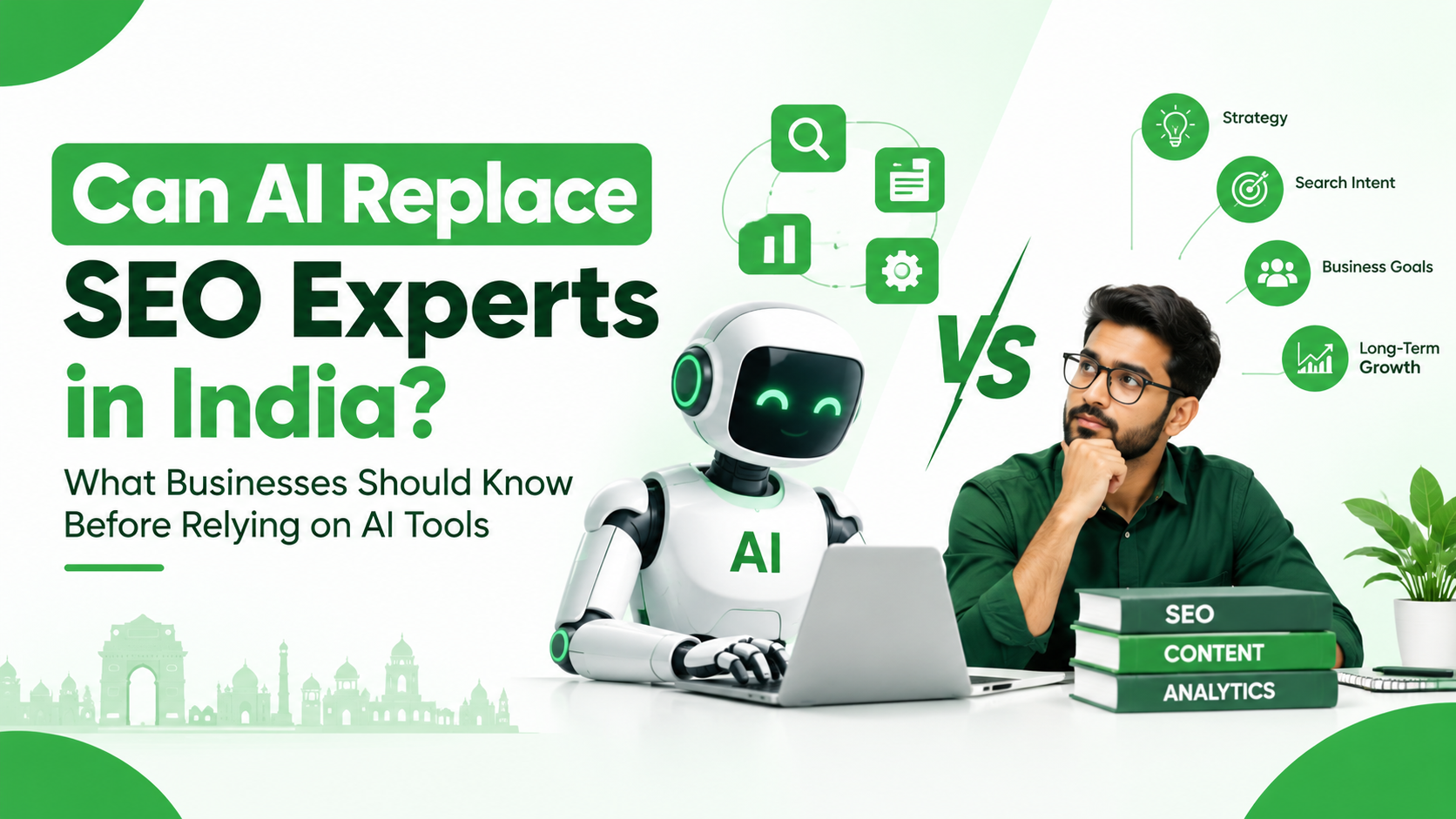
SEO Experts vs AI Tools: What Is the Real Difference?
| Aspect | SEO Experts | AI SEO Tools |
|---|---|---|
| Core role | Build strategy and make judgment calls | Automate tasks and process data |
| Decision making | Based on experience and business goals | Based on patterns and historical data |
| Search intent | Interpreted with human understanding | Inferred through metrics |
| Adaptability | Adjusts quickly during algorithm shifts | Waits for new data signals |
| Risk handling | Anticipates and manages SEO risks | Cannot assess long-term impact |
| Accountability | Owns outcomes and results | Executes without responsibility |
Businesses that rely entirely on automation often see traffic growth without meaningful conversions. Strategy bridges that gap.
Can AI Replace SEO Experts Completely?
No, and the reasons are practical, not emotional.
AI cannot replace SEO professionals because SEO is not just optimization. It is decision-making under uncertainty. AI tools work best as assistants. They speed up workflows and highlight opportunities, but they do not own outcomes.
Businesses that rely only on AI often discover this too late. Rankings fluctuate, traffic stalls, and content loses relevance. Someone still has to diagnose the problem, and that someone is human.
| Scenario | AI SEO Tools Are Enough | SEO Experts Are Needed |
|---|---|---|
| Small websites | Basic optimization tasks | Growth-focused planning |
| Early SEO efforts | Keyword discovery and audits | Full SEO strategy with AI |
| Low-competition niches | Simple ranking improvements | Conversion-focused optimization |
| Stable rankings | Monitoring and reporting | Risk management and recovery |
| Long-term growth | Limited impact | Sustainable SEO direction |
When Should Indian Businesses Combine AI With SEO Experts?
The smartest companies do not treat AI tools versus human experts as an either-or choice. They ask how both can work together.
Scaling Content Without Losing Quality
AI helps generate ideas quickly. SEO experts make sure those ideas match brand voice, search intent, and quality standards. This balance prevents thin content and ranking penalties, a risk that grows as more Indian brands publish AI-generated pages at scale.
Competing in Saturated Markets
India’s digital market is crowded in sectors like e-commerce, education, real estate, finance, healthcare, and travel. In competitive industries, automation alone does not win. Professional SEO consulting brings differentiation, competitor insights, and creative positioning that AI cannot replicate.
Winning Local and Regional Search
Local SEO matters for businesses serving specific cities and regions, from Delhi NCR and Mumbai to fast-growing tier-2 and tier-3 markets. Optimizing a Google Business Profile, building local citations, and creating location-relevant, multilingual content takes market knowledge that generic AI tools lack.
Planning for Sustainable Growth
Long-term SEO success requires foresight. Experts build strategies that account for market changes, product evolution, and algorithm updates.
The Future of SEO in India: AI-Assisted, Human-Led
The future of SEO will not exclude AI. It will depend on it. AI will shape:
- AI-powered SEO workflows
- Generative engine optimization (GEO)
- Answer engine optimization (AEO)
- Advanced automation tools
At the same time, human leadership will matter more. As automation increases, so does the risk of sameness, with every brand publishing similar AI-written content. SEO experts ensure originality, relevance, and trust. The future belongs to teams that guide technology rather than surrender to it. That also means understanding how GEO, AEO, and traditional SEO each fit into a broader growth strategy.
Final Verdict
AI improves efficiency. No argument there. But SEO experts drive outcomes.
The businesses that succeed will not ask whether AI is enough for SEO. They will ask how to combine tools, experience, and judgment intelligently. The future of SEO with AI still needs humans at the wheel.
If you want growth that lasts, use AI thoughtfully and pair automation with professional guidance. Kiefads combines AI-powered tools with expert-led SEO strategy to help Indian businesses grow their visibility, traffic, and revenue. When strategy meets intelligent execution, results follow.
Ready to grow with a smarter SEO strategy?
Talk to the SEO experts at Kiefads and get a growth plan tailored to your business.
Frequently Asked Questions (FAQs)
Can AI replace SEO professionals?
No, and not because AI lacks power. It lacks context. AI can spot patterns, but it does not understand why a business should ignore certain traffic or protect specific pages. When priorities clash or results stall, professionals step in.
Should businesses rely on AI SEO tools?
Use them, yes. Rely on them, no. AI SEO tools are helpful for research and monitoring, but they do not tell you what matters most. Many teams learn this after months of activity with little impact.
What is the difference between AI SEO tools and human SEO experts?
AI moves fast, while humans think ahead. Tools process information, and experts decide what to do next and what to avoid. One handles tasks, the other manages risk. The difference shows up when competition increases or algorithms shift.
What are the limitations of AI in SEO?
Judgment, timing, and intent. AI reacts to what has already happened. It does not sense when user expectations change or when content feels off, which is why AI-driven SEO often plateaus.
Is AI enough for SEO success?
No. AI helps, but it does not lead. SEO success depends on choices made over time, not just outputs. Without human oversight, AI produces activity, not direction.
Is hiring an SEO agency in India worth it if I already use AI tools?
For most growing businesses, yes. Tools give you data and speed, while an agency gives you strategy, accountability, and local market understanding. Combining both usually delivers better returns than either one alone.
What is the difference between SEO, GEO, and AEO?
SEO improves your visibility in traditional search results. AEO helps your content appear in featured snippets, voice answers, and AI response platforms. GEO focuses on getting your brand cited inside AI-generated search experiences. A strong strategy uses all three.