
Introduction
India has one of the fastest-growing internet populations in the world. Millions of people now search on Google every day for products, services, local shops and quick answers, often on their phones. For businesses, from Delhi NCR startups to established brands in Mumbai, Bengaluru and Chennai, this is a big opportunity: be visible at the exact moment a customer is searching.
That is what Search Engine Marketing (SEM) does. Paid ads place your business at the top of search results within hours of launching a campaign. But SEM is not a magic switch. Poor keyword choices, weak landing pages or a lack of monitoring can drain your budget quickly.
In this guide, Kiefads explains the advantages and disadvantages of search engine marketing, how SEM compares with SEO, and how Indian businesses can build campaigns that deliver real returns.
Key Takeaways
- SEM delivers fast visibility and traffic, often within hours of launch.
- It offers precise targeting by keyword, location, device, time and audience.
- Every rupee is measurable, so you can track clicks, leads, calls and sales.
- Costs can rise quickly in competitive industries such as real estate, education, finance, healthcare and e-commerce.
- SEM needs continuous monitoring and optimisation to stay profitable.
- Results stop when the budget stops, so SEM works best alongside SEO.
What Is Search Engine Marketing (SEM)?
Search Engine Marketing is the practice of promoting a website through paid advertising on search engines such as Google and Microsoft Bing. When someone searches for a keyword you are bidding on, your ad can appear above or below the organic results, marked as “Sponsored”.
Most SEM campaigns run on a pay-per-click (PPC) model: you pay only when someone clicks your ad. The most common platform in India is Google Ads, which includes:
- Search ads: text ads shown on Google search results
- Shopping ads: product listings with images and prices
- Display ads: banner ads across websites and apps
- YouTube ads: video ads shown to targeted audiences
- Local and call ads: ads that drive store visits and phone calls
A Short History of Paid Search
Paid search began in the late 1990s with paid directory listings and early pay-for-placement models. As search engines grew, they introduced auction-based systems where ad placement depends on both bid amount and ad quality. Today SEM is a core part of digital marketing, with automation, smart bidding and audience data playing a bigger role every year.
Advantages of Search Engine Marketing
1. Immediate Visibility and Fast Results
SEO can take months to show results. SEM can put your business on page one the same day your campaign is approved. This makes it ideal for:
- Launching a new product or service
- Promoting seasonal offers (Diwali, Holi, wedding season, year-end sales)
- Announcing events, admissions or limited-time discounts
- Entering a new city or market
2. Highly Targeted Audience Reach
SEM shows your ads to people who are actively searching for what you offer, which makes it a high-intent channel. You can target by:
- Keywords: such as “best CA in Faridabad” or “buy running shoes online India”
- Location: country, state, city, PIN code or radius around your store
- Language: Hindi, English and other regional languages
- Device: mobile, desktop or tablet
- Time of day and day of week
- Audience segments: in-market audiences, remarketing lists and custom segments
For local businesses such as clinics, coaching institutes, restaurants and service providers, this precision can bring customers from nearby areas.
3. Measurable and Transparent Results
Few channels give as much data as SEM. With Google Ads and Google Analytics, you can track:
- Impressions and click-through rate (CTR)
- Cost per click (CPC) and cost per acquisition (CPA)
- Conversions such as form fills, calls, purchases and WhatsApp clicks
- Return on ad spend (ROAS)
This data tells you what works, what doesn’t and where to move your budget.
4. Flexible, Scalable Budgets
You decide how much to spend, whether that is a modest daily budget or a large monthly investment. You can pause, increase or reduce spend at any time without long-term contracts. That makes SEM accessible for startups and MSMEs as well as large enterprises.
5. Cost-Effective Pay-Per-Click Model
With PPC, you pay for clicks, not just for being seen. When campaigns are structured well, with relevant keywords, strong ad copy and optimised landing pages, SEM can be a very efficient way to generate qualified leads.
6. Stronger Brand Recognition
Even when users don’t click, seeing your brand repeatedly at the top of search results builds familiarity and trust. Over time, this improves recall and can lift branded searches and direct visits.
7. Easy Testing and Optimisation
You can run A/B tests on headlines, descriptions, offers and landing pages and quickly see which version wins. This makes SEM a useful testing ground for messaging that can later be used across your website, SEO content and social media.
8. Competitive Edge
Paid search lets smaller brands appear next to, or even above, bigger competitors for chosen keywords. You can also bid on keywords where competitors are weak and capture demand they are missing.
Disadvantages of Search Engine Marketing
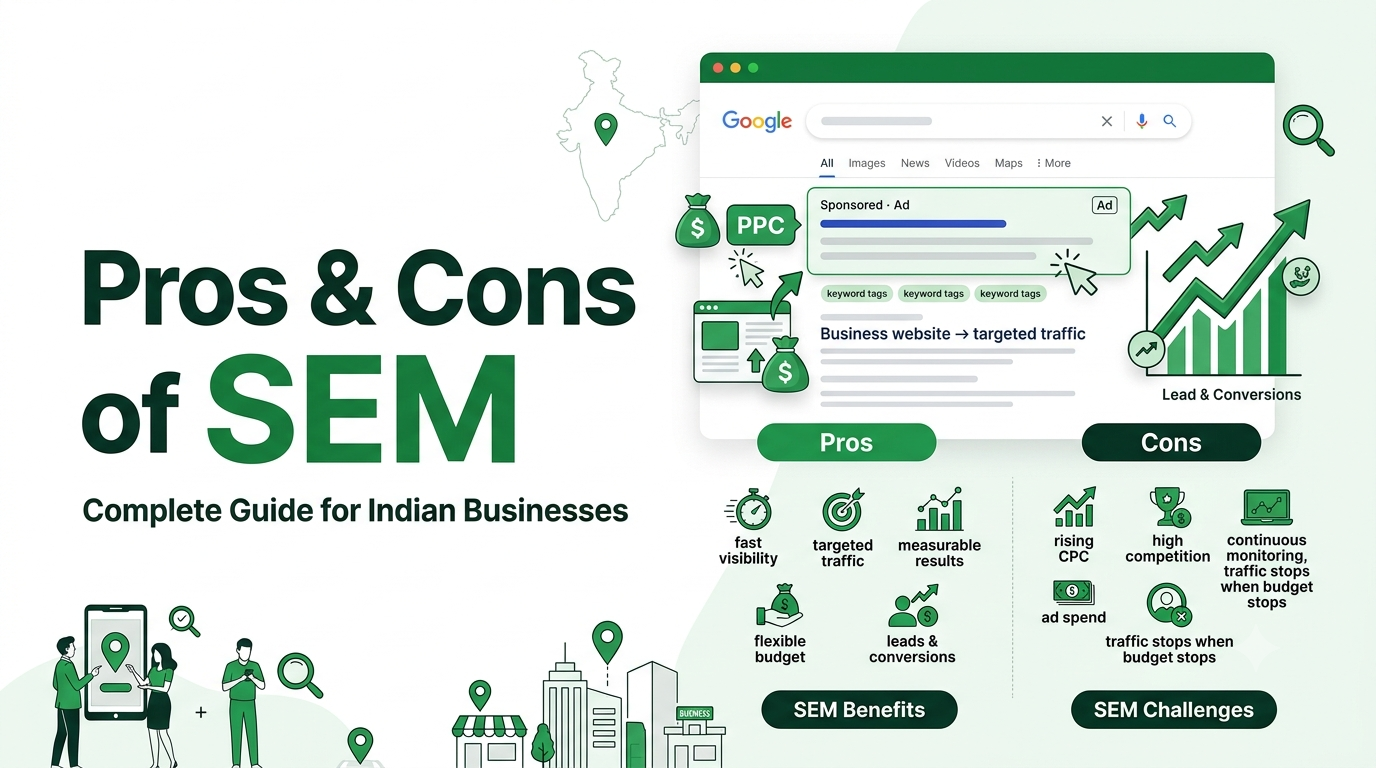
1. High Competition and Rising Costs
Popular keywords in industries like insurance, loans, real estate, education, legal services and travel can have high CPCs. When many advertisers compete for the same terms, the cost of each click goes up and small budgets get used up fast.
2. Ongoing Investment Required
SEM has no “set and forget” benefit. Once your budget runs out or you pause campaigns, your visibility and traffic stop. Unlike SEO, paid ads don’t build lasting organic rankings.
3. Needs Expertise and Constant Monitoring
Effective SEM involves keyword research, negative keywords, bid strategies, ad copy, extensions, conversion tracking and landing page optimisation. Without regular monitoring, campaigns can waste money on irrelevant searches. It is time-consuming, and many businesses benefit from a specialist team.
4. Click Fraud and Irrelevant Clicks
Not every click comes from a genuine buyer. Competitors, bots and accidental clicks can inflate costs. Google filters much of this invalid traffic, but advertisers should still use IP exclusions, negative keywords and click-quality monitoring.
5. Ad Blindness
Some users skip paid results and go straight to organic listings because they trust them more. This is why SEM works best when combined with strong organic visibility.
6. Conversion Tracking Can Be Complex
Setting up accurate conversion tracking, including calls, form submissions, WhatsApp leads and offline sales, takes technical work. Poor tracking leads to poor decisions, so it is important to get this right from day one.
7. Limited to Active Searchers
SEM captures existing demand. If people don’t yet know your product exists, they won’t be searching for it. In those cases, you may need social media, video or content marketing to create awareness first.
8. Landing Page Dependence
Even the best ad fails if the landing page is slow, confusing or not mobile-friendly. Since most Indian users browse on mobile, page speed and usability directly affect your cost and conversions.
SEM at a Glance: Pros vs Cons
| Feature | Advantage | Disadvantage |
|---|---|---|
| Pay-Per-Click Model | Pay only when someone clicks | Costs can climb without proper control |
| Keyword Targeting | Reach high-intent customers | Needs ongoing research and refinement |
| Ad Placement | Top-of-page visibility | Heavy competition for top positions |
| Campaign Control | Target by city, device, time and audience | Requires expertise and regular monitoring |
| Performance Tracking | Real-time, detailed reporting | Data can be overwhelming without analysis |
| Speed | Results within hours or days | Traffic stops when spending stops |
How SEM Impacts Small vs Large Businesses in India
| Factor | Small and Mid-Sized Businesses | Large Enterprises |
|---|---|---|
| Budget | Limited budgets can be consumed quickly | Can sustain high bids and wide coverage |
| Bidding | May be outbid on broad keywords | Can dominate competitive terms |
| Flexibility | Fewer resources for testing | Can run many campaigns at once |
| Best Approach | Focus on long-tail, local and high-intent keywords | Scale across multiple networks and audiences |
Tip for smaller advertisers: Target specific, long-tail keywords (for example, “affordable interior designer in Gurugram” instead of “interior designer”) and use location targeting. These searches usually cost less and convert better.
SEO vs SEM: Understanding the Difference
| Aspect | SEO | SEM |
|---|---|---|
| Primary Focus | Earning organic rankings | Driving paid traffic quickly |
| Cost Model | Investment in time, content and optimisation | Pay per click or impression |
| Time to Results | Medium to long term | Immediate |
| Longevity | Builds lasting authority | Stops when budget stops |
| Key Tools | Google Search Console, Analytics, keyword tools | Google Ads, Keyword Planner, Analytics |
Neither is better in every situation. They are complementary:
- Use SEM for quick visibility, product launches, promotions and testing keywords.
- Use SEO to build long-term traffic, authority and trust.
- Use SEM keyword data (which terms convert) to guide your SEO content strategy.
- Use SEO content to improve landing page quality and Quality Score.
How to Build an Effective SEM Strategy
Step 1: Set Clear Goals
Decide what success looks like: leads, calls, sales, app installs or store visits. Define target CPA or ROAS before you spend.
Step 2: Do Thorough Keyword Research
Find keywords with the right balance of search volume, intent and cost. Group them by theme and add negative keywords to block irrelevant searches.
Step 3: Write Compelling Ad Copy
Include the primary keyword, a clear benefit, a call to action and a differentiator such as free delivery, EMI options or 24/7 support. Use ad extensions like sitelinks, call buttons and location details.
Step 4: Optimise Landing Pages
Make sure pages load fast, work well on mobile, match the ad message and have a clear call to action. Consider regional language versions where relevant.
Step 5: Set Up Conversion Tracking
Track form submissions, phone calls, WhatsApp clicks and purchases through Google Ads and Google Analytics.
Step 6: Choose the Right Bid Strategy
Start with manual or maximise-clicks bidding to gather data, then move to smart bidding such as target CPA or target ROAS once you have enough conversions.
Step 7: Monitor, Test and Optimise
Review search terms, pause low performers, test new ads and adjust budgets weekly. Continuous improvement is what separates profitable campaigns from wasteful ones.
Step 8: Integrate with Other Channels
Combine SEM with SEO, social media advertising, email and remarketing for a full-funnel strategy.
How Much Does SEM Cost in India?
There is no fixed price. Your cost depends on:
- Industry and keyword competition: finance and education keywords often cost far more than local service keywords
- Location targeting: metro cities usually have higher CPCs than smaller towns
- Quality Score: better ad relevance and landing page experience can lower your cost per click
- Management fees: agencies typically charge a flat fee or a percentage of ad spend
A good rule is to start with a test budget, gather data for a few weeks, and then scale what works.
Is SEM Right for Your Business?
SEM is a strong fit if:
- You need leads or sales quickly
- Your customers actively search for your products or services online
- You can measure conversions and know your customer value
- You have a well-designed, mobile-friendly website
SEM may need to be supported by other channels if:
- Your product is brand-new and people don’t search for it yet
- Your budget is too small to compete in your keyword space
- Your website doesn’t convert visitors into enquiries
How Kiefads Can Help
At Kiefads, we help Indian businesses turn search traffic into measurable growth. Our approach to SEM focuses on:
- Strategy first: understanding your goals, audience and competitors before spending a rupee
- Smart keyword targeting: high-intent keywords, including local and regional terms
- Conversion-focused ads and landing pages: built for mobile users and Indian buying behaviour
- Transparent reporting: clear dashboards showing spend, leads and ROI
- Integrated growth: aligning SEM with SEO, social media and content marketing
Whether you are launching your first Google Ads campaign or trying to fix underperforming ones, Kiefads can help you reduce wasted spend and scale what works.
Conclusion
The advantages and disadvantages of search engine marketing show a powerful but demanding channel. SEM gives Indian businesses instant visibility, precise targeting, measurable results and flexible budgets. It also brings rising costs, tough competition, the need for constant optimisation and no lasting benefit once spending stops.
The most successful brands don’t choose between SEO and SEM. They use both: SEM for speed and testing, SEO for long-term growth, and social media to build awareness. With the right strategy, tracking and partner, SEM can become one of your most reliable growth drivers.
Ready to make your ad budget work harder? Connect with Kiefads and start building a search marketing strategy designed for the Indian market.
Frequently Asked Questions (FAQs)
1. What are the advantages and disadvantages of search engine marketing?
The main advantages are quick visibility, targeted reach, measurable results and flexible budgets. The main disadvantages are high competition, rising costs, the need for expert management and no lasting results once you stop paying.
2. How has search engine marketing evolved over time?
SEM began with paid directory listings in the late 1990s and grew into auction-based platforms like Google Ads. Today it uses automation, machine learning, smart bidding and detailed audience targeting.
3. What is the difference between SEO and SEM?
SEO earns organic rankings through content, technical optimisation and backlinks, and takes time. SEM uses paid ads to appear in search results immediately. SEO builds long-term authority, while SEM delivers fast traffic.
4. What are the benefits of targeted advertising through SEM?
Targeted advertising shows your ads to people actively searching for your offering, filtered by location, device, language and behaviour. This improves lead quality and reduces wasted spend.
5. Why is SEM considered a cost-effective advertising option?
With pay-per-click, you pay only when someone clicks your ad. You control your daily budget, can pause at any time, and can track exactly what each lead or sale costs.
6. What are some of the challenges in managing SEM campaigns?
Common challenges include high CPCs, keyword competition, click fraud, complex conversion tracking, ad fatigue and the need to constantly monitor and optimise performance.
7. How do SEO and SEM work together in a digital marketing strategy?
SEM provides quick traffic and keyword insights, while SEO builds sustainable organic visibility. Together they cover both short-term and long-term goals and increase your overall presence on search results pages.
8. What are the key steps in crafting effective SEM campaigns?
Set clear goals, research keywords, write relevant ad copy, build optimised landing pages, set up conversion tracking, choose a bidding strategy, and review performance regularly.
9. Why is continuous campaign analysis and adjustment important for SEM?
Search behaviour, competitor bids and platform algorithms change constantly. Regular analysis of CTR, CPC, conversion rate and ROAS helps you cut wasted spend and improve returns.
10. Is SEM suitable for small businesses in India?
Yes, if managed carefully. Small businesses can succeed by using local targeting, long-tail keywords, modest test budgets and strong landing pages.