
Introduction
Google is where most online journeys in India begin. Whether someone is searching for a service in Delhi, a product in Mumbai, or a college in Bengaluru, they usually start with a search. But ranking on that first page is no longer as simple as it used to be.
Google now updates its systems regularly, and AI sits at the heart of those changes. Basic SEO, such as repeating a keyword and building a few backlinks, is no longer enough. A website can follow every old rule and still lose rankings overnight.
Modern SEO is about understanding what Google actually wants to show: content that is helpful, trustworthy and relevant to what the user needs. At Kiefads, we build SEO strategies around Google’s AI updates and real search intent, so Indian brands can grow organic traffic steadily instead of chasing shortcuts.
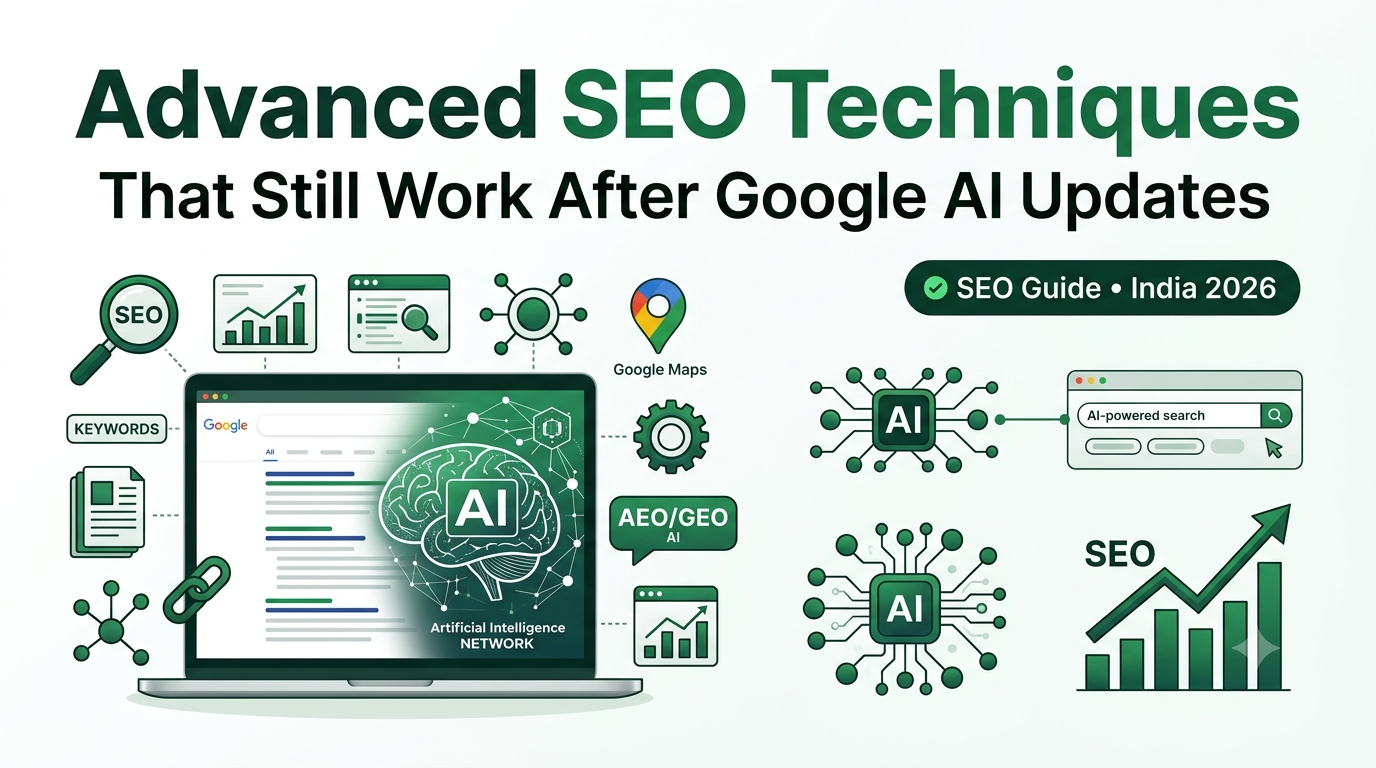
In this guide, we explain how Google’s AI updates affect search, and which advanced SEO techniques still work.
How Google’s AI Updates Have Changed Search
Have you ever seen a good website suddenly drop in rankings even though nothing seemed wrong? In most cases, an AI-driven update changed how Google evaluates content.
Earlier, Google matched the words in a search query with the words on a page. Today, its AI systems try to understand the meaning behind the query and the quality of the answer. Google now looks at:
- Helpfulness: Does the page solve the user’s problem?
- Relevance: Does the content match the search intent?
- Experience: Is the page easy to read, fast and mobile-friendly?
- Engagement signals: Do users stay, scroll and interact, or leave immediately?
- Credibility: Is the content written by someone who knows the subject?
Ranking is no longer just about getting your page listed. It is about earning your place by being the most useful result.
Technique 1: Focus on Search Intent, Not Just Keywords
Every search has a purpose behind it. Broadly, there are four types:
- Informational: “What is GST registration?”
- Navigational: “Kiefads SEO services”
- Commercial: “Best SEO company in India”
- Transactional: “Hire SEO expert for my website”
If your page does not match the intent behind the keyword, it will struggle to rank, however well optimised it looks. Before writing any page, check what is already ranking for your keyword. Are those pages guides, comparisons, service pages or product pages? Match that format, then add something more useful.
Technique 2: Build Content Around E-E-A-T
E-E-A-T stands for Experience, Expertise, Authoritativeness and Trustworthiness. It matters most in areas like health, finance, education and legal services, but it benefits every website. To strengthen it:
- Add author bios with real credentials and experience.
- Include case studies, examples and first-hand insights instead of generic advice.
- Cite reliable sources and keep information up to date.
- Show clear contact details, an About page, and privacy and policy pages.
- Collect and display genuine reviews and testimonials.
AI-generated filler content rarely shows real experience. Content backed by actual work, data and expertise stands out.
Technique 3: Optimise for Conversational and Voice Search
People no longer search like robots. Instead of typing “SEO tips”, they ask, “How can I improve my website ranking?” With the growth of smartphones, voice assistants and cheap mobile data in India, this behaviour is increasing fast. Many users also search in Hinglish or in regional languages such as Hindi, Tamil, Telugu, Bengali and Marathi.
To optimise for conversational search:
- Write in a natural, human tone.
- Use question-based headings (H2s and H3s) and answer them clearly in the first two or three lines.
- Target long-tail keywords that sound like real questions.
- Consider creating Hindi or regional-language content if your audience prefers it.
- Add an FAQ section to every important page.
This also improves your chances of appearing in featured snippets and People Also Ask boxes.
Technique 4: Use AEO and GEO Strategies
Two terms are becoming essential in the AI search era:
- AEO (Answer Engine Optimisation): Structuring your content so search engines, voice assistants and AI tools can pull direct answers from it.
- GEO (Generative Engine Optimisation): Optimising your content so it can be cited or referenced in AI-generated answers, such as Google’s AI Overviews.
To support both:
- Lead sections with a short, direct answer, then expand with detail.
- Use clear headings, bullet points, tables and step-by-step formats.
- Add schema markup (FAQ, Article, Organisation, Local Business) to help machines understand your content.
- Keep facts accurate, specific and verifiable.
- Build brand mentions across trusted websites, since AI systems learn from the wider web.
At Kiefads, AEO and GEO are part of our core SEO approach, because visibility today also means being the source AI search draws from.
Technique 5: Practise Semantic SEO and Topical Authority
Sometimes Google shows a page that never uses the exact keyword you searched. That is because Google understands meaning and context, not just words.
Semantic SEO means covering a topic completely instead of repeating one keyword. To apply it:
- Create topic clusters: one main pillar page supported by several detailed articles.
- Use related terms, synonyms and entities naturally.
- Link related pages together with descriptive internal links.
- Answer the follow-up questions a reader is likely to ask next.
For example, a page on “SEO for small businesses” should also cover local SEO, Google Business Profile, budgeting, content planning and timelines. When you cover a subject thoroughly, Google sees your site as an authority and rewards it with stronger rankings.
Technique 6: Strengthen Local SEO for Indian Markets
Many Indian searches are local, such as “SEO company near me” or “digital marketing agency in Gurugram.” To win these searches:
- Claim and fully optimise your Google Business Profile.
- Keep your name, address and phone number (NAP) consistent everywhere.
- Add location-specific pages and content for the cities you serve.
- Encourage customer reviews and reply to them.
- Add local keywords naturally, along with local schema.
Local SEO is especially powerful for service businesses, clinics, coaching institutes, restaurants and retail stores.
Technique 7: Improve Page Experience and Technical SEO
Great content will not rank if the site is slow or hard to use. Most Indian users browse on mobile, often on varying network speeds, so technical performance matters. Focus on:
- Core Web Vitals: Fast loading, stable layouts and quick interaction.
- Mobile-first design: Clean layouts, readable text and easy navigation.
- Image optimisation: Compressed images in modern formats with descriptive alt text.
- Clean site structure: Logical URLs, XML sitemaps and no broken links.
- HTTPS security and proper indexing controls.
Technique 8: Earn Quality Backlinks, Not Just More Backlinks
Backlinks still matter, but quality has replaced quantity. A few links from relevant, trusted websites are worth more than hundreds from spammy directories. Safe, lasting ways to earn them include:
- Publishing original research, data and useful tools.
- Guest posting on reputable industry sites.
- Digital PR and expert quotes in news and industry publications.
- Creating shareable resources such as checklists, templates and infographics.
Technique 9: Use AI as a Tool, Not a Replacement for Quality
AI tools can speed up research, outlines and ideas, but publishing unedited AI content in bulk is risky. Google’s systems are designed to reward original, helpful content created for people. The best approach is to combine AI efficiency with human expertise, editing and fact-checking. Add your own insights, examples and opinions so your content offers something others do not.
Technique 10: Keep Updating and Tracking Your Content
SEO is never finished. Review your top pages regularly and:
- Refresh outdated facts, statistics and examples.
- Improve pages that are close to page one.
- Merge or remove thin, low-quality pages.
- Track performance with Google Search Console and Google Analytics.
- Watch metrics such as impressions, click-through rate, engagement and conversions.
Master SEO in the Google AI Era with Kiefads
SEO today is not about shortcuts. It is about helping real users find real answers. When your content is clear, useful, trustworthy and easy to understand, it performs better, whatever the next Google update brings.
If you want to grow your visibility in India’s competitive digital market, Kiefads can help. Our team combines technical SEO, semantic content strategy, AEO, GEO and local optimisation to build sustainable organic growth for your brand.
Ready to rank higher and stay ahead in AI-driven search? Contact Kiefads today for a free SEO consultation.
Frequently Asked Questions (FAQs)
1. What are Google AI updates in SEO?
Google AI updates are changes in how Google understands and ranks websites. Instead of focusing only on keywords, Google now tries to judge whether your content is useful, relevant and trustworthy for users.
2. Is SEO still important after AI updates?
Yes. SEO is more important than ever. AI-powered search still relies on well-structured, credible, high-quality content to find and recommend answers. SEO has not become irrelevant, but it has shifted from keyword tricks to quality and user value.
3. What is conversational SEO?
Conversational SEO is optimising your content for the natural, question-style way people search today, including voice search and AI assistants. It uses everyday language, question-based headings and clear, direct answers.
4. How does AI affect search rankings?
AI helps Google understand the meaning of content, the intent behind searches and the quality of pages. It compares pages on the same topic and rewards those that give the clearest, most complete and most helpful answers.
5. What are AEO and GEO?
AEO (Answer Engine Optimisation) helps your content provide direct answers to search engines and voice assistants. GEO (Generative Engine Optimisation) helps your content get referenced in AI-generated answers and summaries.
6. Why work with an SEO agency in India?
An India-based SEO agency understands local search behaviour, including mobile-first users, Hinglish and regional-language searches, and city-level competition. A professional team like Kiefads also saves you time and keeps your strategy up to date with Google’s changes.
7. How long does SEO take to show results?
Most websites start to see meaningful improvement in three to six months, depending on competition, website condition and content quality. SEO is a long-term investment that keeps building over time.
8. Does content length matter for SEO?
Not by itself. What matters is how completely and clearly the content answers the user’s question. A focused page that fully solves the problem will outperform a long page padded with filler.