
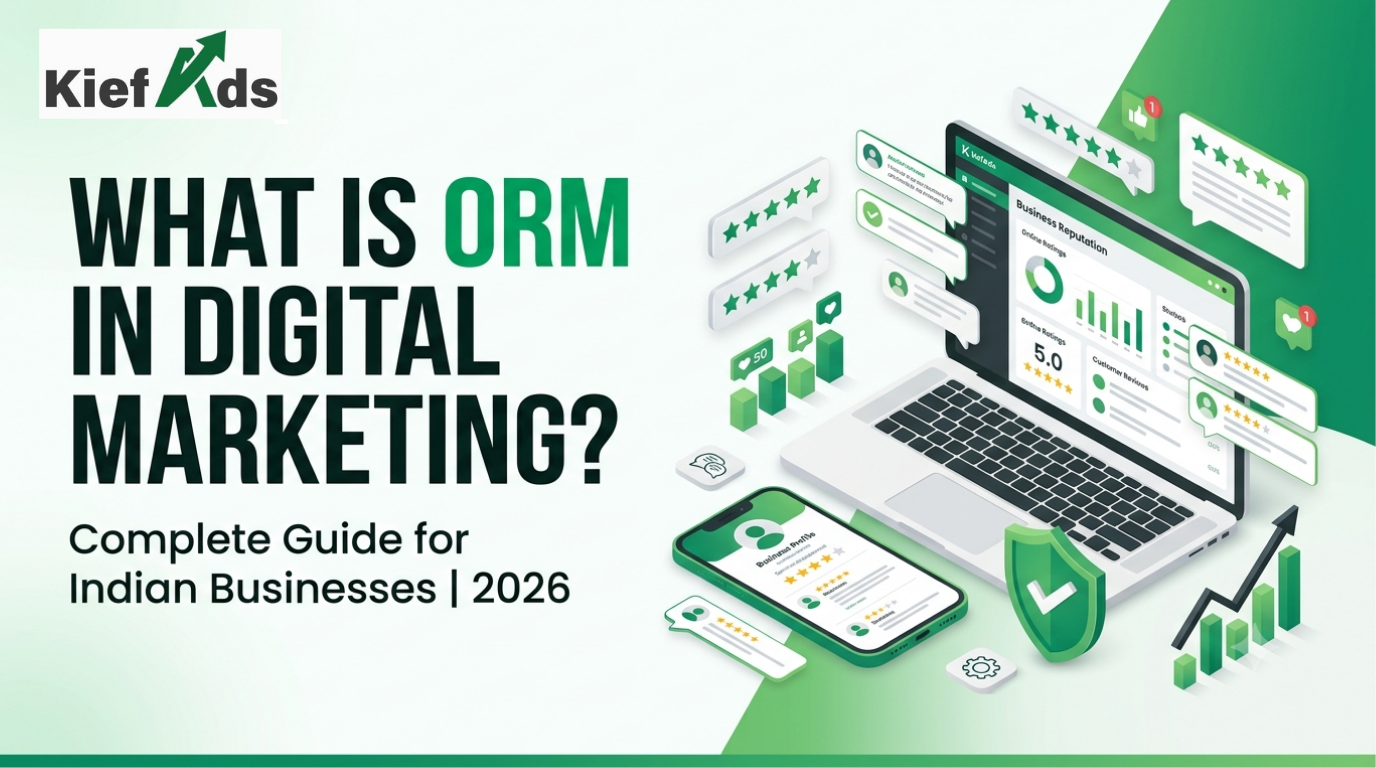
ORM stands for Online Reputation Management. It is the process of monitoring, managing and improving how a business, brand or individual appears online. In simple words, ORM helps you control what people see and think when they search for your business on Google, social media or review platforms.
In India, this matters more every year. Millions of people now use smartphones and cheap mobile data to search for products and services. Before calling a business, visiting a shop or paying for a service, most customers check Google reviews, look at the website, scroll through social media and read what other people say. This guide, written by Kiefads, explains what ORM is, why it matters, how it works and how Indian businesses of every size can use it.
What Is ORM in Digital Marketing?
ORM in digital marketing is the practice of building and protecting a business’s reputation across the internet. It covers Google reviews, search results, social media comments, business listings, news mentions and any other place where people talk about your brand.
ORM is not only about removing negative reviews. It is about:
- Understanding what customers are saying
- Responding to feedback properly
- Fixing genuine problems
- Keeping business information accurate
- Making genuine, useful and positive content easy to find
A business can have an excellent website and good products, but if a customer finds unresolved complaints or wrong information online, they may choose a competitor. ORM helps prevent that.
Why Is ORM Important for Businesses in India?
Earlier, Indian customers relied on family, friends and neighbourhood references. Today, a quick search on Google decides a large part of the buying journey. Whether someone is looking for a restaurant in Delhi, a coaching institute in Kota, a clinic in Pune or a digital marketing agency in Noida, they compare options online first.
Here is why ORM matters:
- It builds customer trust. Genuine reviews and professional replies make new customers feel safe.
- It improves brand image. A consistent, positive presence strengthens your brand over time.
- It helps local searches. “Near me” and city-based searches depend heavily on ratings, reviews and accurate listings.
- It reduces the impact of wrong information. Outdated addresses, wrong phone numbers or misleading posts can be corrected.
- It supports other marketing. SEO, ads and social media work better when your reputation is strong.
- It reveals business problems. Repeated complaints show where your service, delivery or support needs improvement.
- It works in a mobile-first market. Indian users often decide within seconds on a small screen, so ratings and first impressions count.
How Does Online Reputation Management Work?
There is no single method that fits every business. The strategy depends on your industry, size, audience and current reputation. Most ORM follows four stages.
1. Monitoring
Find out what people are saying about you. Check Google reviews, social media comments, review websites such as Justdial, Sulekha, Trustpilot and Glassdoor (where relevant), forums, blogs and news mentions. Set up Google Alerts for your brand name.
2. Understanding the feedback
Not every negative comment is a crisis. A delayed delivery or a small service issue can often be solved with a good response. Look for patterns, not just single complaints.
3. Taking action
Reply to genuine concerns, correct wrong information and politely encourage satisfied customers to share their honest experience.
4. Building a positive online presence
Publish useful website content, keep business profiles updated, share customer stories and stay active on social media.
Main Parts of ORM
Online Review Management
Reviews are one of the most important parts of online reputation. Customers look at the overall rating and read individual reviews before deciding.
Best practices:
- Check reviews regularly, at least weekly
- Thank customers for positive reviews
- Reply to negative reviews calmly and professionally
- Never argue publicly
- Offer a solution and follow up
Example reply to a negative review:
“Thank you for sharing your feedback. We are sorry that your service was delayed. Please contact us at [phone/email] so our team can look into this and resolve it quickly.”
A good response shows future customers that you take feedback seriously.
Google Business Profile Management
For Indian local businesses, Google Business Profile (formerly Google My Business) is often the first thing customers see. It shows your address, phone number, website, photos, working hours and reviews.
Keep it strong by:
- Choosing the correct business category
- Adding accurate address, phone number and timings
- Updating holiday hours during festivals like Diwali and Holi
- Uploading real photos of your shop, office, team and work
- Adding services and products
- Responding to every review and question
Social Media Reputation
Customers comment, message and tag brands on Instagram, Facebook, X, LinkedIn, YouTube and WhatsApp. Monitor these channels and reply to genuine questions and complaints quickly and respectfully. Ignoring customers for days creates a poor impression.
Managing Negative Feedback
Every business gets complaints sometimes. What matters is how you handle them.
- Check whether the complaint is genuine
- Reply politely, without blaming the customer
- Offer a solution
- Move detailed discussions to a private channel such as phone or email
- Make sure you actually follow up
A good response can turn an unhappy customer into a loyal one.
Positive Content Creation
ORM also involves publishing genuine, useful content such as blog articles, service pages, FAQs, case studies and company updates. The goal is not to hide negative information with fake content. The goal is to give people clear, accurate information about your business.
ORM vs SEO: What Is the Difference?
| Point | ORM | SEO |
|---|---|---|
| Full form | Online Reputation Management | Search Engine Optimisation |
| Main focus | How your brand is viewed online | Ranking your website and pages in search |
| Key activities | Reviews, replies, brand monitoring, profile management | Keywords, content, backlinks, technical fixes |
| Goal | Build trust and protect brand image | Increase visibility and organic traffic |
They are different, but they work well together. When someone searches your brand name, SEO helps your website and useful pages appear, while ORM makes sure what appears is accurate, genuine and positive where possible.
ORM vs PR: What Is the Difference?
Public Relations (PR) focuses on communication between a company and the public through press releases, media coverage and events. ORM focuses more on the online side: reviews, search results, social media and websites where people discuss your business. Both help build a good brand image, and many businesses use them together.
How ORM Fits Into Digital Marketing
ORM is one part of a wider digital marketing strategy that includes SEO, social media marketing, paid ads, content marketing and email marketing. For example:
- SEO brings organic traffic
- Social media helps you talk to customers
- Content marketing provides useful information
- ORM manages feedback and brand image
A business does not need every activity at once. The right mix depends on your goals and customers.
Benefits of ORM for Businesses
- Builds trust: Genuine reviews and professional replies make people comfortable contacting you.
- Improves customer experience: Feedback shows what to improve in products and services.
- Protects brand image: Repeated unresolved complaints can hurt a brand. ORM helps you catch them early.
- Boosts local visibility: Strong ratings and correct listings help in local searches.
- Improves communication: Replying shows customers you are listening.
- Finds operational problems: If many customers complain about slow support, you know where to fix things.
- Supports growth: ORM does not guarantee sales, but when customers compare two similar businesses, the one with clear information and genuine good feedback often wins.
Common ORM Activities
- Monitoring brand mentions
- Checking and replying to customer reviews
- Managing Google Business Profile information
- Monitoring social media comments and messages
- Checking search results for your brand name
- Correcting wrong business information
- Creating useful website content
- Publishing genuine customer stories
- Tracking common complaints
- Politely asking genuine customers for reviews
- Monitoring competitor reputation
These should be done regularly, not only after a negative review appears.
How to Handle Negative Reviews
- Read it carefully. Understand what went wrong.
- Verify the facts. Check your records or talk to your team.
- Respond politely and quickly. Ideally within 24 to 48 hours.
- Offer a solution. Refund, replacement, re-service or a call back.
- Take it offline if needed. Share a contact number or email for detailed discussion.
- Follow up. Make sure the issue is actually solved.
- Report policy violations. If a review is fake, abusive or breaks platform rules, report it through the platform’s official process.
Important: Do not buy fake reviews or create fake customer accounts. It damages trust, violates platform rules and can lead to penalties or removal of your listing. In India, misleading and fake reviews may also attract action under consumer protection rules.
Why Genuine Reviews Matter
Customers can usually spot reviews that look repetitive or unnatural. Genuine reviews from real customers are far more valuable. Focus on delivering a great experience first, then politely ask satisfied customers to share honest feedback. You can make it easy by sharing your Google review link through WhatsApp, SMS or email after a completed service.
Role of Content in ORM
When people search for your business, they find different pages about it. Useful content helps provide the correct information.
You can publish:
- Blog articles and how-to guides
- Service pages and FAQs
- Case studies and client success stories
- Company updates and team introductions
- Videos and customer testimonials (with permission)
Write for real users first. Answer real questions, and use simple language that a wide Indian audience can understand. Where it suits your audience, you can also create content in Hindi or other regional languages.
ORM for Different Types of Businesses
ORM for Small Businesses
Local shops, restaurants, salons, clinics, tutors, consultants and small agencies all benefit from ORM. Every customer matters, and a few unanswered negative reviews can affect how new customers see you. Start simple:
- Keep your Google Business Profile updated
- Check reviews regularly
- Reply to feedback
- Stay active on social media
- Publish useful information on your website
- Ask genuine customers for honest reviews
ORM for Large Businesses
Large companies have more customers, more cities and more platforms. They need a proper response process, with different teams handling customer support, social media and reviews. They should also track common complaints and use feedback to improve services.
ORM for Service-Based Businesses
Digital marketing agencies, software companies, consultants, lawyers, CAs, repair services and education providers depend on trust. Customers often research before contacting them. Clearly explain what you do, who you serve and how to contact you, and make sure all online information is correct.
ORM for Local Businesses
When people search for services near them, they compare several options. For example, someone looking for a marketing company in Noida, Gurugram, Faridabad or Delhi NCR will check ratings, reviews and websites before calling. An updated profile, genuine reviews and helpful content create a strong first impression. This is why ORM is often combined with local SEO.
ORM for New Businesses
Start from day one. Create accurate profiles, build a useful website and communicate well with customers. You do not need hundreds of reviews immediately. Focus on good service, and satisfied customers will share their experience over time.
ORM for Established Businesses
Established brands may have many reviews and mentions across platforms. Identify the key platforms, check that old information is still correct, and update any changes in address, phone number, services or timings.
Steps to Create an ORM Strategy
Step 1. Check your current reputation. Search your business name on Google and other platforms. Note reviews, profiles and any wrong information.
Step 2. Find the main problems. Look for repeated complaints, outdated details or misleading content.
Step 3. Monitor reviews and mentions. Use tools like Google Alerts and Google Business Profile notifications. Do not wait for a crisis.
Step 4. Respond properly. Reply to both positive and negative feedback politely.
Step 5. Improve online information. Make sure your website, listings and social profiles have correct, consistent details.
Step 6. Publish useful content. Create content that answers customer questions and explains your business clearly.
Step 7. Track and improve. Keep checking reviews, rankings and feedback to see whether your reputation is improving.
Mistakes to Avoid in ORM
- Ignoring negative reviews: Customers feel the business does not care.
- Arguing with customers publicly: It makes the situation worse.
- Buying fake reviews: It destroys trust and risks penalties.
- Posting only promotional content: People value useful information.
- Giving false promises: Never promise what you cannot deliver.
- Not monitoring mentions: You may miss important feedback.
- Inconsistent business details: Different phone numbers or addresses across platforms confuse customers and search engines.
- Treating ORM as a one-time task: Reputation changes over time.
How Can ORM Improve Brand Image?
Brand image is built slowly through consistent service, good communication and honest online activity. ORM helps by tracking customer opinions and keeping your online information accurate. But remember that ORM cannot replace a poor product or poor service. A good reputation starts with a good customer experience.
ORM and Customer Trust
For many new customers, your online presence is the first interaction with your company. Make sure:
- Your website gives clear information
- Business profiles are updated
- Reviews are monitored
- Questions are answered
- Complaints are handled properly
These small actions add up to a stronger reputation.
ORM and Business Growth
ORM does not directly guarantee more sales, but it supports the customer’s decision. If two companies offer similar services, a customer will often choose the one with clear information, genuine positive feedback and responsive communication over the one with outdated details and unresolved complaints.
ORM and Social Proof
Social proof means people look at others’ experiences before deciding. Reviews, testimonials, ratings and case studies all work as social proof. Use genuine customer feedback on your website and marketing where appropriate, and always keep it truthful.
Role of a Digital Marketing Agency in ORM
A digital marketing agency can monitor reviews, manage social media, improve SEO, create content and track brand mentions. For businesses without an in-house team, this makes ORM easier to handle regularly. When choosing an agency, compare services, experience, work process and genuine client feedback, and understand what results can realistically be expected.
How to Measure ORM Performance
Track different signals together, because no single number shows the full picture.
- Number of new reviews
- Average star rating
- Review response rate and response time
- Common complaints and themes
- Brand mentions
- Social media comments and sentiment
- Search results for your brand name
- Branded search traffic in Google Search Console
- Customer feedback and repeat business
Is ORM Only About Google Reviews?
No. Google reviews matter a lot, especially for local businesses, but ORM also covers social media, forums, review websites, blogs, news articles, video comments and even customer posts on their own accounts.
Can ORM Remove Negative Reviews?
Not every negative review can or should be removed. If a review breaks platform rules (spam, abuse, fake or irrelevant content), you can report it officially. But a genuine negative review is best handled with a polite response and real problem-solving. Trying to erase every negative opinion is not a practical strategy.
Why ORM Should Be a Regular Activity
Reputation changes. You may have excellent reviews today and receive new complaints next month. New posts, new articles and new search results can change how people see you. Regular monitoring helps you find problems early, respond quickly and keep your information updated.
Quick ORM Checklist for Indian Businesses
- Google Business Profile is complete and verified
- Name, address and phone number are the same everywhere
- Reviews are checked at least weekly
- Every review gets a reply
- Social media comments and messages are answered
- Website has About, Contact, Services and FAQ pages
- Genuine customers are asked for reviews
- Brand name is searched on Google every month
- Complaints are tracked and root causes fixed
- Content is updated regularly
Frequently Asked Questions
What does ORM stand for in digital marketing?
ORM stands for Online Reputation Management. It means monitoring and improving how a brand appears online through reviews, search results, social media and other platforms.
Why is ORM important for Indian businesses?
Indian customers search online, read reviews and compare options before buying, especially on mobile. A strong online reputation builds trust and helps you stand out from competitors.
Is ORM the same as SEO?
No. SEO improves your website’s visibility in search engines, while ORM manages how your brand is viewed online. They work best together.
Can small businesses benefit from ORM?
Yes. Local shops, clinics, restaurants, tutors and service providers benefit greatly because customers often decide based on Google ratings and reviews.
How often should I check my online reviews?
Ideally at least once a week, and daily if you receive many reviews. Quick replies show customers you care.
Can I delete negative reviews on Google?
Generally no. You can report reviews that violate Google’s policies, but genuine negative reviews should be answered politely and resolved.
Is it okay to buy reviews?
No. Fake reviews violate platform rules, damage trust and can lead to penalties. Always collect honest feedback from real customers.
How long does ORM take to show results?
It depends on your current reputation, the platforms involved and how consistently you work. Small improvements like better replies and updated profiles can show quickly, while stronger brand trust usually builds over months.
Do I need an ORM agency?
Not always. Small businesses can start with simple steps on their own. Larger or fast-growing businesses may benefit from professional support for monitoring, content and strategy.
Final Thoughts
ORM in digital marketing means Online Reputation Management. It helps businesses monitor, manage and improve their online image through review management, customer communication, social media monitoring, Google Business Profile management, content creation and brand tracking.
ORM is not about hiding every negative comment or creating fake positive reviews. It is about building a genuine, trustworthy online presence. First, deliver a good product or service. Then listen to your customers, respond to feedback and keep your online information updated.
ORM works best alongside SEO, social media marketing, content marketing and other digital marketing activities. Together, they help customers find, understand and trust your brand.
Looking for professional help with ORM? Kiefads offers digital marketing solutions for Indian businesses, including SEO, local SEO, content marketing, social media marketing and online reputation management, all planned around your goals and audience. Contact Kiefads today to build a stronger, more trusted online presence.