
A story (and a strategy) for business owners who are tired of guessing
It was 11 p.m. on a Tuesday when Meera finally closed her laptop and admitted defeat. She’d spent three hours comparing digital marketing agencies, and every single website said almost the same thing: “results-driven,” “data-backed,” “your growth partner.” Meera ran three yoga studios that had grown almost entirely through word of mouth, and now that she wanted to take things online, she had no idea who to actually trust with the job.
If that sounds a little too familiar, you’re in good company. Choosing a digital marketing agency can feel a lot like swiping through a dating app — everyone’s profile looks polished, but you won’t know if it’s a real match until you’re a few weeks in. The difference is that a bad match here doesn’t just cost you an awkward evening. It can cost you months of momentum and a real chunk of your budget.
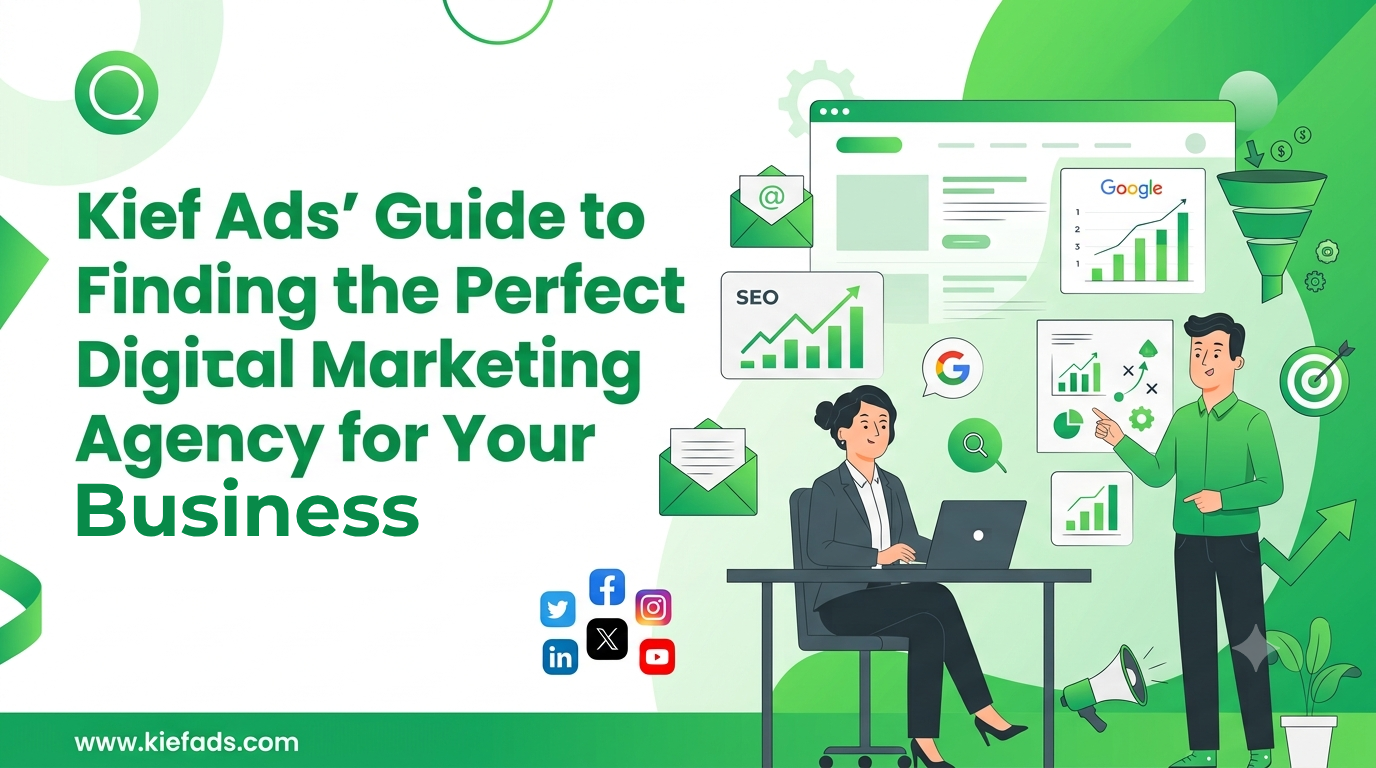
The good news: you don’t have to leave it to chance. There’s a method to this, and we’re going to walk through it together — the same way we walk our own prospective clients through it at Kief Ads, long before pricing or contracts ever come up.
Why This Decision Is Bigger Than It Looks
It’s tempting to treat hiring an agency like hiring any other vendor — pick one, hand off the work, check it off the list. But a good digital marketing agency isn’t really a vendor. Done right, it functions more like a second team embedded inside your business, one that ends up understanding your customers almost as well as you do.
That’s exactly why the stakes are higher than they first appear. The right partner doesn’t just run your ads or manage your Instagram — they learn your industry, ask sharper questions than you expected, and hand you insights that are useful well beyond marketing. The wrong one burns through your budget on tactics that were never suited to your business in the first place, and by the time you notice, you’ve lost months you won’t get back.
There’s also a moving-target problem to consider. Algorithms shift, platforms rise and fall, and what worked brilliantly last year can quietly stop working this year. A genuinely good agency treats staying current as part of the job, not an excuse for underperformance. That’s the real difference between a partner who keeps you moving forward and one who leaves you, a year later, wondering why nothing seems to have changed.
Start With Your Own Story Before You Start Shopping
Before Meera opened a single agency website, she should have answered one question first: what did she actually want to happen? More sign-ups for intro classes? More people finding her when they searched “yoga studio near me”? More repeat bookings from people who’d only ever visited once?
That’s the step most business owners skip — and it’s the one that matters most. “I want more marketing” isn’t a goal an agency can build a strategy around. “I want 50 more trial-class bookings a month by spring” is.
Once you know what you’re aiming for, figure out how you’ll know you’ve gotten there. Website traffic, conversion rate, cost per lead, engagement, actual revenue — pick the numbers that map to your specific goal, not just the ones that are easiest to report. This is also the moment to be honest about timeline. Are you chasing a quick lift before a busy season, or building something that compounds over the next two years? Some agencies are built for sprints, others for the long game, and knowing which race you’re running will save you from hiring a marathon coach for a 100-meter dash.
Get Clear on the Kind of Help You Actually Need
Digital marketing is a big umbrella. SEO, paid ads, social media, content, email, and more all live under it, and almost no agency is genuinely excellent at every single one. So before reaching out to anyone, take an honest look at where you currently stand.
Where are you actually strong? Where are you quietly losing ground? If your website barely shows up when someone searches for what you do, no amount of clever social content is going to fix that on its own — that’s an SEO problem. If you’ve got strong content that nobody’s finding, the gap might be visibility instead. Meera, for instance, had a lovely Instagram feed and almost no presence in local search, which meant the agency she needed had to be strong in SEO first and social second, not the other way around.
It’s also worth thinking hard about where your actual customers spend their time. A B2B software company and a neighborhood bakery aren’t going to win with the same channel mix, and an agency that’s brilliant for one could be the wrong fit entirely for the other. Matching your needs to an agency’s real strengths — not just their sales pitch — is where a lot of the genuine work of choosing happens.
Go Looking: Building a Shortlist That’s Actually Worth Your Time
With clarity on what you need, it’s time to go find who can deliver it. Start close to home: ask other business owners you trust who they’ve worked with — and just as importantly, who they’d steer you away from. A recommendation that comes with real detail (“they doubled our booking rate in four months” or “they went quiet the moment the contract was signed”) is worth more than a dozen anonymous five-star reviews.
From there, widen the net. Sites like Clutch and Upwork, along with LinkedIn, are useful for surfacing agencies with a track record you can actually check — look at who they’ve worked with before and whether those industries resemble yours. Spend time on their own website and social presence too. An agency that can’t market itself convincingly is a fair warning sign about what they’ll do for you.
Once your list is longer than you need, start narrowing it. Size matters more than people expect: a smaller shop might offer far more hands-on attention, while a larger firm might bring more resources and a wider bench of specialists. Location, industry focus, and range of services all belong in this filter too. You’re not looking for the biggest name on the list — you’re looking for the closest fit.
Look Past the Pitch: Vetting Real Expertise
Every agency on your shortlist will tell you they’re great. Your job now is figuring out if that’s actually true. Case studies, testimonials, and industry recognition are a reasonable starting point, but push further than the highlight reel — ask specifically about work with businesses that resemble yours in size, industry, or challenge.
Pay close attention to whether their strengths actually line up with your needs. If SEO is your priority, ask pointed questions about their approach to both on-page and technical work — not just “do you do SEO.” An agency with genuine experience in your industry will often surface problems you hadn’t even thought to ask about, which is usually a good sign you’re talking to people who’ve actually done this before.
This is also the moment to get in a room — or on a call — with the actual people who’d be working on your account, not just whoever first reached out to you. Ask them to walk through how they’d approach your specific situation. Their answer tells you a lot: about their expertise, sure, but also about whether their way of working feels like a fit for yours.
Let Their Work Do the Talking
A portfolio is where an agency’s claims meet reality. Look for range: creativity, strategic thinking, and real evidence they can adapt to different kinds of problems, not one trick repeated across every client. Give the most weight to projects that resemble your own goals — a beautifully executed campaign for a completely different kind of business tells you less than you might think.
Testimonials matter here too, but read between the lines. Vague praise (“they were great to work with!”) tells you far less than specifics about communication, follow-through, and whether the relationship actually delivered what was promised. The most useful case studies read almost like a short story of their own: here was the problem, here’s what was tried, here’s what changed as a result — in numbers you can actually check. An agency willing to show you that kind of detail across more than one industry is usually one with good reason to be confident.
Talk Numbers Early, Not Last
Pricing conversations can feel awkward, but putting them off doesn’t make them easier — it just means you find out too late whether an agency fits your budget. Get clear, early, on exactly what’s included at each pricing tier, and don’t hesitate to ask what happens if your needs grow.
Ask for a detailed proposal before committing to anything: services, timelines, and costs laid out plainly enough that you can compare agencies apples-to-apples. And resist the pull toward the cheapest option on the table. A higher price sometimes just means a bigger margin — but it often reflects a more experienced team, better tooling, or a level of strategic thinking a bargain agency simply can’t match. The real question isn’t “what does this cost.” It’s “what am I getting for it.”
One more thing worth raising upfront: what happens as the relationship grows? Digital marketing rarely stays static — campaigns evolve, new channels get added, strategies shift. A good agency will be upfront about how costs might change over time instead of leaving you to discover it later.
Check the Chemistry: Communication and Collaboration
You can find the most credentialed agency in the world and still end up frustrated if the way you work together doesn’t click. Pay attention to this from the very first email. Are they quick to respond? Do their questions show they’re actually trying to understand your business, or does it feel like a script they run with everyone?
Think, too, about how much involvement you actually want. Some agencies operate largely independently and check in periodically; others expect you at the table for most major decisions. Neither approach is wrong on its own, but mismatched expectations here are one of the most common reasons partnerships sour — so get specific about what you want before you’re locked into a contract.
It’s worth asking what tools they actually use to stay organized — Slack, Trello, Asana, or whatever their system is — because a scattered process on their end usually becomes a frustrating experience on yours. Structure isn’t glamorous, but it’s often what separates a smooth partnership from a chaotic one.
Trust Your Gut, Then Get It in Writing
By this point, you’ve done the real work: goals defined, needs mapped, agencies researched, portfolios reviewed, pricing compared, chemistry tested. Somewhere in that process, one option usually starts to feel right — and that instinct is worth listening to, even as you keep your head about the details.
Before signing anything, read the contract closely. Deliverables, timelines, payment terms, what happens if either side wants out — all of it should match what was actually discussed, in writing, not just in conversation. A good agency won’t flinch at questions here. If anything, they’ll expect them.
And once the ink is dry, don’t treat the signature as the finish line. Set up a regular check-in rhythm from day one, whatever cadence makes sense for the scope of work, so you’re building the relationship — not just monitoring it from a distance.
Back to Meera — and to You
A few months after that 11 p.m. laptop-closing moment, Meera found her match: an agency that asked more questions in the first call than she expected, and one that was upfront about what it wasn’t the right fit for, too. That’s really the thread running through this whole process. You’re not looking for the agency with the flashiest reel. You’re looking for the one that fits the business you’re actually running.
Take the time. Ask the harder questions. And when the fit is right, you’ll know it.
If you’d rather skip a few of those late-night browser tabs, that’s exactly the kind of conversation we like having at Kief Ads.