
Introduction
Ask a friend in Delhi, Bengaluru or Jaipur how they look for a service today, and the answer may surprise you. Many no longer type a keyword into Google and scroll through ten links. They ask Gemini in Hinglish, request a recommendation from ChatGPT, or read the AI summary at the top of the results page and move on.
Search in India has changed in three ways:
- AI-generated answers now appear before the traditional blue links.
- People ask full questions, by typing or by voice, in English, Hindi, or a mix of both.
- Mobile is the main screen. For most Indian users, search happens on a smartphone, often on the move.
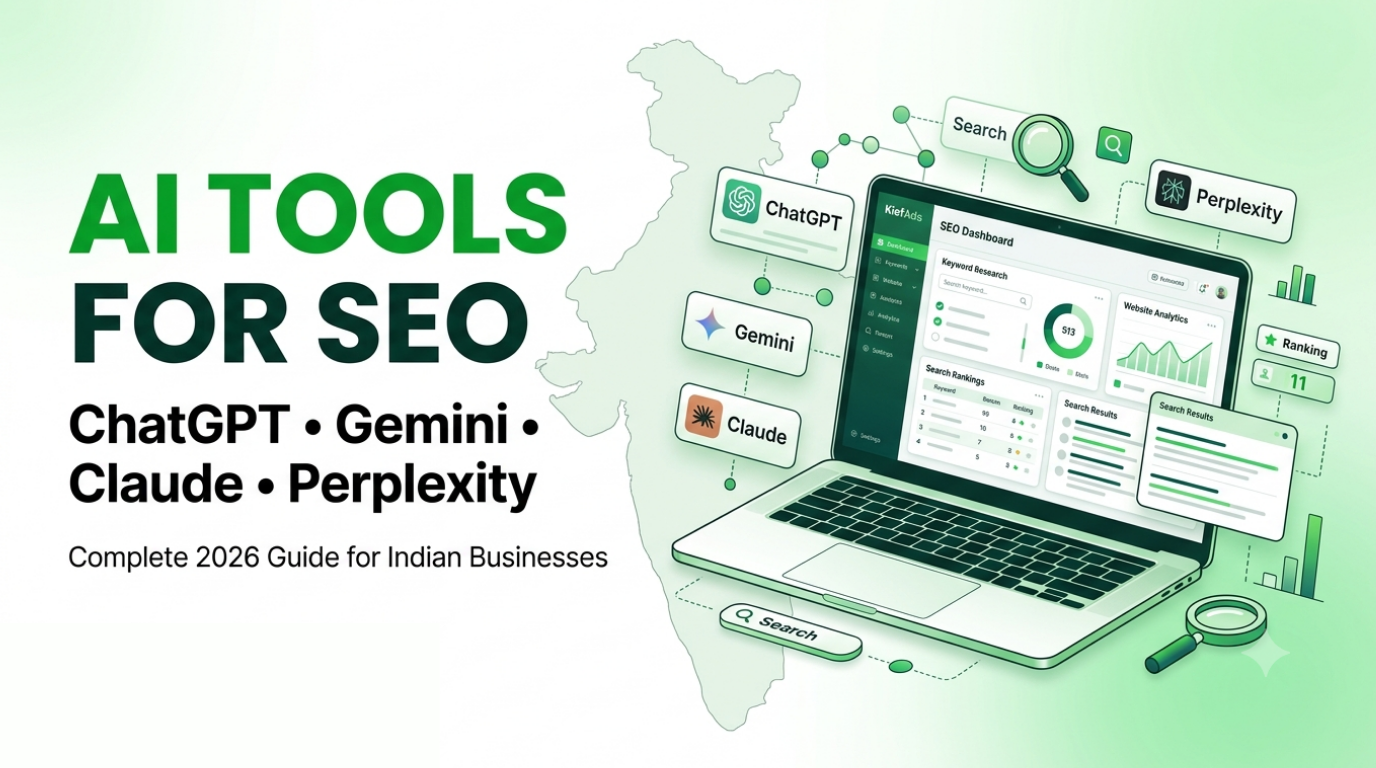
For Indian brands, AI tools for SEO are now a necessity if you want to stay visible on Google and also on ChatGPT, Gemini, Claude and Perplexity. At Kiefads, we help Indian businesses adapt to this shift. This guide covers how AI SEO works in 2026, how to use each tool, and how to build a strategy that suits Indian audiences.
What Is AI SEO?
AI SEO means using artificial intelligence tools such as ChatGPT, Gemini and Claude to research, create and optimize content. The goal is to rank well on traditional search engines and also be cited or summarized by AI answer systems like Google AI Overviews, ChatGPT and Perplexity.
In simple terms, you are optimizing for two audiences at once: search engine crawlers and AI language models. Instead of chasing keyword positions alone, AI SEO focuses on making content:
- Clear and well structured
- Factually credible
- Easy for both people and machines to read, extract and summarize
It combines the fundamentals (technical health, backlinks, site speed, quality content) with newer practices like structuring content for extraction, strengthening EEAT signals and answering questions directly.
Why AI Tools for SEO Matter for the Indian Market
1. India is a mobile-first, voice-friendly market
Most Indian users search on mobile, and many use voice search. Voice queries are longer and more conversational, for example “best digital marketing agency near me for a small business”. AI tools help you find and target these natural-language queries.
2. Multilingual search is growing
Indian users switch between English, Hindi and regional languages, and often write Hinglish. AI models are getting better at understanding these queries, which means your content needs to be clear, simple and context-rich.
3. AI answers compete for attention
When an AI summary answers a question directly, fewer people click through. Your content now competes to be cited as a source, not only to rank.
4. Competition is rising
More Indian startups, SMEs and enterprises are investing in digital marketing every year. AI tools let you research faster, publish more efficiently and spot gaps your competitors have missed.
5. Speed matters
Research, audits, briefs and schema work that took days can now take hours. For lean Indian teams, that is a real advantage.
AI tools help you:
- Understand what kind of content AI models tend to reference
- Structure pages so they get cited rather than skipped
- Speed up research, writing and technical audits
- Find ranking opportunities by spotting patterns at scale
If your SEO strategy ignores how AI models read and summarize content, you are optimizing for only half of the search landscape.
How ChatGPT Is Changing SEO Workflows
ChatGPT SEO does not mean typing “write me a blog post” and publishing the result unedited. Used well, ChatGPT is a research and strategy accelerator.
Topic clustering and content gap analysis
Give ChatGPT your existing blog titles and a competitor’s list of topics, and ask it to find gaps. For an Indian business, you can add context such as “target audience: small business owners in Tier 2 cities” to get more relevant ideas.
Meta titles and descriptions
ChatGPT can produce many variations quickly. Choose the best, refine it for your brand voice, and test it in Search Console.
Schema markup drafts
It can draft JSON-LD for FAQ, Article, Breadcrumb, LocalBusiness and Organization schema. Always validate the output with Google’s Rich Results Test before deploying.
Content briefs
Instead of handing writers a bare keyword, use ChatGPT to build a structured brief covering:
- Search intent
- Suggested headings (H2/H3)
- Questions to answer
- Tone and reading level
- Internal link opportunities
Hinglish and regional query ideation
Ask ChatGPT how people in India might phrase a query in Hinglish or Hindi. This helps you understand how your audience actually speaks.
The catch: ChatGPT does not know your live rankings, Search Console data or traffic unless you provide it. Treat it as a thinking partner, not a replacement for real SEO analytics. Fact-check all statistics, and never publish AI text without human editing.
Gemini SEO: Google’s Own AI in the Ranking Picture
Gemini SEO deserves special attention because Gemini is built by Google and is closely tied to how Google presents answers through AI Overviews.
Content that is well structured, accurate and clearly written tends to suit AI-generated summaries better. In practice, that means:
- Direct answers near the top of the page
- Headings that match real user questions
- Credible data and first-hand experience
- Fast loading, technically clean pages, especially on mobile networks
If you already invest in strong On-Page SEO and Technical SEO, you are partly optimizing for Gemini too. The two disciplines are converging.
Tip for Indian sites: Many users browse on mid-range phones and variable connections. Keep pages light, compress images, and pay close attention to Core Web Vitals.
Claude and Perplexity in Your SEO Workflow
- Claude is strong at long-form editing, technical documentation, audit reports and precise tone adjustments. It is useful for client-facing explanations and for tightening drafts.
- Perplexity is useful for research with source links, competitor content analysis and finding what is currently being said about a topic.
Using several tools together, each for what it does best, usually works better than relying on one.
GEO and AEO: The New Layers of SEO
What is GEO (Generative Engine Optimization)?
GEO is optimizing content so generative AI tools such as ChatGPT, Gemini, Perplexity and Claude are more likely to reference it when they generate answers. In practice:
- Write in a way that is easy to extract and summarize
- Include clear definitions, statistics and structured data
- Build topical authority so your site is seen as a reliable source
What is AEO (Answer Engine Optimization)?
AEO is about answering questions directly. Think FAQ sections, short definitions, “what is” and “how to” formats, and content built around real queries people type or speak.
The simple principle
Write content that is genuinely useful, logically structured and backed by real expertise. It is not a trick. It is good writing that happens to match how AI models process information.
Best AI Tools for SEO in 2026: Quick Comparison
| Tool | Best For | Limitations |
|---|---|---|
| ChatGPT | Content briefs, brainstorming, schema drafts, gap analysis | No live ranking data unless you provide it or use browsing features |
| Gemini | Google-aligned content structuring, understanding AI Overview style answers | Best used with Google Search Console for real data |
| Claude | Long-form editing, technical documentation, tone refinement | Not built specifically for SEO workflows |
| Perplexity | Research with citations, competitor content analysis | Less useful for on-page technical tasks |
| Surfer SEO / Clearscope | Content scoring and optimization | Needs human judgment to avoid over-optimization |
| Ahrefs / SEMrush | Keyword research, backlink analysis, audits, automation | Paid; steeper learning curve |
| Google Search Console & Analytics | Real performance data (free) | Needs interpretation; no content creation |
Using AI in Technical SEO
AI tools do not fix your website for you, but they speed up the thinking, drafting and documentation behind technical work.
ChatGPT can draft schema markup, suggest robots.txt and canonical tag approaches, generate alt text drafts at scale, and explain what a Search Console error means.
Gemini can help you interpret Core Web Vitals findings, suggest page speed and mobile usability improvements, and align page structure with how AI summaries extract content.
Claude is useful for writing detailed audit reports, organizing site structure documentation and refining technical explanations for clients.
A developer or SEO specialist still needs to implement and test every change on the live site.
Practical Ways to Use AI Search Optimization This Month
1. Audit your top pages for AI-readability
Pick your 10 best traffic-driving pages. Does each answer its main question within the first 100 words? If not, restructure. Both AI systems and impatient readers prefer content that gets to the point.
2. Strengthen EEAT signals
EEAT stands for Experience, Expertise, Authoritativeness and Trustworthiness. To strengthen it:
- Add author bios with real credentials
- Publish case studies and original data from Indian markets
- Show genuine client testimonials
- Cite reliable sources
- Keep your About, Contact and policy pages complete and transparent
3. Use AI for keyword research, not final decisions
AI can surface long-tail and conversational variations fast, including Hinglish phrasing. Always verify volume and intent in Google Search Console, Google Keyword Planner or a tool like Ahrefs before building content around a keyword.
4. Structure content for extraction
- Use clear H2 and H3 headings phrased as questions where it makes sense
- Add short summary paragraphs and definition boxes
- Use bullet lists and comparison tables
- Add a FAQ section with FAQ schema
5. Automate the repetitive, not the strategic
Automation suits alt text drafts, internal linking suggestions, meta description variations and report formatting. It suits poorly the decisions about which markets to target or how to position your brand.
6. Build for mobile and voice
Write in a natural, conversational tone. Keep sentences short. Answer questions the way someone would say them aloud.
7. Create content with local relevance
Reference Indian cities, industries, regulations, festivals, pricing in rupees (₹) and local buying behavior. Generic global content rarely earns trust with Indian readers.
Local SEO in India: Still a Major Driver
AI-driven search has not replaced local search fundamentals. For businesses serving customers in cities like Delhi NCR, Mumbai, Pune, Hyderabad or Chennai, these remain essential:
- Google Business Profile fully completed, with accurate categories, hours, photos and services
- NAP consistency (name, address, phone) across directories and listings
- Reviews: ask satisfied customers for reviews and reply to all of them
- Local landing pages for each city or area you serve
- Local schema markup
- Local citations on trusted Indian directories
AI Overviews and AI assistants increasingly draw on local business information, so accurate, consistent data pays off in more than one place.
Enterprise SEO and AI
For large Indian organizations such as e-commerce platforms, BFSI brands, edtech companies and multi-location chains, scale is the challenge. AI helps teams:
- Audit thousands of pages faster
- Generate and standardize metadata and schema
- Spot duplicate and thin content
- Prioritize fixes by likely impact
- Produce consistent documentation across teams
Strategic direction, brand voice and quality control still need experienced human oversight.
Common Mistakes to Avoid
- Publishing raw AI content. Thin, repetitive, unedited text is easy to spot and rarely builds trust.
- Skipping fact-checks. AI tools can state incorrect information confidently.
- Ignoring technical health. Speed, crawlability and mobile usability still matter.
- Over-optimizing. Stuffing keywords or chasing tool scores hurts readability.
- Neglecting original value. Add your own data, experience and opinions.
- Forgetting local and language context. Indian audiences respond to relevance.
- Not measuring. Track impressions, clicks, conversions and brand mentions in Search Console and Analytics.
Where Traditional SEO Fundamentals Fit
AI SEO tools amplify fundamentals. They do not replace them.
Organic traffic still comes from solving real problems for real people. Rankings still depend on quality content, strong backlinks, site speed, mobile usability and topical depth. AI changes how fast you can execute and how precisely you can target.
How Kiefads Approaches AI-Driven SEO
At Kiefads, we do not chase every new AI tool that launches. We test what actually improves rankings, traffic and leads for Indian businesses. Our approach combines:
- Research-led strategy built around Indian search behavior, including mobile, voice and Hinglish queries
- AI-assisted workflows for briefs, audits, schema and reporting, always reviewed by humans
- Strong technical foundations covering speed, structure and crawlability
- EEAT-focused content with real expertise and local relevance
- Visibility across Google, AI Overviews and generative platforms, rather than one at the cost of the other
- Transparent reporting tied to measurable business outcomes
Conclusion: Building a Future-Ready SEO Strategy in India
AI is not replacing SEO. It is reshaping how visibility works. Indian brands that win in 2026 will combine AI tools for SEO with genuine expertise, clear writing, local relevance and technically sound websites.
ChatGPT, Gemini, Claude and Perplexity are powerful accelerators, but they still need a human strategist who understands your business, your audience and what turns a visitor into a customer.
Ready to grow your business with AI-powered SEO? Contact Kiefads today for a free website audit and a personalized SEO strategy built for the Indian market.
Frequently Asked Questions
1. What are the best AI tools for SEO in India in 2026?
A strong combination is ChatGPT and Gemini for research and content strategy, Claude for editing and documentation, Perplexity for cited research, Ahrefs or SEMrush for keyword and backlink data, Surfer SEO for content optimization, and Google Search Console for real performance data.
2. Can ChatGPT improve my Google rankings?
ChatGPT does not directly influence rankings. It speeds up research, briefs, schema drafting and ideation, which, when applied well and combined with human editing, can improve content quality and results over time.
3. What is the difference between GEO and traditional SEO?
Traditional SEO focuses on ranking in search engine results. GEO (Generative Engine Optimization) focuses on getting your content cited or referenced by AI tools like ChatGPT, Gemini and Perplexity. The two work best together.
4. What is AEO?
AEO (Answer Engine Optimization) means structuring content to answer questions directly, using FAQs, concise definitions and query-based headings, so search engines and AI assistants can easily use it.
5. Is Local SEO still relevant with AI-powered search?
Yes. Google Business Profile optimization, local citations, consistent business details and reviews remain critical for “near me” and city-based searches, and AI-driven results also draw on local business data.
6. How does EEAT relate to AI tools for SEO?
AI systems tend to favor content that shows experience, expertise, authority and trust. Strong author profiles, original data, case studies and credible sources help for both Google rankings and AI citations.
7. Does AI understand Hindi and Hinglish queries?
AI tools are improving quickly at understanding Hindi, Hinglish and other Indian languages. Writing clear, natural content and considering how your audience phrases questions can improve your chances of being matched to those queries.
8. Should small businesses in India invest in AI SEO tools?
Yes, especially for research, content planning and routine tasks. Small businesses should still prioritize sound strategy, local SEO and quality content, ideally with guidance from an experienced agency like Kiefads.
9. Is AI-generated content safe for SEO?
AI-assisted content can perform well when it is accurate, original in value, edited by humans and written to help readers. Unedited, mass-produced content is risky.
10. How long does it take to see results from AI-driven SEO?
It depends on competition, site health and content quality, but most businesses see early improvements within a few months and stronger results over six months or more with consistent effort.