
Digital advertising has evolved in waves. Search advertising, led by Google, let brands capture demand through keywords. Social platforms such as Meta, TikTok and LinkedIn made it possible to reach defined audiences through demographics, interests and behavior. Retail media brought advertising closer to the point of purchase through platforms such as Amazon and Walmart.
Now conversational AI is becoming another customer touchpoint. People use AI assistants to research products, compare services, ask for recommendations, understand brands and work through purchase decisions. Instead of reducing a need to a short phrase, users can explain their situation in detail.
For marketers, that changes the signal available at the moment of discovery. The strategic question is no longer only, “What keyword is this person searching?” It can also become, “What problem are they trying to solve, and what constraints shape their decision?”
At Kiefads, we help brands understand what this shift means for paid media, SEO, content, customer acquisition and measurement.
Table of Contents
- What Are ChatGPT Ads?
- Why ChatGPT Ads Differ
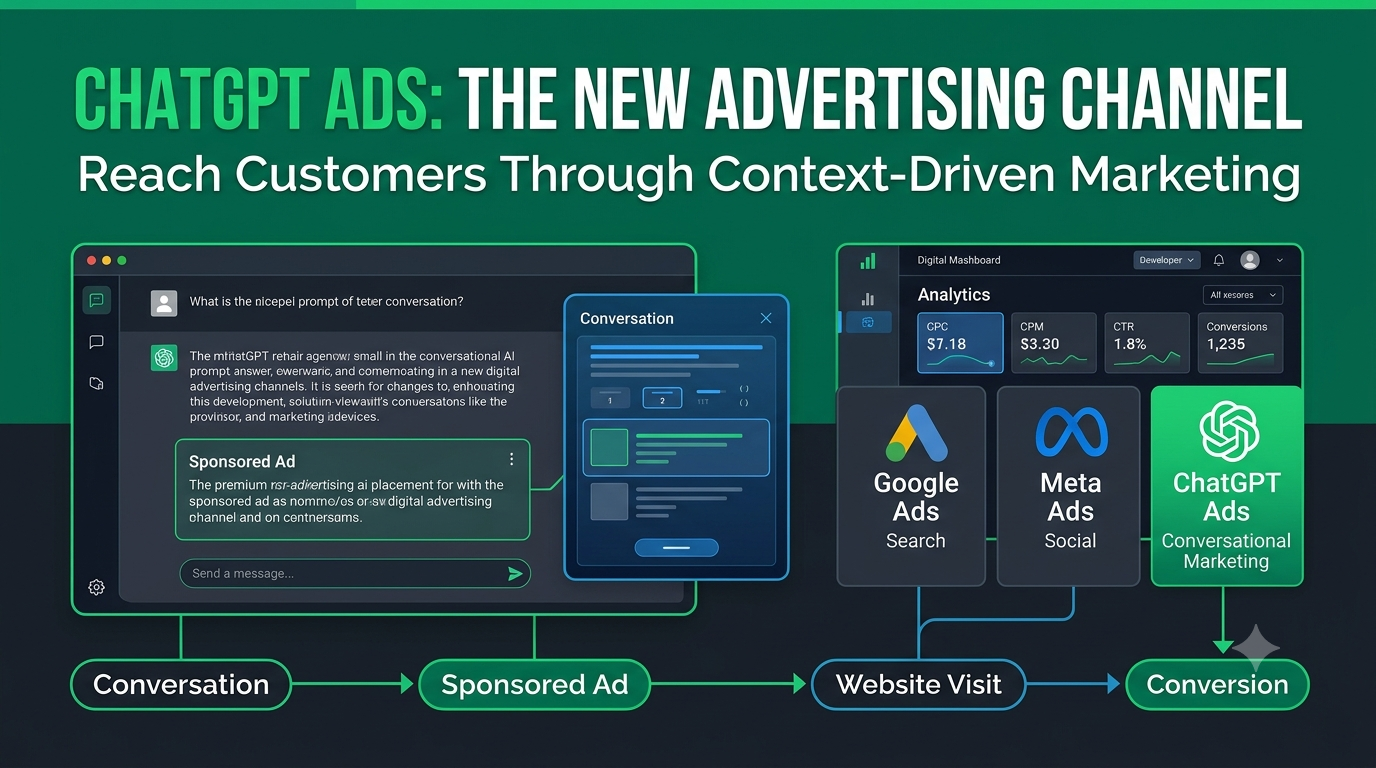
- How ChatGPT Ads Work
- ChatGPT Ads Manager
- ChatGPT Ads vs Google Ads vs Meta Ads
- Why ChatGPT Ads Matter
- Use Cases by Business Type
- Building a ChatGPT Ad Campaign
- Creating Effective ChatGPT Ad Copy
- AI, SEO, AEO and GEO
- Attribution, Privacy and Brand Safety
- How Kiefads Can Help
- ChatGPT Ads FAQs
What Are ChatGPT Ads?
ChatGPT Ads are paid placements that can appear below the end of a ChatGPT response. They are clearly labelled as sponsored and visually separated from the model’s organic answer. An ad may include an advertiser name, a logo or favicon, a headline, a description, image creative and a link to a landing page.
There is an important distinction:
- ChatGPT response: the answer generated by ChatGPT.
- ChatGPT ad: a paid placement from an advertiser.
OpenAI states that ads run on systems separate from the chat model. Advertisers cannot shape, rank or alter ChatGPT’s responses, and seeing an ad does not mean OpenAI endorses the advertiser or its products.
That separation matters. It keeps the organic answer independent from advertising while giving brands a transparent paid route to reach relevant audiences.
Why ChatGPT Ads Differ
Traditional search ads generally respond to keywords. A person might search:
“Best CRM software for small business”
A ChatGPT interaction can be much richer:
“I run a 20-person SaaS company. We use spreadsheets to track leads, but our sales team is growing. What CRM should we consider if we want something affordable and easy to implement?”
The second example offers far more than a category signal. It reveals company type, team size, current workflow, pain point, budget sensitivity, desired outcome and implementation concern.
| Factor | Traditional Search Ads | ChatGPT Ads |
|---|---|---|
| Core environment | Search results | Conversational AI |
| Primary signal | Keyword and search query | Conversation, intent and context |
| Typical interaction | Short query | Multi-turn discussion |
| Intent | Inferred from keywords | Expressly described by the user |
| Journey | Search, then click | Explore, compare, decide, then click |
| Marketing emphasis | Query focused | Context focused |
OpenAI says ad relevance can consider the context and intent of the current conversation, alongside the advertiser’s landing page, title, copy, context hints and targeting choices. If personalized ads are enabled, select signals from a user’s broader ChatGPT experience may also be considered.
How ChatGPT Ads Work
1. A user starts a conversation
The process begins when someone asks ChatGPT a question, explains a challenge, researches a product category or asks for help deciding.
2. ChatGPT recognizes intent and context
A query is what the person literally asks. Intent is the outcome they want. Context includes the details that make an answer more relevant, such as location, timeline, budget, preferences, requirements, industry, product category and pain points.
For example, “best running shoes” is a query. A runner who says they run 20 miles a week, have flat feet and need a durable training shoe gives the system much more to work with.
3. The ads system assesses relevance
OpenAI’s advertising system can evaluate the current conversation’s context and intent, the advertiser’s landing page, headline and copy, context hints, targeting selections and bids.
Advertisers do not receive a person’s chats, chat history, memories or personal details. They receive aggregated, non-identifying performance data such as views and clicks.
4. A relevant ad appears
When there is an eligible match, one or more sponsored units may appear below the ChatGPT response. The placements are labelled and visually separated from the organic response.
5. The user chooses whether to interact
A user may click through to a website, investigate a product, compare options, request a demo, complete a form, make a purchase or simply keep researching.
6. The advertiser measures results
Marketers can assess impressions, clicks, CTR, CPC, conversions, conversion rate, CPA, cost per lead, revenue, ROAS and downstream business outcomes. The right metric depends on the campaign objective.
ChatGPT Ads Manager
OpenAI Ads Manager (currently in beta) lets advertisers:
- Create campaigns and choose objectives
- Set budgets and start and end dates
- Target countries and supported platforms
- Create ad groups and develop creative
- Use custom audiences where available
- Configure conversion events for conversion-focused campaigns
Campaigns can use daily or campaign-total budgets. Advertisers can target supported platforms including Android app and web, iOS app and web, and desktop web. Targeting availability varies by market, and new product feed campaigns currently use country-level geographic targeting and exclusions.
OpenAI currently supports three core campaign objectives:
| Objective | How It Is Priced | Best Use |
|---|---|---|
| CPM | Cost per 1,000 impressions | Awareness, scale, reach and visibility |
| CPC | Cost per valid click | Website traffic, engagement and consideration |
| oCPC | Cost per valid click, optimized toward a conversion | Leads, sales, sign-ups and other tracked downstream actions |
Conversion-optimized CPC (oCPC) helps the system seek clicks more likely to produce a selected conversion event. Advertisers pay for valid clicks rather than for conversions themselves.
ChatGPT Ads vs Google Ads vs Meta Ads
| Factor | Google Ads | Meta Ads | ChatGPT Ads |
|---|---|---|---|
| Core environment | Search | Social media | Conversational AI |
| Primary signal | Search intent | Audience, interests and behavior | Conversation intent and context |
| User mindset | Searching for an answer | Browsing and discovering | Exploring and deciding |
| Creative importance | High | Very high | High |
| Context depth | Moderate | Audience led | Potentially high |
| Strongest use | Capturing existing demand | Creating and influencing demand | Supporting research and decision making |
| Funnel role | Demand capture | Demand creation | Intent and context capture |
| Key limitation | Short queries may lack detail | Intent may not be immediate | New channel with limited historical benchmarks |
ChatGPT Ads should not be positioned as a replacement for Google Ads or Meta Ads.
Google remains central for keyword-led demand capture. Meta remains a powerful channel for audience development, creative testing and demand generation. ChatGPT can add another consideration stage for brands whose customers research, compare and ask detailed questions before converting.
The real opportunity is less about choosing one platform over another and more about understanding where each channel fits.
Why ChatGPT Ads Matter
1. High-intent conversations
People often use AI assistants because they have a specific problem to solve. They may be looking for a product, evaluating a service, weighing alternatives or seeking guidance before committing to a purchase. Someone asking for a CRM for a 20-person SaaS company has already given you more commercial context than someone searching “CRM software.”
2. Richer context
A single conversation can surface details marketers rarely get from a keyword alone: budget, preferences, deadlines, location, required features, pain points and category knowledge.
3. Relevance beyond broad targeting
Conversational advertising can move beyond broad demographic or interest targeting toward relevance shaped by what a person is actively trying to achieve. That doesn’t eliminate the need for audience strategy. It adds another contextual layer.
4. An emerging customer touchpoint
ChatGPT may become part of the discovery and consideration path alongside Google, YouTube, Instagram, Facebook, TikTok, Amazon, Reddit, review platforms and brand websites.
For early adopters, the opportunity isn’t guaranteed scale. It is the ability to learn while the channel and its benchmarks are still developing.
Use Cases by Business Type
- E-commerce: Product discovery, category education, seasonal offers, gift ideas, product comparison and high-consideration purchases such as electronics, furniture, sporting goods or beauty products.
- SaaS: CRM tools, project management platforms, marketing software, analytics platforms, AI tools and business applications that require feature comparison or implementation research.
- B2B: Enterprise software, consulting, professional services, business technology and lead generation where prospects have complex needs and lengthy decision cycles.
- Healthcare: Compliant promotion of services, provider education or non-sensitive health products. Advertisers must avoid misleading claims and follow all legal, platform and category-specific requirements.
- Financial services: Fintech tools, banking products, financial software and business services may be relevant, subject to regulatory compliance, responsible claims and strict eligibility requirements.
- Travel and hospitality: Hotels, destinations, tours, experiences and itinerary-related products suit research-heavy decision journeys.
- Local businesses: Restaurants, dental practices, legal services, home services and local professional firms can benefit when campaigns align with local needs, high-intent services and strong location landing pages.
OpenAI states that ads are not eligible near sensitive or regulated conversation topics, including personal health, mental health and politics. Some health and financial advertisers may be eligible if they meet strict criteria, but political advertising is not currently allowed.
Building a ChatGPT Ad Campaign
1. Define the business objective
Choose the outcome that matters most: awareness, traffic, leads, sales, purchases or another measurable conversion. The objective should shape the campaign structure, budget, creative, landing page and reporting model.
2. Identify valuable conversations
Move beyond keyword lists. Ask:
- What problem causes someone to look for this product?
- What barriers stop them from buying?
- Which use cases, needs or buying stages matter most?
- What information will help them decide?
3. Structure ad groups around customer needs
Organize ad groups around customer problems, product categories, use cases, industries, buying stages or commercial intent themes. OpenAI recommends using multiple ad groups to test different value propositions and messaging approaches.
4. Develop multiple creative variations
Don’t rely on one message. Test price, ease of use, product features, outcomes, industries, customer types and seasonal relevance.
5. Build landing pages that match
The message should stay coherent from ad to landing page. If the ad promotes affordable CRM for growing SaaS teams, the landing page should reinforce that specific value proposition rather than send visitors to a generic homepage.
6. Set up tracking and optimize
Use reliable conversion tracking before making decisions about performance. Monitor delivery, conversion quality, cost per outcome and assisted impact, not just clicks.
Creating Effective ChatGPT Ad Copy
The strongest copy is specific, useful and relevant to the situation being explored. Avoid generic claims such as “The best solution for your business” or “World-class, revolutionary technology” unless the statement is properly supported. Instead, articulate a clear problem and benefit.
| Copy Angle | Example |
|---|---|
| Price | Affordable CRM for growing sales teams |
| Ease of use | Launch your sales CRM in days, not months |
| Feature | Automate lead tracking and follow-ups |
| Industry | CRM software built for SaaS sales teams |
A useful ad should feel like a relevant next step, not an interruption. Someone comparing CRM options may respond better to a message about implementation time and ease of use than to a broad claim about being the “best” platform.
Match copy to the likely decision stage:
- Early exploration: educational
- Consideration: comparative
- Close to conversion: action-oriented
AI, SEO, AEO and GEO
AI-native advertising changes the advertising sequence. Instead of the traditional path of keyword, search, ad and click, the path becomes conversation, context, relevant ad and click. This can support contextual relevance, automated optimization, creative variation and more informed media planning.
However, paid AI advertising is only one part of visibility in AI-driven journeys.
- SEO supports visibility in search results.
- Answer Engine Optimization (AEO) focuses on making information easier for answer-focused systems to surface.
- Generative Engine Optimization (GEO) focuses on improving brand and content visibility in generative AI experiences.
ChatGPT Ads should not replace SEO. A stronger approach combines paid placements with organic visibility across search and AI platforms.
Brands still need strong website authority, clear brand entities, structured content, useful product and service pages, accurate product feeds where applicable, and content that genuinely helps people solve problems.
Attribution, Privacy and Brand Safety
ChatGPT Ads may contribute to multi-touch customer journeys. A user could see an ad, visit a website, later search Google for the brand and then convert. Last-click attribution may credit Google even if the ChatGPT placement started the consideration process.
Marketers should therefore examine:
- Assisted conversions
- Branded search changes
- Pipeline influence
- New customer growth
- CAC and lifetime value
- Cross-channel results alongside CTR
OpenAI states that users can manage ad personalization, dismiss or report ads, and learn why an ad was shown. Advertisers do not receive users’ chats, history, memories, personal details, precise location or sensitive information. Ads are not shown to accounts identified as belonging to people under 18.
How Kiefads Can Help
Kiefads can help brands assess whether ChatGPT Ads fit their audience, customer journey, category and growth objectives. An AI advertising strategy with Kiefads may include:
- Channel assessment, audience research, competitor analysis and campaign planning
- ChatGPT Ads campaign setup, ad group architecture, creative development, budget allocation and optimization
- Integrated Google Ads, Meta Ads and ChatGPT Ads media strategy
- SEO, AEO, GEO, content optimization, and brand and entity visibility
- Conversion tracking, attribution analysis, performance reporting and cross-channel insights
Contact Kiefads today to find out whether ChatGPT Ads belong in your marketing mix.
ChatGPT Ads FAQs
1. What are ChatGPT Ads?
Sponsored placements displayed separately from ChatGPT’s organic responses.
2. Where do ads in ChatGPT appear?
Below the end of a ChatGPT response when there is a relevant, eligible match.
3. Do ads influence ChatGPT’s answers?
No. OpenAI states that ads are separate from the chat model and advertisers cannot influence ChatGPT’s responses.
4. Who can advertise on ChatGPT?
Availability varies by country and may change as the program expands. Interested businesses can register through OpenAI Ads and check current availability.
5. What targeting options are available?
Campaign setup supports country targeting, location targeting in certain markets, platform targeting and optional custom audience inclusions or exclusions. Availability depends on market and campaign type.
6. How much do ChatGPT Ads cost?
Cost depends on campaign type, budget, bid dynamics, delivery and competition. Advertisers can currently choose CPM, CPC or oCPC objectives.
7. Are ChatGPT Ads like Google Ads?
Both can reach commercially relevant intent, but Google Ads is primarily query and keyword led, while ChatGPT Ads are designed for a conversational, context-informed environment.
8. Can ChatGPT Ads replace Google Ads or Meta Ads?
No. Evaluate them as a complementary channel within a broader paid media strategy.
9. Are ChatGPT Ads useful for B2B companies?
They may suit B2B businesses with complex products, longer research cycles, multiple decision makers or detailed implementation requirements.
10. Should small businesses advertise on ChatGPT?
Start with a focused test once the platform is available in your market: one clear goal, a defined customer problem, relevant creative, a strong landing page and reliable conversion tracking.
11. How can marketers get started?
Define a measurable objective, map customer problems and high-value conversations, create varied messages, implement tracking and compare outcomes against other paid channels.
So, What Does This Mean for Marketers?
ChatGPT Ads are not simply another PPC platform. They represent a move toward conversational, context-driven advertising, where people can describe what they need instead of reducing intent to a few keywords.
The smart starting point probably isn’t “How much should we spend?” It is “Which customer conversations could actually lead to a sale?”
Kiefads can help you assess that opportunity across paid media, SEO, AI visibility, content, measurement and customer acquisition. If ChatGPT is becoming part of how your customers research, it may be worth testing what that means for your brand.