
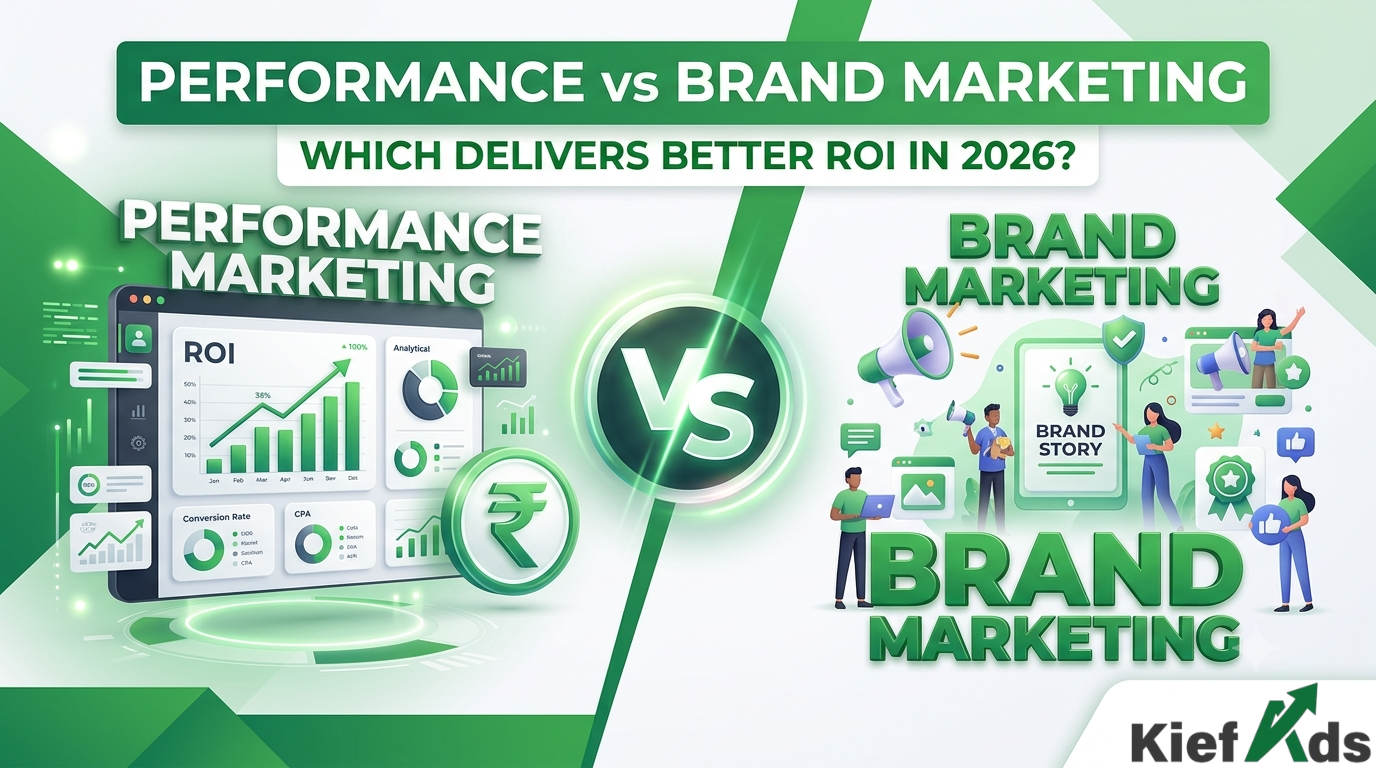
If you have ever sat in a marketing budget meeting and heard someone ask, “Should we spend more on brand or on performance this year?”, you already know how heated the debate can get. In 2026 it matters more than ever. Digital ad costs in India keep climbing, attention spans keep shrinking, and every platform promises “AI-powered growth.”
At Kiefads, we work with Indian businesses that are trying to answer one question: where should the next rupee of the marketing budget go? Should it fund performance marketing campaigns that bring leads and sales right now, or brand marketing that builds trust, recall and long-term equity?
This guide explains both approaches in simple language, compares their ROI potential in the Indian market in 2026, and helps you decide what fits your business, whether you are a startup in Bengaluru, a D2C brand in Mumbai, a manufacturer in Gujarat or a service business in Delhi NCR.
In this guide:
- What is performance marketing?
- What is brand marketing?
- Key differences at a glance
- Which delivers better ROI in 2026?
- What is changing in the Indian market
- Budget split by business stage
- How to build a performance marketing strategy
- How to build a brand without wasting money
- Common mistakes Indian brands make
- Why choose Kiefads
- FAQs
What Is Performance Marketing?
Performance marketing is a results-driven approach where you pay for measurable actions such as clicks, leads, app installs, calls, WhatsApp enquiries or sales. Every rupee is tracked, tested and optimised against a specific outcome.
Common channels in India include:
- Google Ads (Search, Performance Max, YouTube, Display)
- Meta Ads (Facebook and Instagram, including Advantage+ campaigns)
- Marketplace advertising on Amazon, Flipkart, Myntra, Nykaa and Meesho
- Affiliate and influencer performance campaigns
- Programmatic and connected-TV advertising
- Click-to-WhatsApp and lead-form campaigns, which suit India’s mobile-first buyers
The biggest appeal is accountability. You can see how many leads a campaign generated, what your cost per acquisition (CPA) or cost per lead (CPL) was, and whether the campaign paid for itself. That is why performance marketing has become the default choice for Indian businesses that need fast, trackable growth.
What Is Brand Marketing?
Brand marketing (or brand building) creates recognition, trust and emotional connection over time. It covers storytelling, TV and OTT commercials, PR, sponsorships, out-of-home (OOH) advertising, creator collaborations, thought-leadership content and a consistent visual and verbal identity.
Its goal is not necessarily an immediate click or sale. Its payoff shows up months or years later:
- Higher brand recall and top-of-mind awareness
- Better conversion rates on your performance campaigns
- Customers who pick you over a cheaper rival because your name feels familiar and trustworthy
- More pricing power and stronger repeat purchase
In a country where trust drives buying decisions, from a first-time online shopper in a Tier-2 city to a B2B buyer comparing vendors, brand marketing carries real weight.
Performance Marketing vs. Brand Marketing: Key Differences
| Factor | Performance Marketing | Brand Marketing |
|---|---|---|
| Goal | Immediate, measurable action | Long-term recognition and trust |
| Timeframe | Days to weeks | Months to years |
| Measurement | Clicks, leads, sales, CAC, ROAS | Awareness, recall, sentiment, share of search |
| Budget flexibility | Highly flexible, can scale or pause daily | Needs sustained investment |
| Risk | Lower, easy to test in small budgets | Higher, harder to prove in the short term |
| Typical channels | Google Ads, Meta Ads, marketplaces, affiliates | PR, OOH, video storytelling, sponsorships, content |
| Best for | Lead generation, e-commerce, D2C, local services | Category leadership, premium positioning, trust |
Neither approach is “better” in isolation, because they solve different problems. The real question for 2026 is which one delivers stronger ROI in digital marketing given today’s conditions.
Which Delivers Better ROI in 2026?
The answer depends on your business stage, but a clear pattern holds for most small and mid-sized Indian businesses.
1. Performance marketing wins on short-term, trackable ROI
Smarter bidding, better attribution and automated formats like Google Performance Max and Meta Advantage+ mean performance marketing now delivers faster and more precise ROI than it did a few years ago. You can see revenue per campaign, per keyword and even per ad creative.
For businesses that need cash flow and quick customer acquisition, performance marketing is the most efficient starting point. A well-structured campaign can often show measurable results within 30 to 60 days, something brand marketing cannot match in the short term. (Timelines vary by industry, ticket size and sales cycle.)
2. Brand marketing wins on sustainable, compounding ROI
Performance marketing has a ceiling. When you only fish in the “ready to buy now” pool, you compete with every other advertiser for the same small audience, and auction costs rise.
A strong brand changes that. Marketing research and industry experience consistently point the same way: well-known brands tend to see higher click-through and conversion rates, lower acquisition costs and higher customer lifetime value (LTV). In effect, brand marketing makes every performance rupee work harder over time.
3. The 2026 reality: integration beats isolation
The businesses winning in 2026 are blending both. Performance captures existing demand. Brand creates future demand. If you only do the first, you eventually run out of people who already know you. If you only do the second, you cannot prove what is working.
The honest answer from Kiefads: performance marketing delivers faster ROI, brand marketing delivers bigger ROI, and the smartest 2026 budgets use both.
What Is Changing in the Indian Market in 2026
Several shifts are shaping how Indian brands should think about this choice:
- Rising ad costs. More advertisers are competing on Google and Meta, so cost per click and cost per lead keep rising in crowded categories such as education, real estate, finance, fashion and beauty. Brands now demand accountability from every campaign.
- AI-driven targeting and creative. Platforms automate bidding, audience selection and creative testing. This helps, but it rewards brands with strong data and strong creative, and it punishes those relying on automation alone.
- Mobile-first, vernacular India. Buyers in Tier-2 and Tier-3 cities increasingly discover brands through short video, regional-language content and WhatsApp. Communication in Hindi and regional languages often outperforms English-only messaging.
- UPI, quick commerce and trust. Smooth payments and fast delivery have raised customer expectations. Brand trust now decides who gets the first order.
- First-party data and privacy. With third-party tracking under pressure globally and India’s data protection rules (the DPDP Act) maturing, brands need their own customer data from forms, CRM, WhatsApp and loyalty programmes.
- Leaner budgets and demand for quick wins. Many businesses want fast, provable returns before committing to long-term brand plays.
This is why growth-minded Indian businesses now look for a performance marketing agency in India that can prove ROI with real numbers, not just impressive-looking decks.
How Much Should You Spend on Each? A Budget Split by Business Stage
There is no universal formula, but these ranges are a practical starting point:
| Business Stage | Performance Marketing | Brand Marketing | Why |
|---|---|---|---|
| Early-stage startup (0 to 1 year) | 70 to 80% | 20 to 30% | Prove demand and generate cash flow first. Keep a consistent identity from day one. |
| Growth-stage brand (1 to 4 years) | 60 to 70% | 30 to 40% | Acquisition costs begin to rise, so brand starts lowering them. |
| Established brand | 40 to 50% | 50 to 60% | Strong demand already exists, so protect share and pricing power. |
Adjust these based on your industry, margins, sales cycle and competition. A B2B manufacturer with a long sales cycle needs a different mix from a D2C skincare brand with impulse purchases. Review the split every quarter.
How to Build a Winning Performance Marketing Strategy in 2026
Here is a simple framework to follow:
- Define one primary KPI (leads, sales, app installs or qualified calls) before you spend a single rupee.
- Fix your landing pages and tracking first. Slow, confusing pages waste budget. Set up GA4, conversion tracking and CRM integration properly.
- Collect first-party data through forms, WhatsApp opt-ins, quizzes and loyalty programmes.
- Test creatives aggressively. Ad fatigue now happens faster, so refresh creatives every 2 to 3 weeks and test hooks, formats and languages.
- Use AI bidding, but keep human strategy on top. Full automation with no oversight burns budget quietly.
- Track the full funnel. Look beyond clicks and cheap leads. Measure lead quality, cost per qualified lead, customer acquisition cost (CAC), ROAS and LTV.
- Close the loop with sales. Especially in B2B, real estate and education, compare lead quality with what your sales team sees.
- Add a light branding layer. A consistent logo, colour palette, tone and offer presentation lifts ad conversion rates measurably.
Social media is a natural bridge between the two worlds. Instagram, YouTube and LinkedIn blend organic content with paid reach, so your social presence directly affects your ad performance and cost efficiency.
How to Build a Brand Without Wasting Money
You do not need a TV budget to build a brand in India. Smart brand marketing in 2026 can include:
- A clear positioning: one sentence on who you serve and why you are different.
- Consistent identity across your website, ads, packaging and social profiles.
- Short-video storytelling on Instagram Reels and YouTube Shorts, including regional-language versions.
- Customer proof: reviews, case studies, before-and-after stories and testimonials.
- Creator and micro-influencer partnerships for credibility at a reasonable cost.
- PR and thought leadership: expert articles, founder stories, local media and industry features.
- SEO and content marketing that builds authority and captures organic demand over time.
- Measurement that fits brand: track branded search volume, direct traffic, share of search, social engagement and repeat purchase rate.
Common Mistakes Indian Brands Make
- Treating performance as the whole strategy. Costs rise, margins shrink and growth stalls.
- Expecting brand campaigns to deliver sales in 30 days. Brand needs time and consistency.
- Chasing cheap leads. A lead costing ₹150 that never buys is more expensive than one costing ₹600 that converts.
- Changing strategy every month. Optimisation needs enough data and time.
- Ignoring creative quality. Targeting is increasingly automated, so creative is the main lever you control.
- Ignoring local language and culture. One English creative rarely works across India.
- Reporting vanity metrics. Impressions and likes do not pay salaries.
Why Choose Kiefads as Your Marketing Partner
Kiefads helps Indian businesses make sense of the performance-versus-brand debate and turn that clarity into revenue growth. We do not just run ads. We build data-backed marketing systems that combine ROI-driven precision with brand consistency.
- Performance expertise across Google Ads, Meta Ads, programmatic and marketplace advertising for businesses in different industries.
- Transparent reporting: real-time visibility into spend, leads and ROI, with no vanity metrics.
- In-house creative and content support, so your campaigns never run out of fresh, high-converting creatives.
- India-first understanding: we know how buyer behaviour differs across metros, Tier-2 and Tier-3 cities, and across Hindi, English and regional audiences.
- Full-funnel capability: SEO, social media, paid performance and branding under one strategy instead of siloed efforts.
- Strategies for your growth stage, not generic templates, whether you are a startup that needs fast, trackable growth or an established brand balancing equity with performance.
Not sure which marketing strategy is right for your business? Get a customised performance + brand strategy from Kiefads. [Get a Free Consultation →]
Frequently Asked Questions (FAQs)
Q1. What is the main difference between performance marketing and brand marketing? Performance marketing focuses on immediate, measurable results such as clicks, leads and sales. Brand marketing focuses on building long-term trust, recall and emotional connection with customers.
Q2. Which gives faster ROI, performance marketing or brand marketing? Performance marketing usually delivers faster and more trackable ROI, often within 30 to 60 days, because every action can be measured and optimised in real time. Brand marketing takes longer but compounds over time.
Q3. Can small businesses in India rely only on performance marketing? Yes, in the early stages. Most small businesses start performance-heavy for quick revenue, then add brand-building as they scale and acquisition costs rise. Even then, keep a consistent identity and good customer reviews.
Q4. How much budget should go to performance marketing vs brand marketing in 2026? A common approach is 60 to 70% to performance and 30 to 40% to brand, adjusted for business maturity, industry and growth goals. Startups often lean 70 to 80% performance, while established brands shift towards brand.
Q5. How do I measure the ROI of brand marketing? Track branded search volume, direct and organic traffic, share of search, social engagement, recall surveys, conversion-rate improvement on performance campaigns and repeat purchase rate. Look at trends over 6 to 12 months, not weeks.
Q6. Which platforms work best for performance marketing in India? Google Ads (especially Search and Performance Max) and Meta Ads are the core for most businesses. Marketplace ads suit e-commerce sellers, and YouTube and WhatsApp-based campaigns work well for reaching mobile-first and regional audiences.
Q7. Is performance marketing suitable for B2B companies? Yes. Google Search, LinkedIn and lead-generation campaigns work well for B2B. Because sales cycles are longer, pair them with content, case studies and brand authority, and track lead quality, not just lead volume.
Q8. Why hire a specialised agency instead of managing ads in-house? An experienced agency like Kiefads brings tested frameworks, better tooling, creative capacity and cross-industry learnings that most in-house teams lack the bandwidth to build from scratch.
Final Thoughts
The performance marketing vs. brand marketing debate will continue through 2026 and beyond. Performance marketing gives you speed, control and measurable ROI. Brand marketing gives you trust, pricing power and lower acquisition costs over time. For most Indian businesses, the best approach is to start with what pays the bills, then invest steadily in what makes growth cheaper.
Kiefads follows this approach as a full-funnel growth partner, combining paid campaigns, SEO, content and branding to deliver sustainable results. If you are looking for a data-driven, ROI-focused marketing strategy built for the Indian market, Kiefads can help you build it.
Use up and down arrow keys to resize the meta box pane.
Use up and down arrow keys to resize the meta box pane.