
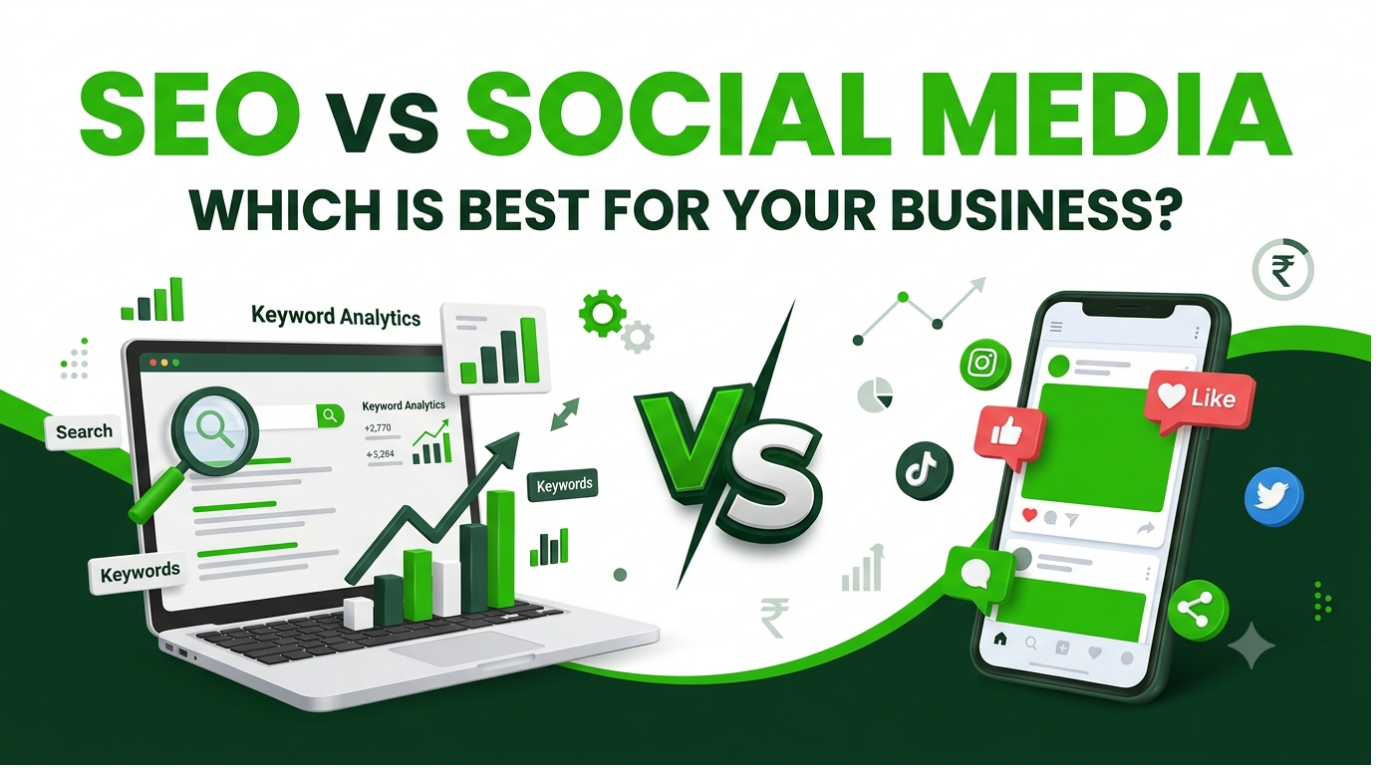
If you run a business in India today, you have probably asked yourself this at least once: should I invest in SEO or focus on social media? With more Indians searching on Google, scrolling Instagram Reels and watching YouTube every day, it’s a fair question. At Kiefads, it’s one of the first things new clients ask us, and the honest answer is that there is no one-size-fits-all.
SEO and social media are not rivals. They are two different roads to the same destination: more visibility, more trust and more customers. But depending on your industry, budget and goals, one may deserve priority over the other, at least in the short term.
In this guide, we break down what SEO and social media marketing do, how they differ, when to choose one over the other, and why most Indian businesses eventually need both. By the end, you’ll have a practical answer for your own business.
What Is SEO and How Does It Work?
Search Engine Optimization (SEO) is the practice of optimizing your website so it ranks higher on search engines like Google when people search for terms related to your business. It rests on three pillars: technical health, quality content, and authority (backlinks and trust signals).
When someone in Jaipur searches “best interior designer near me,” or a founder in Bengaluru searches “affordable CRM software for startups,” strong SEO puts your business in front of them at the moment they are looking for a solution. That is why SEO is so effective for lead generation: you are not interrupting anyone’s day, you are answering a question they already have.
India is also a mobile-first market. Most searches happen on smartphones, often in Hindi, Hinglish or regional languages, so your SEO needs to account for how Indian customers actually search.
SEO has several moving parts:
- On-page SEO: optimizing titles, headings, content, images and internal links.
- Technical SEO: improving site speed (vital on mobile networks), mobile-friendliness, crawlability and structured data.
- Off-page SEO: earning backlinks from relevant, trusted websites to build domain authority.
- Local SEO: optimizing your Google Business Profile and location pages for “near me” and city-based searches. This matters most for clinics, salons, coaching institutes, restaurants, real estate firms and other service businesses.
- Multilingual SEO: targeting Hindi and regional-language keywords to reach audiences beyond English-speaking users.
What Is Social Media Marketing?
Social media marketing means using platforms like Instagram, Facebook, LinkedIn, YouTube and WhatsApp to connect with your audience, build relationships and promote your brand. Unlike SEO, which is usually slow and steady, social media can generate quick engagement and instant feedback.
A well-planned social media strategy usually includes:
- Consistent content (Reels, carousels, posts, Stories, YouTube Shorts)
- Community engagement, including replying to comments and DMs
- Paid social campaigns on Meta platforms and YouTube
- Influencer and creator collaborations
- Scheduling and analytics tools to track performance
Social media is where brand awareness is built. People don’t just discover you there. They get to know your personality, your values and what makes you different. In India, where word of mouth and recommendations drive many buying decisions, that social proof carries real weight.
What Is Social Media SEO?
Social media SEO means optimizing your profiles and posts so people can find you through in-app search on platforms like Instagram, YouTube and Facebook, as well as through Google. In practice, that means:
- Using your main keyword in your username, name field and bio
- Keeping your business name, links and contact details consistent across platforms
- Writing keyword-rich captions and descriptions
- Adding alt text, captions and subtitles to your content
- Using relevant hashtags and location tags
- Optimizing YouTube titles, descriptions and thumbnails for search
More Indian users, especially younger ones, now search directly inside social apps instead of Google. Social media SEO has therefore become just as important as traditional search optimization.
SEO vs Social Media: Key Differences
| Factor | SEO | Social Media |
|---|---|---|
| Time to see results | 3–6 months (long-term) | Days to weeks (short-term) |
| Cost over time | Lower ongoing cost once ranked | Needs continuous effort and ad spend |
| Traffic type | Organic, intent-driven | Interest-driven, browsing |
| Longevity | Long-lasting once ranked | Content has a short lifespan |
| Best for | Search-based discovery | Relationship building and engagement |
| Trust factor | High (users trust search results) | Builds emotional connection |
Long-Term vs Short-Term Results
| Aspect | SEO (Long-Term) | Social Media (Short-Term) |
|---|---|---|
| Growth curve | Slow start, compounding returns | Fast start, needs constant fuel |
| Maintenance | Periodic content updates | Daily or weekly content creation |
| Risk of decline | Low, if maintained | High, if posting stops |
| ROI timeline | 6–12 months for strong ROI | 1–3 months for initial ROI |
Lead Quality Comparison
| Metric | SEO Leads | Social Media Leads |
|---|---|---|
| Intent level | High: the user is actively searching | Varies: often lower initial intent |
| Conversion rate | Generally higher | Moderate, improves with retargeting |
| Cost per lead (long-term) | Lower over time | Can be higher without optimization |
| Nurturing required | Often less | Often more (multiple touchpoints) |
Both feed your overall online visibility, but in different ways. SEO captures people who are already searching for a solution. Social media reaches people who may not yet know they need your product, and sparks their curiosity.
When Should You Prioritize SEO?
SEO usually makes sense first if:
- You run a service-based or local business. If you are a dentist, lawyer, CA, gym, coaching centre or restaurant, people are actively searching Google for “near me” services. Ranking well captures that ready-to-buy intent.
- You want long-term, sustainable growth. SEO compounds. A blog post you publish today can bring traffic for years.
- Your budget is limited. Once you rank, you aren’t paying for every click, which makes SEO one of the most cost-effective channels over time.
- You target specific cities or regions. Local SEO helps you appear when someone in Pune, Lucknow or Chandigarh searches for your service.
- Your product is high-consideration. Education, healthcare, real estate, finance and B2B software buyers research heavily on Google before deciding.
When Should You Prioritize Social Media?
Social media may deserve more attention first if:
- You have a visually appealing product. Fashion, jewellery, food, décor, beauty and lifestyle brands thrive on Instagram and YouTube, where people see the product in action.
- You want quick brand recognition. If you have just launched, a strong social strategy can create buzz within days.
- You rely on community and trust. Comments, shares, reviews and creator endorsements build credibility fast for newer brands.
- You want direct, two-way communication. Instant replies on Instagram DMs and WhatsApp build loyalty.
- You are running seasonal campaigns. Festive sales and wedding-season offers benefit from the speed and reach of social.
Why the Smartest Businesses Use Both
Most people miss that SEO and social media strengthen each other.
- Social signals support SEO. Shares are not a direct Google ranking factor. But more brand searches, backlinks from shared content and higher website traffic from social platforms indirectly help SEO performance.
- SEO content fuels social media. One well-researched blog post can become five Instagram carousels, a LinkedIn article and a YouTube script.
- Social media builds the trust search engines look for. Google’s E-E-A-T guidelines (Experience, Expertise, Authoritativeness, Trustworthiness) favour brands with a consistent, credible presence across the web.
- AI and voice search reward both. With AI-powered search experiences (AEO and GEO), brands showing consistent authority across search and social content are more likely to be surfaced and cited.
So instead of asking “SEO or social media?”, ask: “What is the right mix for my stage of business?”
How to Decide the Right Mix for Your Business
At Kiefads, we recommend a simple three-stage framework:
Stage 1: New business (0–6 months). Lean on social media to build awareness and community, while setting up basic on-page SEO and your Google Business Profile so your website is ready to rank.
Stage 2: Growing business (6–18 months). Shift more budget into content marketing and SEO to capture organic, intent-driven traffic, while continuing consistent social media management.
Stage 3: Established business (18+ months). Run both in parallel with roughly equal investment. Use social data to shape your content calendar, and use SEO insights to find what your audience actually searches for.
A good digital marketing agency in India should build strategy around what grows your business, not push one channel because it’s easier to sell.
Common Mistakes Indian Businesses Make
- Treating social media as a replacement for a website. Followers on a platform you don’t own are not a stable asset.
- Expecting SEO results in 30 days. SEO needs patience, and a quick-fix promise is a red flag.
- Ignoring local and regional-language search. Hindi and Hinglish queries are huge opportunities that many competitors overlook.
- Posting without a strategy. Random posting rarely converts. Content should map to a goal.
- Neglecting mobile experience. Slow, clunky mobile sites lose both rankings and customers.
- Not tracking results. Without analytics, you can’t tell which channel is actually producing leads.
Why Choose Kiefads
Kiefads is an India-based digital marketing agency with hands-on experience running SEO and social media campaigns across industries, from local service businesses to eCommerce brands. We don’t treat SEO and social media as separate departments. Our strategists work together so your content, keywords and messaging stay consistent wherever your audience finds you.
Here’s what you can expect when you work with us:
- Transparent monthly reporting, with no vague “trust the process” promises
- A custom strategy based on your industry, audience and competitors
- A content and social media plan built around your brand voice
- Technical SEO audits and ongoing optimization
- Experience across campaigns for 50+ brands in multiple sectors
Ready to grow your online presence? Get in touch with Kiefads today for a free strategy consultation.
Frequently Asked Questions
1. Is SEO more important than social media for Indian businesses?
Neither is inherently more important. SEO is better for long-term, intent-driven traffic, while social media excels at fast brand awareness and community building. The right priority depends on your goals, budget and business stage.
2. Can social media replace SEO?
No. Social posts have a short lifespan and depend on algorithms you don’t control. SEO builds a lasting asset, your website, that keeps generating organic traffic over time.
3. How long does SEO take to show results?
Most businesses see meaningful movement in rankings and traffic within 3 to 6 months, depending on competition, industry and website history.
4. Does social media help my SEO ranking directly?
Not directly. It helps indirectly through increased brand searches, more website visits and additional backlink opportunities when your content gets shared.
5. Which is cheaper, SEO or social media marketing?
SEO usually costs less per lead over the long run because organic rankings keep working without per-click spend. Social media, especially paid campaigns, needs continuous investment to maintain results.
6. Should a small business in India invest in both?
Yes, if the budget allows. A local business benefits from local SEO to appear in nearby searches, combined with social media to build trust and stay visible in the community. If the budget is tight, start with the channel that matches your business type, then add the other as you grow.
7. Is local SEO worth it for businesses outside metro cities?
Absolutely. Competition is often lower in Tier 2 and Tier 3 cities, so well-optimized businesses can rank faster and capture high-intent local customers.
Final Thoughts
SEO vs social media isn’t a competition. Both work best together. SEO gives you long-term visibility, while social media builds fast, human connections. Businesses that combine both thoughtfully tend to grow the fastest.
At Kiefads, we help Indian businesses solve exactly this confusion, whether to start with SEO, social media or both. If you’re not sure where to begin, we’ll build a clear, custom plan for your business rather than a generic template.