
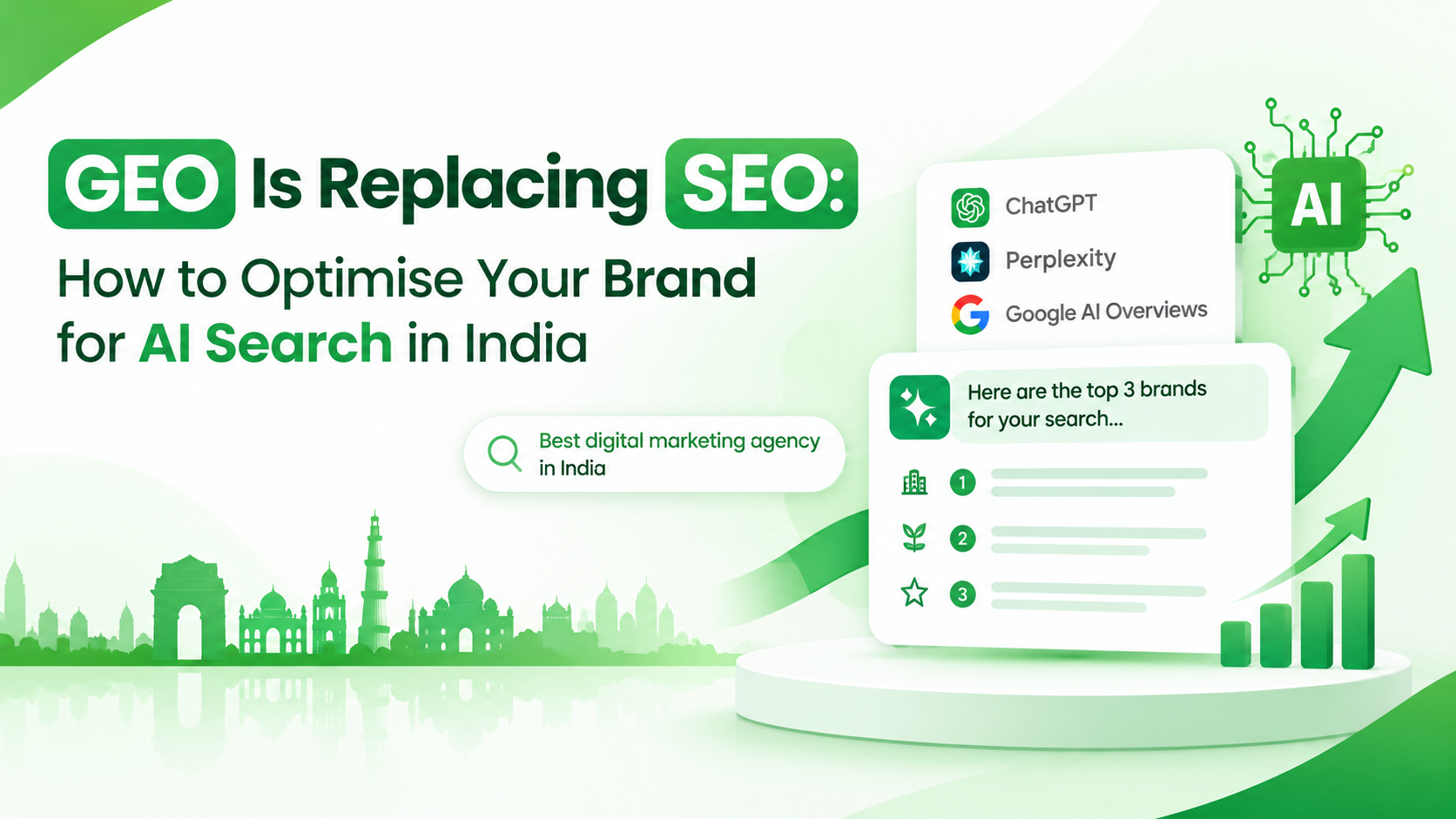
For two decades, digital marketing in India ran on one simple idea: if you want customers to find you, rank on Google. That idea is now being tested. A growing number of people are asking ChatGPT, Perplexity, and Google AI Overviews for recommendations and getting a direct answer instead of a list of links.
Think about how an Indian buyer might search today: “best CRM for small businesses in India,” “top digital marketing agency in Gurugram,” or “which accounting software supports GST filing.” Increasingly, the answer arrives as a short summary naming two or three brands. If yours is not among them, you may never get the visit.
This is where Generative Engine Optimisation (GEO) comes in. In this guide, we explain what GEO is, how it differs from SEO, which tactics work, and how Indian businesses can prepare. Kiefads helps brands build visibility across both traditional search and AI-driven discovery.
What Is Generative Engine Optimisation (GEO)?
GEO is the practice of optimising your brand so that AI systems cite, reference, and recommend you in their generated answers. It is closely related to Answer Engine Optimisation (AEO) and AI search optimisation.
The key difference from SEO is the goal. In SEO, you try to rank a page on a results list. In GEO, you try to become part of the answer itself.
When someone searches on Google, they see multiple links and choose one. When someone asks an AI tool, they receive one synthesised answer that mentions specific brands, tools, and sources. Either your brand appears in that answer or it does not. There is no “position four” on the page.
Why AI Search Matters for Indian Businesses
India is one of the world’s largest internet markets, with a young, mobile-first audience that adopts new technology quickly. Several trends make AI search especially relevant here:
- Rapid AI adoption: Students, professionals, and business owners increasingly use AI assistants for research, comparisons, and buying decisions.
- Voice and conversational search: Many Indians prefer speaking or typing natural, conversational queries, often in Hinglish or regional languages.
- Zero-click behaviour: Informational queries are increasingly answered directly, without the user visiting any website.
- Trust and research culture: Indian buyers compare options, read reviews, and seek recommendations before purchasing, which is exactly what AI tools summarise.
- Growing language support: As AI tools improve in Hindi and other Indian languages, local-language discovery will expand.
Google still dominates search in India, and SEO remains essential. But the share of discovery happening inside AI answers is growing, and brands that ignore it risk losing visibility at the top of the funnel.
GEO vs SEO: Key Differences
| Aspect | Traditional SEO | GEO |
|---|---|---|
| Main goal | Rank pages on search results | Be cited or recommended in AI answers |
| Level of focus | Page-level | Brand and entity-level |
| Key signals | Keywords, backlinks, technical health | Brand mentions, entity clarity, third-party validation, original data |
| Success measure | Rankings, traffic, clicks | Citations, mentions, recommendation frequency |
| Feedback loop | Fairly direct and measurable | Less direct, requires regular testing |
| User behaviour | Clicks through to websites | Reads the answer, may never click |
GEO is not a replacement for SEO. It is an expansion of what SEO means. The two share strong foundations: quality content, technical health, and authority. The difference is where you point those efforts.
How AI Engines Decide Which Brands to Mention
An AI model forms an overall picture of your brand based on everything it has encountered: news articles, industry publications, review sites, forum discussions, social conversations, and your own website. That aggregate picture decides whether the model reaches for your brand when answering a relevant question.
Here is the important part: you cannot optimise a single page to appear in an AI answer. You need to build a web presence that makes your brand a high-confidence signal. Platforms behave differently:
- ChatGPT: Draws on patterns learned in training and can use live web sources when search is enabled.
- Perplexity: Retrieves current web content and displays its sources, so fresh, well-structured pages matter.
- Google AI Overviews: Builds on Google’s index, so strong SEO, structured data, and topical authority help.
Five GEO Tactics That Work
1. Publish Original Research and Data
Data that others cite is one of the most powerful GEO actions. Run a survey, analyse your own customer data, or publish a benchmark. When journalists and bloggers reference your findings, AI systems encounter your brand in many credible contexts.
Ideas for Indian brands:
- An annual report on consumer behaviour or digital adoption in India
- A survey of MSMEs on technology and marketing spend
- A city-wise or state-wise analysis of trends in your industry
- A benchmark study using anonymised platform data
Use clear headings, summary statistics, a named methodology, and a visible publication date so the findings are easy to cite.
2. Earn Coverage in Credible Publications
A mention in a respected publication carries far more weight than many self-published blog posts. Prioritise earned media such as contributed articles, expert commentary, and press coverage of launches and milestones.
Indian outlets to consider:
- Business press: Economic Times, Mint, Business Standard, Moneycontrol, The Hindu BusinessLine
- Startup and tech media: YourStory, Inc42, Entrackr, Analytics India Magazine
- Industry trade publications relevant to your sector
- Regional-language media if you serve audiences outside the metros
Editorial coverage matters more than paid press releases on low-quality sites.
3. Build Entity Consistency Across the Web
Your brand name, description, category, and positioning should say the same thing everywhere. Inconsistent signals confuse AI models and reduce citation likelihood.
Align these touchpoints:
- Website homepage and About page
- LinkedIn company page
- Google Business Profile
- Crunchbase, Tracxn, and startup databases
- Wikipedia and Wikidata, only if your brand meets notability guidelines
- Directories like Clutch, JustDial, Sulekha, and IndiaMART, where relevant
Define your brand in one precise sentence and use the same category term everywhere.
4. Implement Comprehensive Schema Markup
Structured data helps AI systems understand what your business is and what it offers. Prioritise:
- Organization schema with name, logo, address, contact details, and
sameAssocial profile links - Article schema with author and date on all editorial content
- FAQ schema on pages that answer real customer questions
- LocalBusiness, Product, and Service schema where relevant, especially for city-focused businesses
Pair this with fast, mobile-friendly pages, clear headings, and logical internal linking.
5. Answer Specific Questions in Depth
AI systems favour content that is comprehensive and specific. Vague brand copy gets ignored. Create content that directly answers what your customers ask, with real data, examples, and clear recommendations.
For India, this includes:
- “Cost of” and “price in India” content
- Comparison pages (for example, Tool A vs Tool B for Indian businesses)
- City-specific guides
- Content addressing GST, UPI, EMI, compliance, and other local needs
- Hindi, Hinglish, and regional-language versions of high-value pages
Start answers with a clear, direct statement, then expand with detail. This makes your content easier for AI systems to extract and quote.
Do Reviews and Social Discussions Matter?
Yes. Independent validation helps AI systems trust your brand. Encourage detailed, authentic reviews on:
- Google Business Profile
- G2, Capterra, Clutch, and Trustpilot
- Sector-specific platforms such as Practo (healthcare) or AmbitionBox and Glassdoor (employer brands)
- Consumer review sites like MouthShut
Participate genuinely in relevant communities such as Reddit, Quora, and LinkedIn discussions, by providing helpful, honest answers rather than promotion. Never post fake reviews, which violate platform rules and can seriously damage trust.
How to Measure GEO Success
GEO measurement is less direct than SEO, but it is possible:
- List 20 to 30 core buyer questions your customers ask.
- Test them regularly in ChatGPT, Perplexity, and Google AI Overviews.
- Record which brands are mentioned, and whether yours appears, in what context, and with what sentiment.
- Track referral traffic from AI platforms in your analytics where available.
- Monitor branded search volume, which often rises as AI mentions grow.
- Review quarterly and compare against competitors.
AI answers can vary between sessions and over time, so look at patterns rather than single results.
Common GEO Mistakes to Avoid
- Treating GEO as a trick to “game” AI instead of building real authority
- Relying only on your own website for credibility
- Describing your brand differently on every platform
- Publishing generic content with no original data or expert insight
- Buying low-quality press releases in place of earned coverage
- Neglecting technical SEO and schema
- Ignoring regional languages and local intent
- Abandoning SEO entirely (both are needed)
- Expecting results overnight, as authority compounds over months
Why Choose Kiefads for GEO and SEO in India?
Winning in AI search takes strategy, content, technical know-how, and media relationships working together. Kiefads helps Indian startups, SMEs, and established brands build visibility across Google, ChatGPT, Perplexity, and beyond.
Our services include:
- AI search visibility audit: We test how your brand appears across AI platforms and identify gaps against competitors.
- Entity and brand consistency review: We align your presence across your website, profiles, and directories.
- GEO and SEO strategy: A combined roadmap tailored to your category, audience, and target cities.
- Schema and technical SEO: Structured data and site improvements that help both search engines and AI systems.
- Content and original research: Expert-led articles, data studies, and case studies built to earn citations.
- Earned media and thought leadership support: Positioning your founders and experts in credible publications.
- Regional and multilingual optimisation: Content in Hindi, Hinglish, and other Indian languages.
- Tracking and reporting: Regular monitoring of mentions and visibility, with clear next steps.
Ready to make your brand the answer AI recommends? Contact Kiefads today for a consultation and a customised proposal.
Frequently Asked Questions (FAQs)
1. What is GEO (Generative Engine Optimisation)?
GEO is the practice of optimising your brand so AI systems like ChatGPT, Perplexity, and Google AI Overviews cite, reference, and recommend you in their generated answers.
2. Is GEO replacing SEO?
Not entirely. GEO expands what SEO means. Traditional search remains important, especially in India, but a growing share of discovery happens in AI answers. The strongest strategy combines both.
3. What is the main difference between SEO and GEO?
SEO focuses on ranking individual pages in search results. GEO focuses on building brand-level authority so AI systems mention you in synthesised answers.
4. How long does GEO take to show results?
Retrieval-based platforms like Perplexity and Google AI Overviews can reflect improvements within weeks to a few months. Broader brand authority builds more slowly, so plan for at least three to six months of steady effort.
5. Can small businesses and startups in India benefit from GEO?
Yes. AI answers often recommend niche and local specialists. A focused brand with clear positioning, strong reviews, and original insights can be cited alongside much larger competitors.
6. Does schema markup help with GEO?
Yes. Organization, Article, and FAQ schema help AI systems understand your brand and content, though schema works best alongside strong content and third-party signals.
7. Do I need a Wikipedia page for GEO?
It can help, but it is not mandatory, and you should only create one if you meet Wikipedia’s notability rules. Wikidata, Crunchbase, LinkedIn, and consistent directory listings also matter.
8. Does GEO work in Hindi and regional languages?
As AI tools improve their Indian language support, quality content in Hindi and regional languages can help you reach audiences your competitors overlook. Have native speakers review the content.
9. How do I know if my brand appears in AI answers?
Test your core buyer questions regularly across ChatGPT, Perplexity, and Google, and record the results. Kiefads offers structured tracking and reporting.
10. How can Kiefads help with GEO?
Kiefads provides AI visibility audits, entity alignment, schema implementation, content and research, earned media support, and ongoing monitoring, tailored to Indian businesses.
Final Thoughts
AI search is changing how Indian customers discover brands. SEO is not going away, but it is no longer the whole picture. Brands that earn third-party validation, stay consistent across the web, publish original insights, and structure their content well will be the ones AI engines recommend. Start now, because authority compounds over time. With a partner like Kiefads, you can build that advantage with confidence.
Contact Kiefads now and make your brand the answer in AI search.