
Paid media has a repetition problem. Bid adjustments, budget shifts, audience exclusions, creative swaps, and performance reviews all demand constant attention. Done well, they make the difference between profitable and wasteful ad spend. Done manually at any real scale, they eat up strategist time that could be spent on growth.
For Indian advertisers, the pressure is even higher. Cost per click keeps rising in competitive categories like real estate, education, finance, and e-commerce. Festive peaks such as Diwali, Navratri, and big sale events compress weeks of optimisation into days. And many teams are running lean, with one or two people managing several accounts.
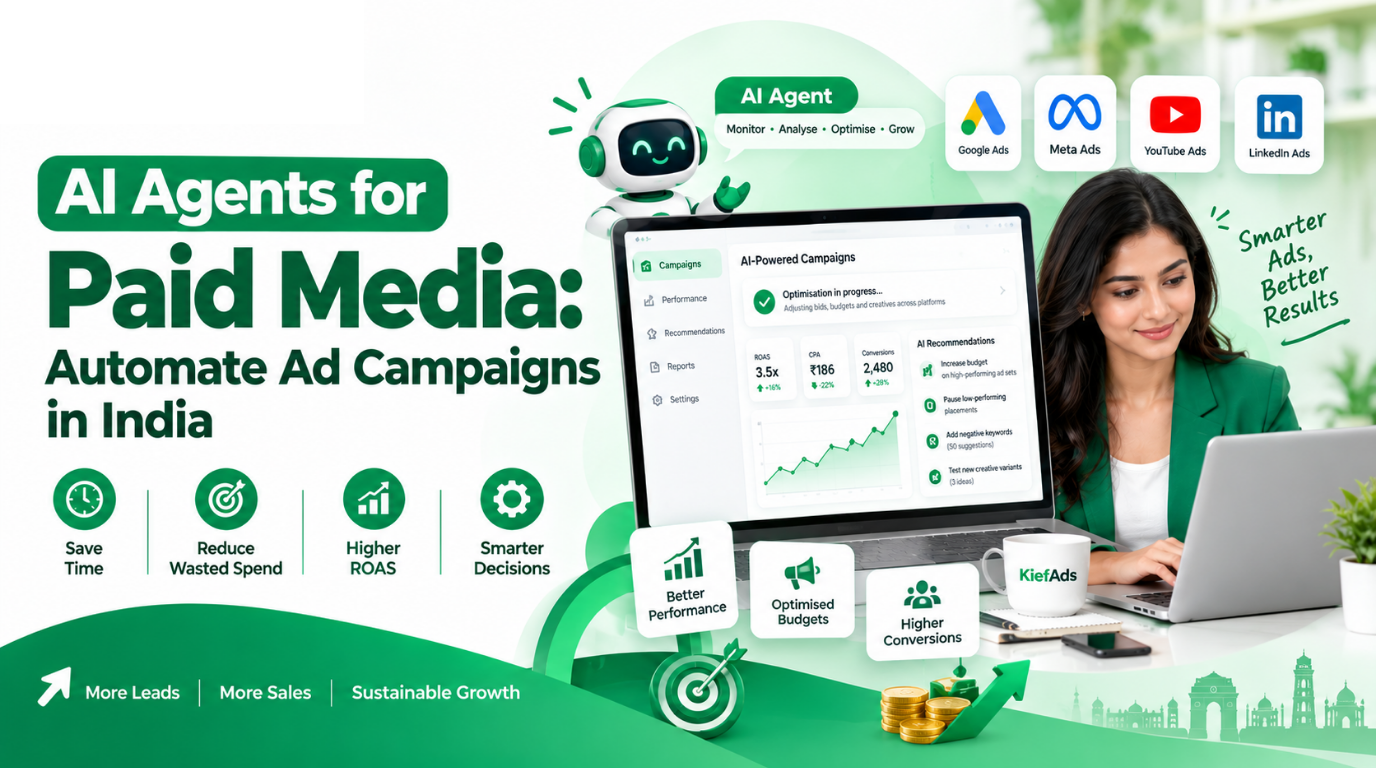
AI agents are starting to solve this. In this guide, we explain what AI agents do in paid media, where they work best, where they fall short, and how Indian businesses can implement them safely. Kiefads helps brands build these workflows with the right guardrails.
What Are AI Agents in Paid Media?
AI-assisted ad management is not new. Google’s Smart Bidding and Meta’s Advantage+ have used machine learning for bidding and audience optimisation for years. What is new is the layer above them: AI agents that can monitor multiple signals, reason about what is going wrong, make cross-platform recommendations, and explain their thinking in plain language.
Think of it this way. Platform automation optimises inside a campaign toward the goal you set. An AI agent asks bigger questions:
- Is this the right goal in the first place?
- Is the budget split across campaigns and platforms sensible?
- Is the creative, not the bid, the real reason performance has dropped?
Platform Automation vs AI Agents
| Aspect | Platform-native automation (Smart Bidding, Advantage+) | AI agents |
|---|---|---|
| Scope | Within one campaign or platform | Across campaigns, platforms, and reports |
| Main job | Optimise toward a set objective | Monitor, diagnose, recommend, and act |
| Questions the goal itself | No | Yes, flags when targets look wrong |
| Explains decisions | Limited | Plain-language reasoning |
| Cross-platform budget decisions | No | Yes, within defined guardrails |
The two work best together. Platform tools handle real-time auctions. Agents handle the strategic layer on top.
What a Paid Media Agent Does in Practice
A well-configured agent might:
- Check performance every morning across Google Ads, Meta, and LinkedIn.
- Flag campaigns that missed their ROAS or CPL target by more than a set threshold, for example 15%.
- Diagnose the cause, whether bid-related, audience-related, creative-related, or tracking-related.
- Act or escalate, either making a pre-approved adjustment or sending a suggested fix to a human for approval.
- Report in plain language, summarising what changed, why, and what to do next.
This replaces the daily check-in that a paid media specialist might spend an hour or more on, and it runs every day without fatigue or missed days.
Where AI Agents Outperform Manual Management
High-Volume Google Search Campaigns
With hundreds or thousands of keywords, manual management cannot keep up at the granularity that matters. Agents connected to the Google Ads API can:
- Monitor Quality Scores and flag falling ones
- Find search terms to add or exclude as negatives
- Adjust bids by hour of day, device, and location
- Spot wasted spend on irrelevant queries, including Hinglish and misspelled variations common in Indian search
E-commerce Retargeting
First-party data, audience segments, and dynamic creative make retargeting ideal for agents. They can identify which segments convert, exclude people who already purchased, and rotate creative based on engagement, without waiting for a weekly review. This is especially useful for D2C brands and marketplace sellers running always-on retargeting.
Cross-Platform Budget Allocation
Most Indian advertisers split budgets across Google, Meta (Facebook and Instagram), YouTube, and LinkedIn for B2B. Most agencies rebalance once a week at best. An agent can recommend shifts daily, based on actual ROAS or cost per lead, and execute within limits you define.
Festive and Sale Season Campaigns
During Diwali, Big Billion Days-style sale windows, or end-of-season sales, performance can change within hours. Agents can watch pacing, catch budget exhaustion early, and flag creatives that are fatiguing, so you do not discover the problem a day too late.
Lead Generation Campaigns
For real estate, education, healthcare, and financial services, agents can monitor lead quality as well as lead volume. They can flag campaigns producing cheap but unqualified leads, and connect with CRM data to optimise toward qualified leads or sales rather than form fills.
What Works and What Doesn’t
Agents work best for tasks that are data-driven and rules-based, even when the rules are complex:
- Performance monitoring and anomaly detection
- Bid and budget adjustment recommendations
- Search term and audience analysis
- Reporting and insight summaries
- A/B test tracking and result interpretation
Agents work less well for tasks needing deep business context:
- Creative strategy and concept development
- Landing page design and messaging
- Brand positioning and campaign narrative
- Judgment calls on pricing, offers, and market timing
Agents also struggle when tracking is broken. If your conversion tracking is inaccurate, an agent will confidently optimise toward the wrong numbers. Fix measurement first.
How to Implement AI Agents Safely
Most failures happen when teams give agents too much freedom too quickly. A safer rollout looks like this:
Stage 1: Read and recommend. The agent analyses and suggests. A human reviews and approves every change. Use this stage to learn what “good” looks like in your account.
Stage 2: Limited automation. Once recommendations prove reliable, allow the agent to execute narrow, low-risk actions, such as adding clearly irrelevant negative keywords or pausing ads with severe disapprovals.
Stage 3: Guardrailed autonomy. Expand to broader actions with firm limits, such as:
- Maximum daily budget change (for example, no more than 20%)
- Hard spend caps per campaign
- Minimum data thresholds before any change is made
- Mandatory human approval for new campaigns, large budget shifts, or anything touching brand-sensitive messaging
- A full log of every action, with the ability to roll back
Always keep a human accountable. The agent assists; a strategist owns the results.
Prerequisites Before You Start
- Accurate conversion tracking: Google Tag Manager, GA4, Meta Pixel, and Conversions API set up correctly
- Clean account structure: Logical campaigns, naming conventions, and audience definitions
- Clear targets: Defined ROAS, CPA, or CPL goals tied to real business economics
- Data access: API connections to ad platforms, analytics, and ideally your CRM or e-commerce backend
- Documented rules: Written guidelines about what the agent may and may not do
India-Specific Considerations
- Compliance: Follow ASCI guidelines on advertising claims and influencer disclosures, and be extra careful with regulated sectors like healthcare, finance, and education.
- Data privacy: Handle customer data in line with India’s Digital Personal Data Protection Act, 2023, and avoid sharing personal data with tools that lack proper safeguards.
- Language and region: Test creative in Hindi, English, Hinglish, and regional languages. Agents can flag which language and region combinations perform best.
- Mobile-first behaviour: Most Indian traffic is on mobile, so agents should monitor mobile landing page speed and conversion separately.
- Payment and trust factors: Cash on delivery, UPI, and EMI options can strongly affect conversion rates, and creatives should reflect them.
- Budget sensitivity: Many Indian advertisers work with modest budgets, so guardrails around daily spend and learning phases matter even more.
The ROI Case
You do not need a huge budget for the numbers to make sense. Consider a simple example:
A business spends ₹5,00,000 per month on ads at a 3x ROAS, generating ₹15,00,000 in revenue. If better monitoring and optimisation lifts ROAS to 3.5x, revenue rises to ₹17,50,000 from the same spend. That is ₹2,50,000 in additional monthly revenue.
This is an illustrative example, not a guaranteed result. Actual outcomes depend on your industry, account health, margins, and how well the system is set up.
Beyond performance, there is the time saved. Hours previously spent on monitoring and reporting can go toward creative testing, landing page improvements, and growth strategy.
Common Mistakes to Avoid
- Giving agents full autonomy before establishing baselines
- Automating on top of broken or unreliable tracking
- Optimising only for cheap leads instead of qualified leads or sales
- Having no spend limits or rollback process
- Expecting agents to replace creative strategy
- Ignoring regional language and local audience differences
- Treating automation as “set and forget”
Why Choose Kiefads for AI-Powered Paid Media in India?
Strong paid media results come from combining smart technology with experienced strategists. Kiefads helps Indian startups, D2C brands, and established businesses build paid media workflows that are efficient, transparent, and accountable.
Our services include:
- Paid media and tracking audit: We review account structure, measurement accuracy, and wasted spend.
- AI agent workflow design: Monitoring, diagnosis, and recommendation systems tailored to your goals and platforms.
- Google Ads, Meta Ads, YouTube, and LinkedIn management: Hands-on execution backed by automation.
- Cross-platform budget strategy: Data-led allocation with clear guardrails.
- Creative testing frameworks: Structured testing for ad copy, visuals, and videos, including regional language versions.
- Reporting and insights: Clear dashboards and plain-language summaries focused on business outcomes.
- Human oversight at every stage: Strategists review and own decisions, with transparent action logs.
Want to see what AI-assisted paid media could do for your account? Contact Kiefads today for a consultation and a customised plan.
Frequently Asked Questions (FAQs)
1. What are AI agents in paid media?
They are AI systems that monitor ad performance across campaigns and platforms, diagnose problems, recommend or make changes, and explain their reasoning, working above the built-in automation of Google and Meta.
2. How are AI agents different from Smart Bidding or Advantage+?
Smart Bidding and Advantage+ optimise within a campaign toward your set goal. AI agents work at a strategic level, checking whether goals, budgets, and creatives make sense across campaigns and platforms.
3. Will AI agents replace my paid media team?
No. They take over repetitive monitoring so strategists can focus on creative, strategy, and growth. Human judgment is still essential.
4. Can small businesses in India use AI agents for ads?
Yes. Even modest budgets benefit from faster monitoring and fewer wasted clicks, provided tracking is accurate and guardrails are in place.
5. Is it safe to let AI make changes to my ad account?
It can be, with a staged approach: start with recommendations only, move to limited actions, and always set spend caps, approval rules, and activity logs.
6. Which campaigns benefit most from AI agents?
High-volume search campaigns, e-commerce retargeting, cross-platform budget allocation, and fast-moving festive or sale campaigns benefit most.
7. What do I need before starting?
Accurate conversion tracking, a clean account structure, clear performance targets, and API access to your ad platforms and ideally your CRM.
8. How much does AI-powered paid media management cost in India?
Costs depend on ad spend, number of platforms, and scope of work. Kiefads provides customised proposals based on your budget and goals.
9. How long before I see results?
Early efficiency gains, such as less wasted spend and faster reporting, can appear within weeks. Larger performance improvements usually build over two to three months as the system learns your account.
10. How can Kiefads help?
Kiefads audits your account, designs AI-assisted workflows, manages campaigns, and reports clearly on results, with human oversight throughout.
Final Thoughts
AI agents are changing how paid media gets managed. They free strategists from the daily monitoring grind and make faster, data-led decisions possible, especially valuable in India’s competitive, fast-moving advertising landscape. The winners will not be those who hand everything to automation, but those who combine it with sound strategy, accurate tracking, and clear guardrails. With a partner like Kiefads, you can build that foundation and turn your ad spend into steady, measurable growth.
Contact Kiefads now and start automating your paid media the smart, safe way.