

Search Engine Optimization (SEO) is a fundamental part of any successful digital marketing strategy. Done correctly, it drives organic traffic, generates high-quality leads, and boosts revenue. But SEO is complex and constantly changing, so it is easy to make mistakes that quietly hold your business back.
Getting SEO right is about more than avoiding penalties. It is about building a sustainable online presence that connects you with your target audience. Many Los Angeles businesses invest time and money in their websites but never see results because of common, often overlooked errors, from technical oversights to flawed content strategies.
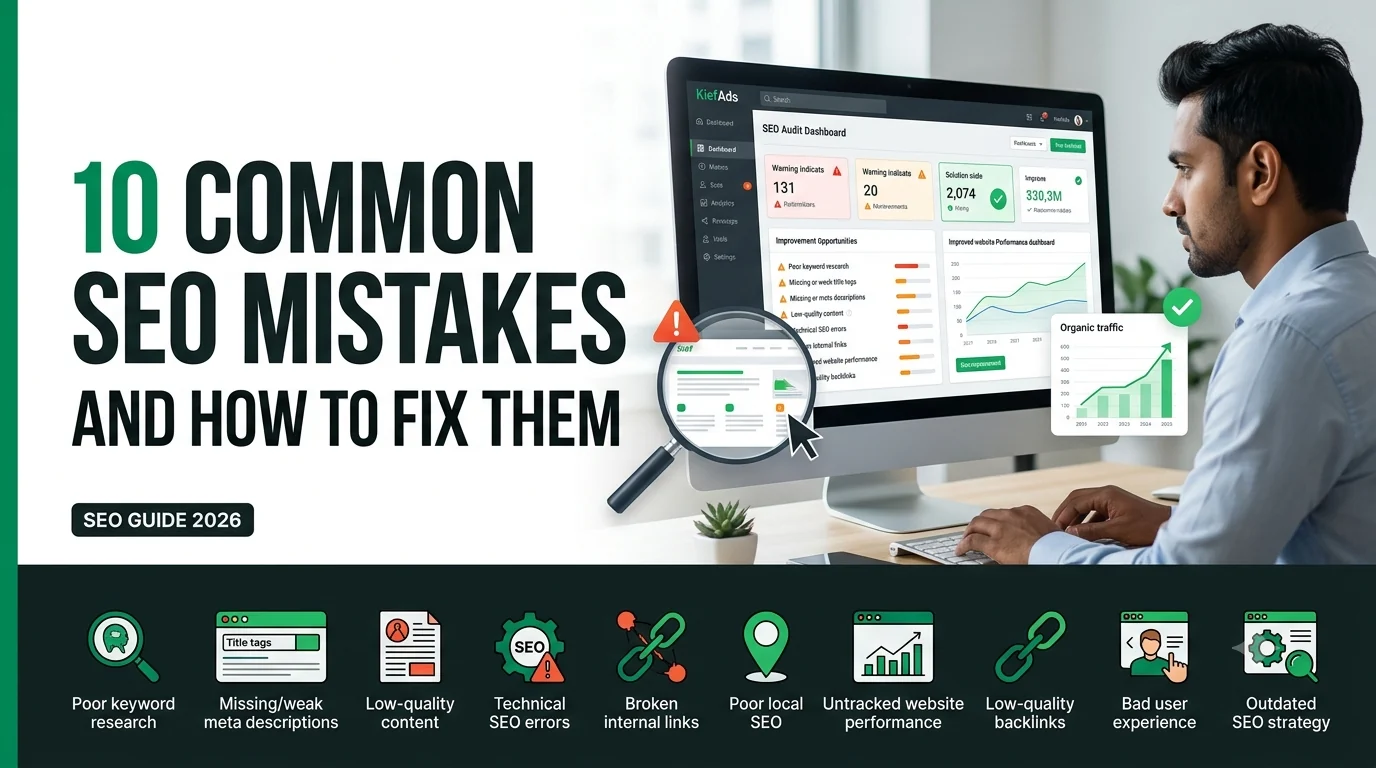
This guide covers 10 of the most common SEO mistakes and gives practical fixes for each. Kiefads helps Los Angeles businesses correct these issues and turn their websites into dependable growth engines.
1. Neglecting Keyword Research
One of the most damaging mistakes is skipping keyword research. Many businesses guess what their audience searches for, or target terms that are too broad and competitive. You may publish excellent content, but if it does not match what customers actually type, it will not reach them.
Targeting a term like “digital marketing” is a losing battle for a small business competing with industry giants. Targeting terms with no search volume brings no traffic at all.
How to fix it:
- Use professional tools. Ahrefs, Semrush, and Google Keyword Planner show search volume, competition, and related terms.
- Focus on long-tail keywords. Phrases like “local SEO services for small businesses” or “best family dentist in Silver Lake” face less competition and convert better because the intent is clearer.
- Analyze competitors. See which keywords they rank for to find opportunities and gaps.
- Map keywords to the buyer’s journey. Assign terms to awareness, consideration, and decision stages.
- Match search intent. Understand whether people want information, comparisons, or a place to buy.
- Assign one primary keyword per page so your pages do not compete with each other.
2. Ignoring On-Page SEO Basics
On-page SEO means optimizing individual pages. Many businesses publish content with missing or weak title tags, meta descriptions, and headings. A missing H1 or a generic title confuses search engines and users.
How to fix it:
- Optimize title tags. Make them unique, roughly under 60 characters, and include the primary keyword. Make them compelling enough to earn clicks.
- Write strong meta descriptions. They are not a direct ranking factor, but they influence click-through rate. Keep them concise (roughly 155 characters) with the keyword and a call to action.
- Use header tags properly. One H1, H2s for main sections, and H3s for subsections.
- Optimize images. Compress them and add accurate, descriptive alt text.
- Use clean URLs that are short and readable.
3. Creating Low-Quality or Irrelevant Content
Content is the cornerstone of SEO, but quantity over quality is a common trap. Thin, poorly researched articles rarely rank. Search engines reward content that genuinely helps users. Content that is not aligned with your business goals or audience wastes effort too.
How to fix it:
- Focus on E-E-A-T. Show Experience, Expertise, Authoritativeness, and Trustworthiness with real authors, credentials, and first-hand examples.
- Address user intent. Understand why someone searches, not just which words they use.
- Cover topics thoroughly. In-depth content that answers related questions tends to perform better than shallow pages.
- Use varied formats. Add videos, infographics, case studies, and FAQs.
- Fact-check AI-assisted drafts. Have a subject expert review all content before publishing.
4. Overlooking Technical SEO
Technical SEO helps search engines find, understand, and index your site. Slow pages, broken links, duplicate content, and poor structure can damage performance no matter how good your content is. If search engines cannot crawl your site properly, they cannot rank it.
How to fix it:
- Prioritize page speed. Use Google PageSpeed Insights, compress images, and enable caching.
- Ensure mobile-friendliness. Google uses mobile-first indexing, so your mobile experience is the primary version.
- Fix crawl errors. Use Google Search Console to find 404s and server errors.
- Build a logical site structure and submit an XML sitemap.
- Add schema markup such as LocalBusiness, Organization, and FAQ, kept accurate and consistent with the page.
- Use HTTPS and fix mixed-content warnings.
5. Having a Poor Internal Linking Strategy
Internal links connect pages on your site. They help search engines understand relationships between pages, distribute ranking strength, and guide users to relevant content. Many businesses ignore them or add them randomly.
How to fix it:
- Link from strong pages to newer pages you want to boost.
- Use descriptive anchor text such as “our guide to technical SEO” instead of “click here.”
- Create topic clusters. A central pillar page covers a broad topic, with cluster articles linking back to it on related subtopics.
- Fix orphan pages that have no internal links pointing to them.
6. Ignoring Local SEO
For businesses with a physical location or service area, ignoring local SEO is a massive missed opportunity. Many customers search “near me” or add a city or neighborhood name. In a sprawling market like Los Angeles, from Hollywood and Santa Monica to Pasadena and Long Beach, local visibility is essential.
How to fix it:
- Optimize your Google Business Profile. Complete every section, including name, address, phone, hours, categories, services, and photos.
- Collect genuine reviews and respond professionally. Never buy or post fake reviews.
- Build consistent citations. Keep your name, address, and phone number identical across Yelp, Apple Maps, Bing Places, and industry directories.
- Create localized content. Neighborhood pages and local guides, only for areas you genuinely serve.
7. Not Tracking SEO Performance
You cannot improve what you do not measure. Without tracking, you will not know which strategies work, and you may waste money on tactics that deliver nothing.
How to fix it:
- Set up Google Analytics 4 and Google Search Console. Track organic traffic, queries, click-through rate, and engagement.
- Track conversions. Measure calls, form submissions, bookings, and sales from organic traffic.
- Monitor keyword rankings over time with an SEO tool.
- Run regular audits monthly or quarterly to find new issues and opportunities.
8. Building Low-Quality Backlinks
Backlinks are a powerful ranking signal, but quality matters far more than quantity. Buying links or joining link schemes may bring quick numbers, yet it can fail to help rankings and may lead to penalties that are hard to recover from.
How to fix it:
- Create link-worthy content such as original research, in-depth guides, and useful tools.
- Write guest articles for authoritative, relevant sites.
- Try broken link building by suggesting your content as a replacement for dead links.
- Pursue digital PR and local partnerships, such as chambers of commerce and community organizations.
- Audit your backlink profile and remove or disavow clearly spammy links with care.
9. Forgetting About User Experience (UX)
Search engines aim to give users the best results, and that includes the experience on your site. Difficult navigation, intrusive pop-ups, and confusing layouts hurt engagement and can undermine your rankings.
How to fix it:
- Simplify navigation so users find what they need quickly.
- Improve readability with clear headings, short paragraphs, and white space.
- Optimize Core Web Vitals. These measure loading (Largest Contentful Paint), responsiveness (Interaction to Next Paint, which replaced First Input Delay), and visual stability (Cumulative Layout Shift).
- Add clear calls to action, click-to-call buttons, and easy contact options, especially for mobile users.
10. Thinking SEO Is a One-Time Task
Perhaps the biggest mistake of all is treating SEO as a one-and-done project. Algorithms evolve, competitors emerge, and audience behavior shifts. A strategy that works today may not work next year.
How to fix it:
- Stay informed about search updates and AI search changes.
- Update content regularly so it stays accurate and relevant.
- Review performance monthly and adjust.
- Partner with an expert if you lack time or in-house skills.
Quick Reference: SEO Mistakes and Fixes
| Mistake | Quick Fix |
|---|---|
| No keyword research | Use tools, target long-tail keywords, match intent |
| Weak on-page SEO | Optimize titles, metas, headings, images |
| Low-quality content | Build E-E-A-T, cover topics in depth |
| Technical neglect | Improve speed, mobile, crawl errors, schema |
| Poor internal linking | Use pillar and cluster structure, descriptive anchors |
| Ignoring local SEO | Optimize Google Business Profile, citations, reviews |
| No tracking | Set up GA4 and Search Console, track conversions |
| Bad backlinks | Earn quality links, avoid schemes |
| Poor UX | Simplify navigation, optimize Core Web Vitals |
| One-time SEO mindset | Commit to ongoing optimization |
Bonus: Mistakes in the Age of AI Search
Search is changing as tools like ChatGPT, Perplexity, and Google AI Overviews answer questions directly. Common new mistakes include:
- Publishing unchecked AI-written content with errors
- Inconsistent business details across profiles and directories
- Hiding key information in images or scripts
- Ignoring FAQs and direct, clear answers
- Neglecting reviews and third-party credibility
Clear structure, accurate information, and trusted mentions help both traditional search and AI tools understand your business.
How Long Does It Take to Fix SEO Mistakes and See Results?
Technical and on-page fixes can show effects within weeks. Steady, meaningful growth usually takes around three to six months, and longer in competitive Los Angeles markets. No ethical agency can guarantee rankings.
Partner With SEO Experts for Lasting Growth
Avoiding these mistakes is crucial for building a strong online presence. These fixes point you in the right direction, but a comprehensive strategy takes expertise, dedication, and understanding of a changing landscape.
Kiefads develops tailored SEO strategies focused on measurable results and return on investment. Our services include:
- SEO audit: Technical, on-page, content, backlink, and competitor review
- Keyword research and content strategy: Built around real customer intent
- Technical SEO: Speed, mobile usability, crawlability, and schema
- Local SEO and Google Business Profile optimization: Citations, reviews, and neighborhood-focused pages for LA businesses
- Ethical link building and digital PR
- GEO and AI search optimization: Visibility in ChatGPT, Perplexity, and Google AI Overviews
- Clear monthly reporting: Rankings, traffic, calls, and leads in plain language
Ready to stop making costly SEO mistakes and start driving real growth? Contact Kiefads today for a free consultation and a customized plan.
Frequently Asked Questions (FAQs)
1. What are the most common SEO mistakes?
Skipping keyword research, weak on-page optimization, low-quality content, technical problems, poor internal linking, ignoring local SEO, not tracking results, bad backlinks, poor user experience, and treating SEO as a one-time task.
2. Why is my website not ranking on Google?
Common causes include weak keyword targeting, thin content, technical errors, slow speed, few quality backlinks, or strong competition. An SEO audit can pinpoint the cause.
3. How do I fix SEO mistakes on my website?
Run an audit, prioritize issues by impact, fix technical and on-page problems first, improve content, and track results.
4. How long does SEO take to work?
Usually three to six months for steady results, depending on competition and your starting point.
5. Is local SEO important for Los Angeles businesses?
Yes. Many customers search “near me” or by neighborhood, and local SEO helps you appear in those results and on maps.
6. Do bad backlinks hurt my site?
Manipulative or spammy links can lead to penalties or wasted effort. Focus on earning relevant, quality links.
7. How often should I audit my SEO?
A quick check monthly, a deeper review quarterly, and a full audit annually or after major changes.
8. Can I do SEO myself?
Many basics can be done in-house with free tools. Agencies help when you need to scale, lack expertise, or compete in a tough market.
9. Does SEO still matter with AI search?
Yes. Accurate, well-structured content and consistent business information help your brand appear in both search results and AI answers.
10. How can Kiefads help with my SEO?
Kiefads audits your site, fixes mistakes, builds a tailored strategy, and reports progress transparently.
Conclusion
Avoiding these common SEO mistakes is essential for sustainable online growth. Start with keyword research and on-page basics, strengthen content and technical health, build local presence and quality links, track results, and treat SEO as an ongoing commitment. With a partner like Kiefads, you can turn your website into your most powerful marketing asset.
Contact Kiefads now and start fixing the SEO mistakes holding your business back.