
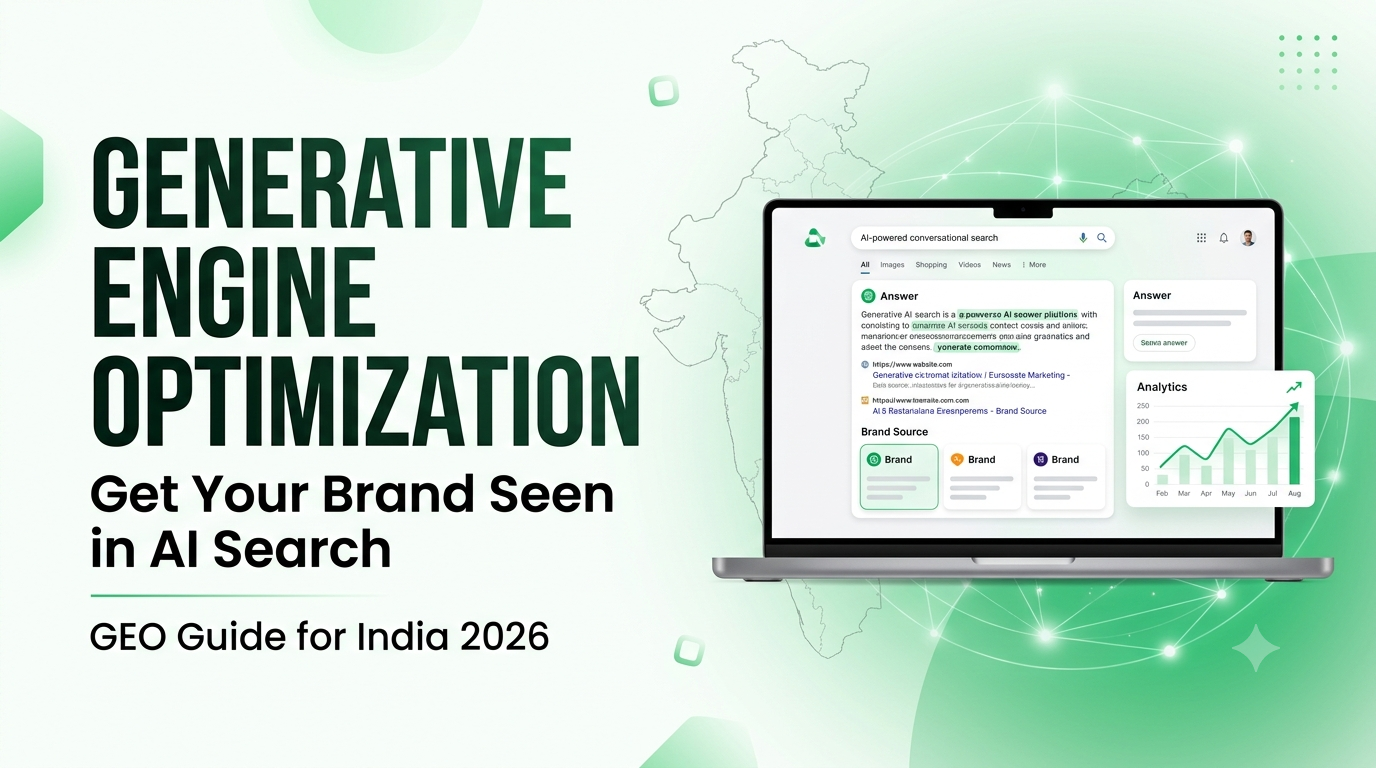
Search behaviour in India is changing quickly. Millions of users are no longer typing short keywords like “best CRM software” into Google. They are asking full questions, often in English, Hindi or a mix of both, to ChatGPT, Perplexity, Gemini and Google AI Overviews. They expect one clear, well-reasoned answer, not ten links to compare.
This shift has created a new discipline called Generative Engine Optimization (GEO).
If you have spent years optimizing for traditional rankings, GEO can feel unfamiliar. It is not about chasing the same blue links. It is about making sure AI systems can understand, trust and cite your content when they generate answers. As AI-powered search grows, many Indian businesses are turning to a specialist AI SEO agency like Kiefads to make sense of the change.
This guide explains what GEO means, how it compares with traditional SEO and Answer Engine Optimization (AEO), and what Indian businesses should do to stay visible.
What Is Generative Engine Optimization (GEO)?
Generative Engine Optimization (GEO) is the practice of structuring and optimizing content so AI-powered search tools, such as ChatGPT, Google AI Overviews, Gemini, Perplexity and Claude, can accurately read, trust and cite it when answering user queries.
In traditional SEO, the goal is to rank a page on a results list. In GEO, the goal is to become a trusted source that an AI model chooses to cite, summarize or draw from. The win is not just a click on a blue link. It is being part of the answer itself.
This matters because a growing share of searches never reach a traditional results page. The user asks a question, reads a synthesized answer and moves on. If your content is not structured in a way AI systems can parse and trust, you will not be part of that answer.
Why GEO Matters for Indian Businesses
India is a mobile-first, voice-friendly and multilingual market, which makes the move to AI search especially significant.
- Mobile-first behaviour: Most Indian users search on smartphones, where a single direct answer is far more convenient than scrolling through several pages.
- Voice and conversational queries: Voice search in English, Hindi and Hinglish favours natural, question-style queries (“Delhi mein best digital marketing agency kaun si hai?”), which AI tools are built to handle.
- Regional language growth: As AI tools improve in Hindi, Tamil, Telugu, Marathi, Bengali and other languages, users increasingly search in the language they think in.
- Research before purchase: Indian buyers compare prices, reviews and alternatives before spending. They now use AI tools to shortlist products, services and vendors.
- Competitive digital market: Startups, D2C brands, MSMEs and large enterprises are all competing for the same attention. Early adopters of GEO can build visibility before their competitors do.
Brands that ignore AI-powered search risk becoming invisible in exactly the channels where their audience is starting to look. That is the gap an experienced AI SEO agency like Kiefads is built to close.
How AI Search Differs From Traditional Search
Traditional search engines rank pages using backlinks, keyword relevance, technical performance and user engagement. Generative engines work differently. They:
- Pull from multiple sources at once instead of ranking a single page.
- Prioritize clarity, accuracy and structure over keyword density.
- Favour direct answers over content that makes the reader dig.
- Rely on semantic SEO, meaning context and intent, rather than exact-match keywords.
- Cross-check facts across websites, directories, reviews and third-party mentions.
This is why artificial intelligence SEO differs from classic ranking tactics. It is less about gaming a scoring algorithm and more about producing content that is genuinely clear, organized and easy for a language model to understand.
How Generative Engine Optimization Works: 7 Practical Steps
GEO does not replace good SEO. It builds on it. Here is what makes content more usable for AI systems.
1. Answer the Question Early
Place a direct, concise answer (ideally 40 to 60 words) near the top of the page, then follow it with supporting detail. Burying the answer under long introductions hurts both readability and AI extractability.
2. Use Clear Structure
Descriptive headings, bullet points, numbered steps, comparison tables and FAQs help AI models parse and summarize your content accurately. Featured-snippet-style formatting is more valuable today, not less.
3. Demonstrate Real Expertise (E-E-A-T)
AI systems weigh credibility. Back your content with specific examples, accurate data, named authors, case studies and clear reasoning. For Indian businesses, this can include local case studies, industry-specific insights, certifications, client results and references to Indian regulations or market conditions where relevant.
4. Maintain Consistency Across the Web
Generative engines often cross-check information. Make sure your business name, address, phone number, services and claims are identical across:
- Your website
- Google Business Profile
- Indian business directories such as Justdial, Sulekha and IndiaMART (where relevant)
- LinkedIn and social profiles
- Press mentions and third-party listings
5. Add Structured Data
Schema markup (Organization, LocalBusiness, FAQPage, Article, Product, Review) gives machines a clear, labelled view of your content. It is one of the simplest ways to make your pages easier for AI systems to interpret.
6. Create Multilingual and Local Content
If your audience searches in Hindi or regional languages, publish helpful content in those languages too. Include city- and state-level context such as Delhi NCR, Mumbai, Bengaluru, Hyderabad, Pune, Chennai and Kolkata, and use natural phrases your audience actually uses.
7. Write for Humans First
The best AI SEO strategy is still human-first writing. Natural language, real usefulness and clarity outperform content engineered purely for algorithms.
Traditional SEO vs AEO vs GEO
| Aspect | Traditional SEO | AEO (Answer Engine Optimization) | GEO (Generative Engine Optimization) |
|---|---|---|---|
| Primary focus | Ranking pages on search results | Providing direct, concise answers | Being understood, trusted and cited by AI systems |
| Main goal | Higher rankings and organic traffic | Featured snippets, voice search, quick answers | Being referenced or summarized in AI-generated responses |
| Optimization methods | Keywords, backlinks, technical SEO, page experience | Structured data, concise answers, FAQ formatting | Semantic clarity, factual accuracy, contextual depth, structured content |
| Visibility | Blue-link rankings and click-through traffic | Snippet boxes and voice assistant answers | Citations and mentions inside AI answers, sometimes without a click |
| Best suited for | Long-term organic growth and authority | Quick-answer, mobile and voice queries | Conversational AI tools, AI Overviews, chat-based research |
None of these replaces the others. Most Indian businesses need all three working together: strong technical SEO, answer-friendly formatting and content built for AI comprehension.
Common GEO Mistakes Indian Businesses Should Avoid
- Treating GEO as a trick. There is no shortcut to being cited. Accuracy and usefulness win.
- Keyword stuffing. AI systems read meaning, not keyword counts.
- Thin, generic content. Mass-produced AI-written articles with no original insight rarely earn trust.
- Inconsistent business information. Conflicting details across platforms weaken credibility.
- Ignoring technical basics. Slow pages, poor mobile experience and blocked crawlers limit visibility.
- No measurement. Track brand mentions in AI answers alongside rankings and traffic.
How to Measure GEO Success
Because GEO outcomes do not always show up as clicks, measure a wider set of signals:
- Brand mentions and citations in ChatGPT, Gemini, Perplexity and AI Overviews
- Branded search growth
- Referral traffic from AI platforms
- Featured snippet and People Also Ask presence
- Quality of leads and enquiries, not just traffic volume
- Share of voice against competitors for key questions
Choosing the Right Tools and Support
Many businesses start by researching the best AI for SEO: tools that analyze content structure, spot semantic gaps and check how AI-friendly a page is. These tools are useful for audits and AI content optimization, but they work best alongside strategic judgment, not as a replacement for it.
This is where a dedicated AI SEO agency can help. A good agency does not just chase rankings. It looks at how your content performs across traditional search, answer boxes and generative AI tools together, then builds one strategy that covers all three without duplicated effort.
About Kiefads
Kiefads is a digital marketing agency helping Indian businesses grow through SEO, content strategy and AI-driven search visibility. As search moves toward AI-generated answers, Kiefads focuses on content structure, technical SEO and semantic SEO so brands stay visible across both traditional search and AI-powered platforms.
Want to know where your content stands in AI search? Get in touch with Kiefads for a free GEO and SEO visibility review.
Frequently Asked Questions
1. What is Generative Engine Optimization in simple terms?
It is the practice of optimizing content so AI tools like ChatGPT, Gemini, Perplexity and Google AI Overviews can understand it, trust it and use it when answering user questions.
2. Is GEO replacing traditional SEO in India?
No. GEO builds on SEO fundamentals like technical performance and content quality, and adds a focus on semantic clarity and AI comprehension. You need both.
3. How is GEO different from AEO?
AEO targets specific answer formats such as featured snippets and voice search results. GEO focuses more broadly on being cited or summarized in AI-generated conversational responses.
4. Do Indian businesses need special tools for GEO?
Not necessarily. AI content-analysis tools can help, but strong writing, clear structure and factual accuracy matter more than any single tool.
5. Can small businesses and MSMEs benefit from GEO?
Yes. Generative engines prioritize clarity and trust over sheer domain authority, so smaller businesses with well-structured, accurate content can still be cited in AI answers.
6. Does GEO work for Hindi and regional-language content?
Yes. As AI tools improve in Indian languages, helpful, well-structured regional-language content can earn visibility, especially for local and voice-style queries.
7. How long does GEO take to show results?
Like SEO, it is a long-term effort. Improvements in structure and clarity can help sooner, but building trust and consistent citations typically takes months.
8. Should I hire an AI SEO agency in India?
If you lack in-house expertise or time, a specialist agency like Kiefads can audit your content, fix technical gaps and build a strategy covering SEO, AEO and GEO together.
Conclusion
AI-powered search is changing how people in India discover and consume information, but the fundamentals of good digital marketing still apply. Businesses should create content that answers genuine questions, gives useful context, demonstrates real expertise and is technically accessible.
Traditional SEO, AEO and Generative Engine Optimization are connected parts of one modern search strategy, not competing approaches. The goal is not to chase every new AI development. It is to build a digital presence that is clear, credible, useful and ready for the way Indians increasingly search.
Ready to make your brand visible in AI search? Contact Kiefads today and start building a future-ready SEO and GEO strategy.